
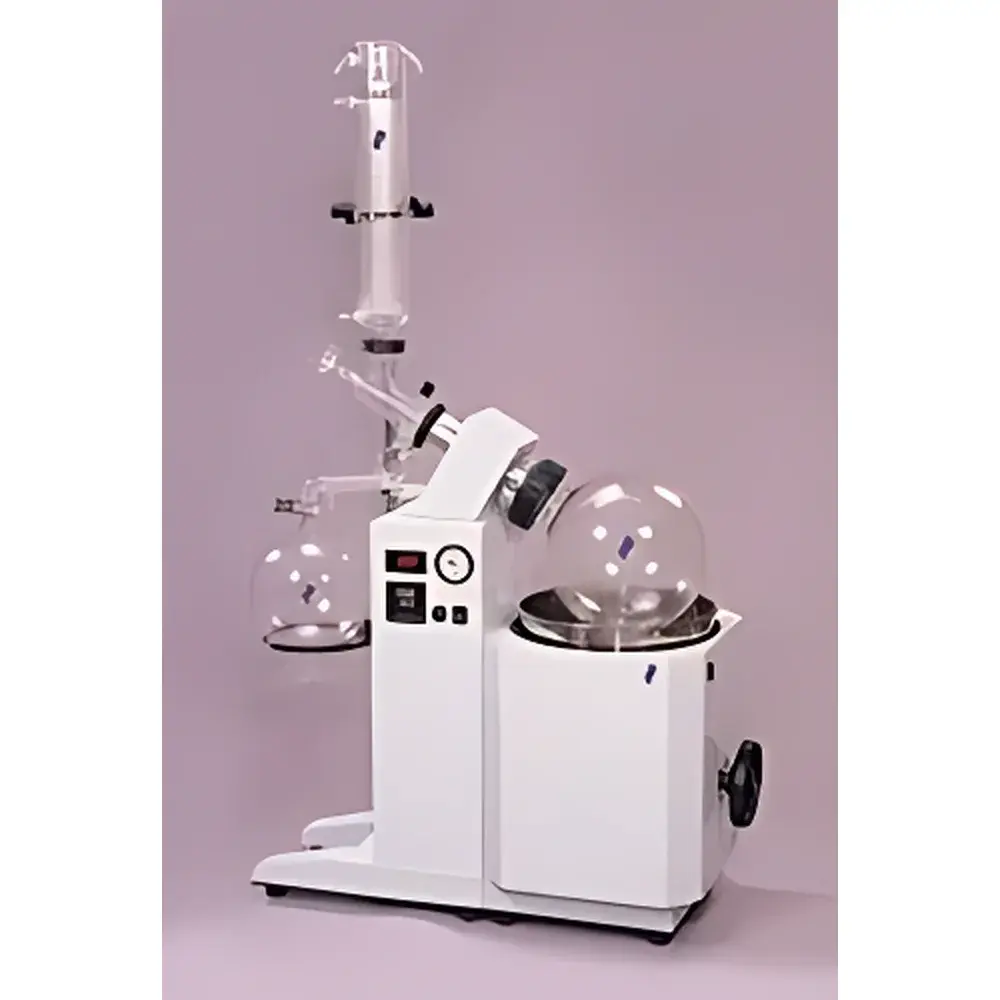
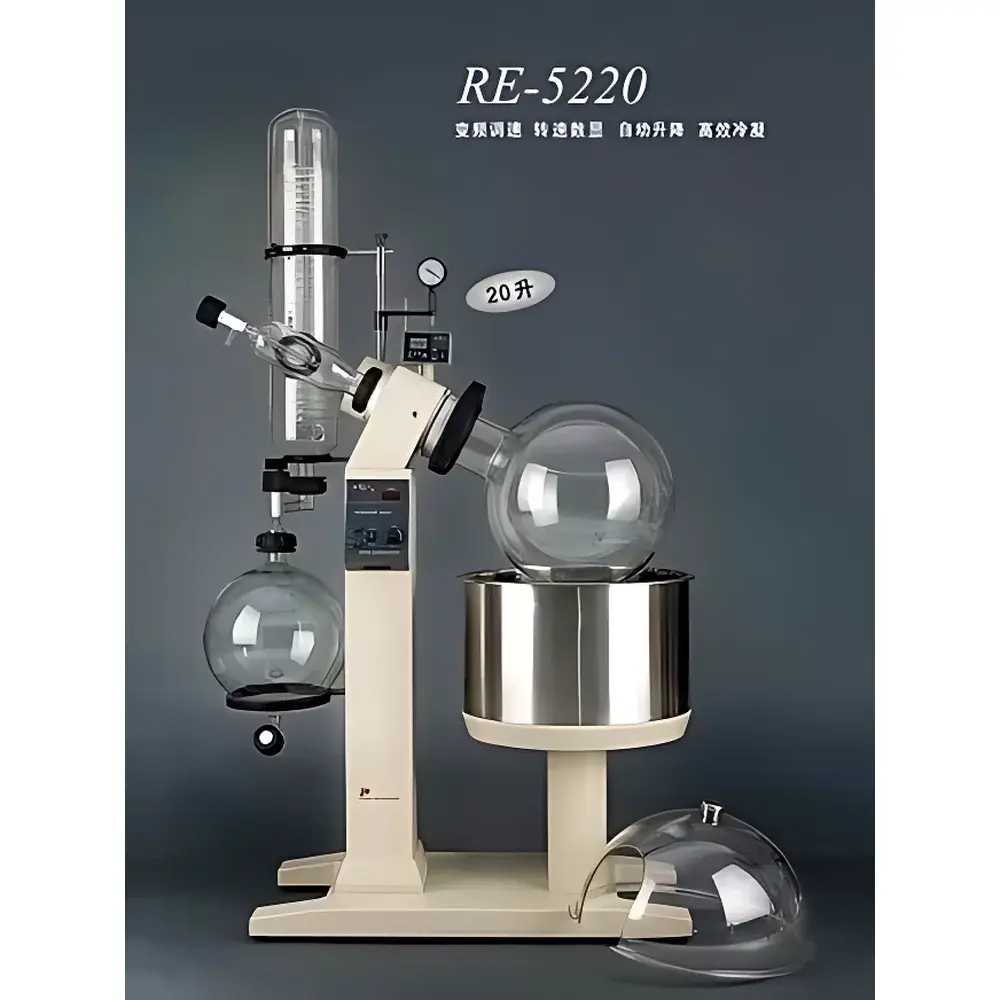
Yarong RE5220 Rotary Evaporator
| Brand | Yarong |
|---|---|
| Origin | Shanghai, China |
| Model | RE5220 |
| Capacity | 20 L |
| Rotation Speed | 20–110 rpm (digital display, frequency-controlled) |
| Bath Temperature Range | Ambient to 98 °C (water bath) |
| Cooling Surface Area | 0.11 m² |
| Heating Control Accuracy | ±1 °C (typical for analog-adjusted water bath systems) |
| Lift Mechanism | Manual (RE5220) / Motorized (RE5220A) |
| Condenser Type | Vertical dual-coil high-density serpentine glass condenser |
| Collection Flask Capacity | 10 L |
| Power Consumption | 5180 W |
| Dimensions (W×D×H) | 1100 × 650 × 1900 mm |
Overview
The Yarong RE5220 Rotary Evaporator is an engineered solution for efficient solvent removal, concentration, and purification under reduced pressure—principally based on thin-film evaporation dynamics. Operating under vacuum, the system rotates a 20 L evaporation flask at controlled speeds (20–110 rpm), spreading sample material into a uniform, thermally exposed film along the inner wall. Simultaneously, a thermostatically regulated water bath (ambient to 98 °C) supplies consistent conductive heating. Vapor generated from the rotating film travels through a vertical, high-efficiency dual-coil serpentine condenser (0.11 m² effective cooling area), where it undergoes rapid phase transition and is collected in a 10 L receiving flask. This configuration minimizes thermal degradation risk—making the RE5220 particularly suitable for heat-sensitive compounds common in pharmaceutical intermediates, natural product extracts, and biopolymer solutions.
Key Features
- Robust mechanical architecture: Mainframe constructed from corrosion-resistant stainless steel and aerospace-grade aluminum alloy, ensuring long-term dimensional stability and load-bearing integrity during continuous operation.
- Frequency-controlled digital rotation drive: Provides precise, stepless speed regulation across the full 20–110 rpm range with low-vibration torque delivery—critical for maintaining film uniformity and preventing bumping or foaming.
- Vertically oriented dual-serpentine glass condenser: Optimized geometry and high surface-area-to-volume ratio maximize latent heat transfer efficiency, enabling rapid condensation even with low-boiling solvents such as dichloromethane, ethyl acetate, or pentane.
- One-piece deep-drawn stainless steel water bath: Manufactured from imported 304 stainless steel, seamless construction eliminates crevices and enhances thermal homogeneity; manual lift mechanism (standard RE5220) allows ergonomic flask positioning and safe handling of large-volume loads.
- Chemically inert sealing system: Critical rotary joints and vapor path interfaces utilize PTFE-composite seals processed via proprietary surface fluorination—delivering extended service life under aggressive organic solvent exposure and elevated temperature cycling.
Sample Compatibility & Compliance
The RE5220 accommodates a broad spectrum of laboratory-scale purification workflows involving aqueous, polar aprotic, and moderately volatile organic solvents. Its design supports standard ISO/KIMAX borosilicate glassware (29/32 and 35/20 standard taper joints), ensuring interoperability with third-party flasks, adapters, and cold traps. While not certified to UL/CSA or CE for standalone safety compliance, the unit meets fundamental electrical safety requirements per GB 4793.1–2019 (Chinese equivalent to IEC 61010-1). For GLP/GMP-aligned environments, users may integrate external vacuum controllers and temperature loggers compliant with FDA 21 CFR Part 11 data integrity provisions—though the base instrument itself does not include audit-trail or electronic signature functionality.
Software & Data Management
The RE5220 operates as a stand-alone analog/digital hybrid instrument without embedded firmware or network connectivity. Temperature setpoint and rotation speed are adjusted via front-panel potentiometers with digital LED readouts—ensuring operational simplicity and electromagnetic noise immunity in shared lab infrastructure. No proprietary software is required or provided. Users seeking traceable process records must employ external calibrated data loggers interfaced with PT100 probes (bath temperature) and tachometric sensors (rotation speed). Such configurations support basic SOP adherence in QC labs performing routine batch evaporation per USP or ASTM E2654–18 guidelines.
Applications
- Concentration of thermolabile APIs and peptide fractions during downstream processing in cGMP pilot labs.
- Solvent exchange protocols in polymer synthesis—e.g., transitioning from THF to toluene prior to precipitation.
- Recovery of high-value solvents (e.g., chloroform, acetone) in multi-step organic synthesis workflows to reduce operational costs and environmental impact.
- Preparative isolation of essential oils and phytochemicals via gentle co-evaporation with carrier solvents under ≤100 mbar vacuum.
- Removal of residual low-boiling reagents post-Suzuki coupling or Grignard reactions prior to column chromatography.
FAQ
What vacuum level is recommended for optimal performance with the RE5220?
The system is designed for operation under medium vacuum (5–50 mbar), achievable using a diaphragm or circulating water vacuum pump. Absolute vacuum (<1 mbar) is neither required nor advisable—excessive vacuum increases bumping risk and reduces condensation efficiency.
Is the water bath temperature digitally regulated with feedback control?
No—the RE5220 employs analog proportional heating control. Temperature stability is ±1 °C under steady-state conditions; for tighter tolerance (±0.2 °C), external PID controllers with PT100 input are recommended.
Can the RE5220 accommodate custom glassware with non-standard joint sizes?
Only if compatible adapters (e.g., 29/32 to 45/50 reducers) are used. The standard condenser and flask interface conform strictly to ISO 35/20 and ISO 29/32 taper specifications.
Does the unit include a vacuum safety valve or pressure relief mechanism?
No. A separate vacuum release valve or solenoid-controlled vent line must be installed upstream of the pump to prevent backstreaming or sudden pressure equalization during power loss.
What maintenance intervals are advised for the PTFE sealing components?
Inspect seals every 200 operating hours; replace after 500 hours or immediately upon visible cracking, discoloration, or vacuum leakage exceeding 5 mbar/min decay rate.



