
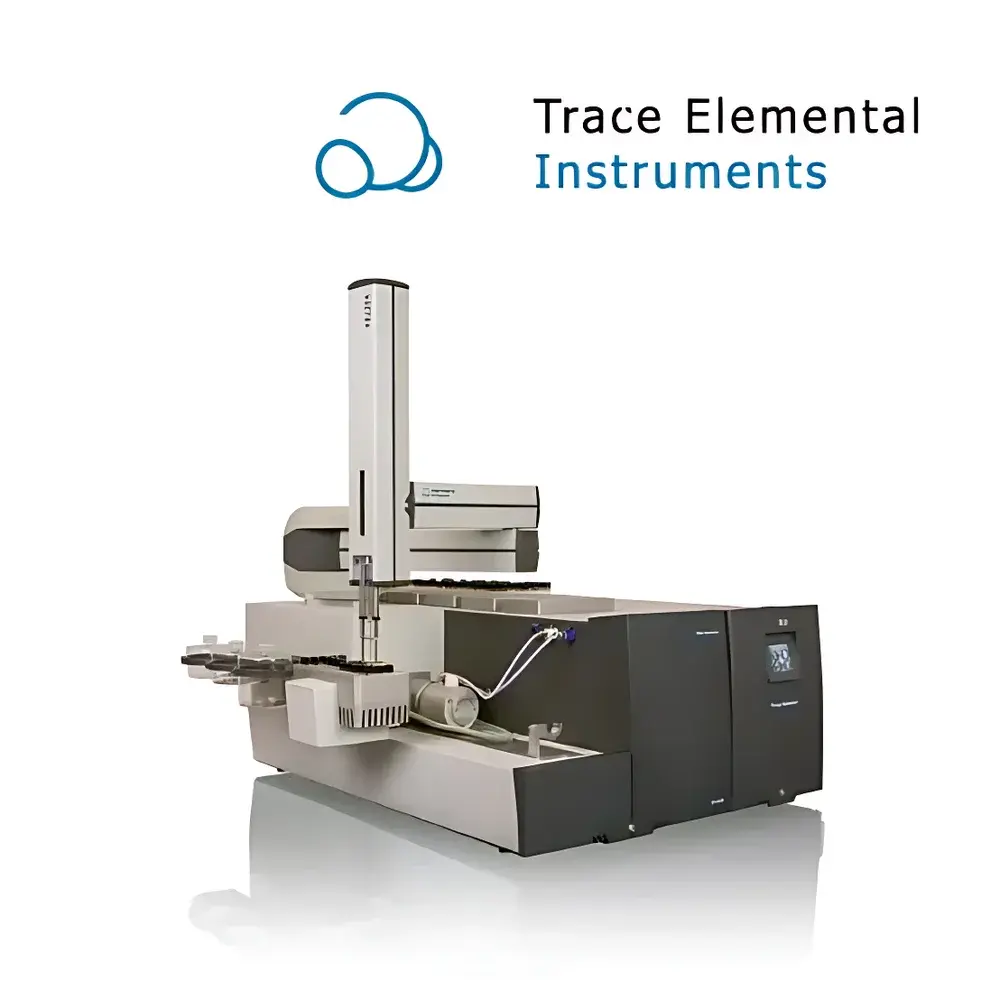
Trace Elemental Instruments XPLORER NS Total Sulfur and Total Nitrogen Analyzer
| Brand | TE/Trace Elemental Instruments |
|---|---|
| Origin | Netherlands |
| Model | XPLORER NS |
| Detection Principle | UV Fluorescence for Sulfur / Chemiluminescence for Nitrogen |
| Sample Types | Liquids, Gases, LPG, Solids |
| Measurement Range | S and N from sub-ppb to percent level |
| Combustion Furnace Temperature | 1050 °C |
| Software | TEIS 2 Professional Control & Data Management Software |
| Compliance | ASTM D5453, D7183, D7184 |
| Optional Autosamplers | 105-position 2-mL vial XYZ autosampler (with auto-dilution & auto-calibration), Gas/LPG autosampler, 20-position solid autosampler |
| Detector | Temperature-controlled UVF and CLD detectors with active feedback loops |
| Automation Level | Fully automated combustion, gas flow control, calibration, and data validation |
Overview
The Trace Elemental Instruments XPLORER NS is a high-performance, dual-detection elemental analyzer engineered for the simultaneous quantitative determination of total sulfur (S) and total nitrogen (N) in a broad spectrum of sample matrices—including liquid fuels, lubricants, petrochemical feedstocks, gases (e.g., natural gas, refinery off-gas), LPG, and solid materials such as catalysts and polymers. It employs two orthogonal, industry-validated detection technologies: ultraviolet fluorescence (UVF) for sulfur quantification and chemiluminescence detection (CLD) for nitrogen analysis. Both methods are based on high-temperature oxidative combustion (at a precisely controlled 1050 °C furnace temperature), ensuring complete conversion of all organosulfur and organonitrogen compounds into SO₂ and NO, respectively—followed by selective, interference-resistant detection. This fundamental design enables trace-level sensitivity (sub-ppb detection limits), wide dynamic range (ppb to % w/w), and exceptional measurement reproducibility across heterogeneous sample types—making it suitable for routine QC, R&D, and regulatory compliance testing in petroleum, energy, environmental, and chemical laboratories.
Key Features
- Fully integrated dual-channel architecture enabling concurrent S and N analysis without hardware reconfiguration or method switching delays
- Temperature-stabilized UVF and CLD detectors equipped with real-time thermal feedback loops—minimizing baseline drift and enhancing long-term signal stability
- Modular, field-upgradable autosampling system supporting multiple configurations: 105-position XYZ liquid autosampler (2 mL vials) with integrated auto-dilution and multi-point auto-calibration; dedicated gas/LPG pressurized injection module; and 20-position solid combustion boat loader
- Robust ceramic combustion tube and optimized oxygen-rich oxidation environment ensure complete sample mineralization—even for refractory species (e.g., thiophenes, pyridines, nitroaromatics)
- Intelligent combustion parameter control: automatic adjustment of O₂ flow, carrier gas composition, and furnace ramp profiles based on sample type and expected analyte concentration
- Minimal maintenance design: self-cleaning quartz reaction chamber, corrosion-resistant gas path components, and extended service intervals validated under GLP/GMP operating conditions
Sample Compatibility & Compliance
The XPLORER NS accommodates diverse physical states and compositional complexities without requiring matrix-specific hardware modifications. Liquid samples (e.g., gasoline, diesel, jet fuel, biodiesel blends) are introduced via syringe or autosampler with optional dilution. Gaseous and LPG samples are metered using precision mass flow controllers and pressure-regulated injection valves. Solid samples—including powders, granules, and filter media—are combusted in ceramic boats with programmable ash removal cycles. All operational protocols align with internationally recognized standard methods: ASTM D5453 (UVF-S), D7183 (CLD-N), D7184 (combined S/N); ISO 20846 (gasoline S), 20884 (diesel S); IP 541 (S in hydrocarbons), 560 (N in distillates); UOP 97 (S in naphtha), 474 (N in reformate); EN 15470/15471 (S/N in biofuels); and SH/T 0689 (Chinese standard for S in light distillates). Instrument qualification documentation supports 21 CFR Part 11-compliant audit trails when deployed with TEIS 2 software in regulated environments.
Software & Data Management
TEIS 2 Professional Software serves as the central control and data governance platform. It provides full method development, sequence scheduling, real-time instrument monitoring, and automated pass/fail evaluation against user-defined specification limits. All analytical parameters—including combustion temperature, gas flows, detector voltages, and integration windows—are stored with electronic signatures and time-stamped metadata. Raw chromatograms and processed peak tables are archived in vendor-neutral formats (CSV, XML) and support direct export to LIMS via ASTM E1384-compliant interfaces. Audit trail functionality records every operator action, parameter change, and result modification—enabling full traceability required under GLP, GMP, and ISO/IEC 17025 accreditation frameworks.
Applications
- Ultra-low sulfur diesel (ULSD) and gasoline quality control per EPA Tier 3 and Euro 6 specifications
- Monitoring nitrogen content in refinery streams to prevent catalyst poisoning in hydrotreating units
- Speciation-independent total S/N screening of biofuels, aviation turbine fuels, and marine distillates
- Regulatory reporting for emissions-related feedstock characterization (e.g., EPA 40 CFR Part 1065, Annex VI MARPOL)
- R&D of low-sulfur lubricants, fuel additives, and novel polymer formulations
- Environmental analysis of soil extracts, wastewater effluents, and airborne particulate filters
FAQ
What detection technologies does the XPLORER NS use for sulfur and nitrogen analysis?
UV fluorescence detection (UVF) is used for sulfur quantification; chemiluminescence detection (CLD) is used for nitrogen determination—both following high-temperature oxidative combustion.
Does the system comply with ASTM D5453 and ISO 20846?
Yes—the XPLORER NS is fully compliant with ASTM D5453 (sulfur in light hydrocarbons), D7183 (nitrogen in liquid fuels), and ISO 20846 (sulfur in gasoline), among other key international standards.
Can the same instrument analyze both liquid and solid samples without hardware changes?
Yes—modular autosamplers (liquid XYZ, solid boat loader, gas/LPG module) are interchangeable in minutes, enabling seamless transition between sample types while maintaining calibrated performance.
Is TEIS 2 software 21 CFR Part 11 compliant?
When configured with electronic signature enforcement, role-based access control, and immutable audit trails, TEIS 2 meets the technical requirements for Part 11 compliance in regulated laboratories.
What is the typical detection limit for sulfur in liquid fuels?
Under optimized conditions, the system achieves sulfur detection limits below 0.5 ppb (as sulfur) with high repeatability (RSD < 1.5% at 10 ppb level).





