
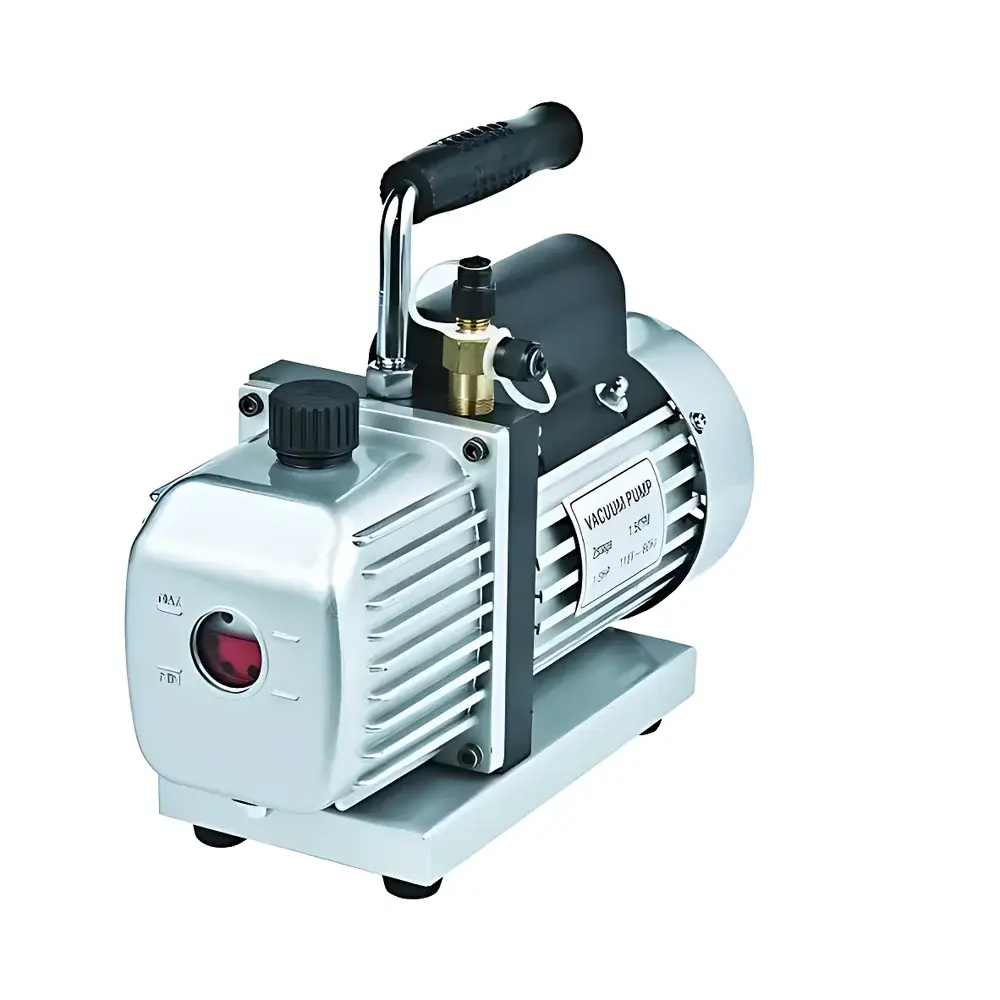
ROCKER Tanker 230 Rotary Vane Vacuum Pump
| Brand | ROCKER |
|---|---|
| Origin | Taiwan |
| Model | Tanker 230 |
| Pump Type | Oil-Lubricated Rotary Vane |
| Ultimate Vacuum | 0.07 mbar |
| Flow Rate | 85 L/min |
| Noise Level | 52 dB(A) |
| Power Consumption | 372.9 W |
| Weight | 13 kg |
| Voltage | 100–120 V / 60 Hz (200–240 V / 50 Hz optional) |
Overview
The ROCKER Tanker 230 is an oil-lubricated rotary vane vacuum pump engineered for reliable, continuous operation in demanding laboratory environments. Based on the well-established Couette-flow principle of rotary vane displacement, it achieves stable ultimate vacuum levels down to 0.07 mbar (≈0.05 Torr) with a nominal volumetric flow rate of 85 L/min at atmospheric pressure. Its robust cast-aluminum housing, precision-ground vanes, and optimized oil circulation system ensure consistent performance across extended duty cycles—making it suitable for applications requiring both medium-to-high vacuum levels and high gas throughput. Unlike dry scroll or diaphragm pumps, the Tanker 230 leverages oil-sealed compression to deliver superior vapor handling capacity and long-term stability under variable load conditions, particularly when managing condensable vapors generated during solvent removal or drying processes.
Key Features
- Oil-lubricated rotary vane architecture for high reproducibility and low ultimate pressure
- Integrated thermal overload protection: bimetallic switch embedded in motor windings automatically interrupts power above safe operating temperature, resuming operation after passive cooling
- Acoustically dampened enclosure achieving ≤52 dB(A) at 1 m distance—compatible with shared lab spaces and noise-sensitive instrumentation suites
- Low-vibration mechanical design with dynamically balanced rotor assembly minimizes transmission to connected apparatus (e.g., vacuum ovens, centrifugal concentrators)
- Standard oil mist filter port enables seamless integration with optional coalescing oil mist filters (ROCKER F-01 series), reducing airborne hydrocarbon emissions to meet ISO 8573-1 Class 4 air quality requirements
- CE-marked per EN 61000-6-3 (EMC) and EN 61000-6-2 (immunity), confirming compliance with EU safety and electromagnetic compatibility directives
Sample Compatibility & Compliance
The Tanker 230 is designed for non-corrosive, non-reactive gas streams typical of organic solvent vapors (e.g., ethanol, acetone, ethyl acetate), water vapor, and inert carrier gases. It is not rated for use with halogenated solvents (e.g., chloroform, DCM), strong oxidizers (e.g., NO₂, O₃), or acidic/alkaline vapors without upstream cold traps or chemical scrubbers. For GxP-regulated workflows—including those aligned with FDA 21 CFR Part 11 and EU Annex 11—the pump itself does not store or process data; however, its predictable operational parameters (vacuum level, runtime, thermal status) support traceable vacuum system validation when paired with external digital vacuum gauges and logging controllers. Routine maintenance intervals (oil change every 500 hours, filter replacement every 1,000 hours) are documented in the manufacturer’s GLP-compliant service manual.
Software & Data Management
As a standalone mechanical vacuum source, the Tanker 230 operates without embedded firmware or digital interfaces. It features no USB, RS-232, or Ethernet connectivity—ensuring electromagnetic isolation from sensitive analytical instruments. System-level monitoring and control are implemented externally via third-party vacuum controllers (e.g., MKS 974B, Pfeiffer TPG300) or PLC-based lab automation platforms. All operational logs—including cumulative runtime, thermal event history, and maintenance timestamps—must be recorded manually or through integrated building management systems (BMS) compliant with ISO/IEC 17025 documentation standards.
Applications
- Vacuum filtration of aqueous and organic suspensions using Buchner or Hirsch funnels
- Controlled dehydration in vacuum desiccators and heated vacuum ovens (up to 150 °C chamber temperature)
- Rotor-based concentration of biological samples in centrifugal evaporators (e.g., Genevac EZ-2, Thermo Savant SPD131DDA)
- Evacuation of glove boxes and sample preparation chambers prior to inert gas purging
- Supporting vacuum distillation setups where moderate vacuum stability (60 L/min) are required
- Pre-evacuation of mass spectrometer ion sources and residual gas analyzers
FAQ
What type of vacuum pump oil is recommended for the Tanker 230?
ROCKER specifies ISO VG 100 mineral-based vacuum pump oil (e.g., ROCKER VPO-100 or equivalent ASTM D2889 Grade 1). Synthetic oils may be used only if certified for rotary vane service and compatible with nitrile elastomer seals.
Can the Tanker 230 operate continuously for 24/7 applications?
Yes—when installed with adequate ventilation (minimum 10 cm clearance on all sides), ambient temperature ≤35 °C, and routine oil/filter maintenance per the service schedule, it supports uninterrupted operation in pilot-scale or core facility settings.
Is the 0.07 mbar ultimate vacuum measured with or without gas ballast engaged?
The specified 0.07 mbar is achieved under standard conditions: clean pump, fresh oil, gas ballast valve closed, and measured with a calibrated capacitance manometer at the inlet port after 30 minutes of stabilization.
Does the pump include an oil mist filter by default?
No—the oil mist filter (ROCKER F-01) is an optional accessory. The pump body includes a threaded M22×1.5 port for direct mounting.
How often should the vacuum pump oil be changed?
Every 500 operating hours or semiannually—whichever occurs first—under normal laboratory use. More frequent changes are required when processing high-boiling-point solvents or operating near maximum duty cycle.
Related Products



