
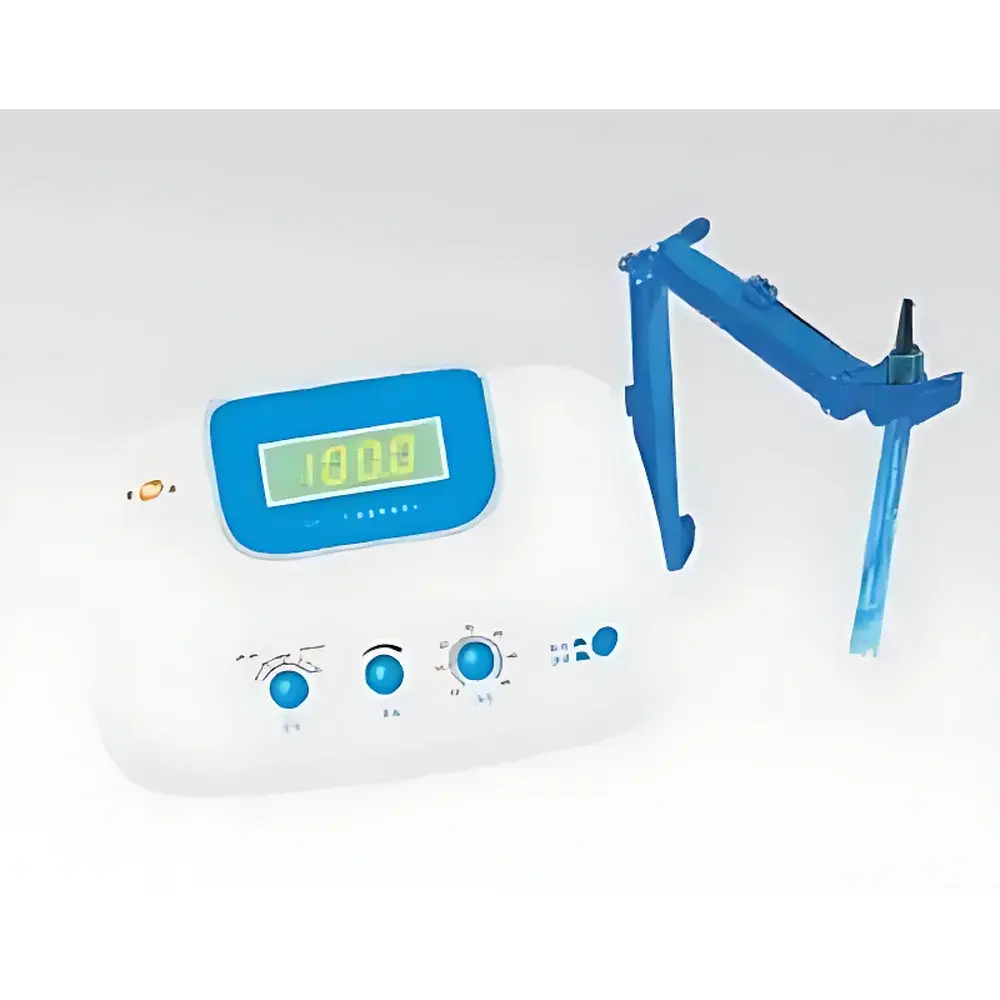
Leici DDS-11A Digital Conductivity Meter
| Brand | Leici |
|---|---|
| Origin | Shanghai, China |
| Model | DDS-11A |
| Form Factor | Benchtop |
| Conductivity Range | 0–1.999 S, 2.0–19.99 S, 20.0–199.9 S, 200–1999 S, 2.0–19.99 mS, 20.0–199.9 mS |
| Temperature Range | −5 to 105 °C |
| Accuracy | ±0.5% FS (conductivity), ±0.5 °C (temperature) |
| Resolution | 0.01 (conductivity units), 0.1 °C (temperature) |
| Temperature Compensation | Automatic, 0–100 °C, 2.0% / °C coefficient |
| Electrode Constant Compatibility | 0.01, 0.1, 1.0, 10.0 cm⁻¹ |
| Measurement Modes | Conductivity, TDS (calculated), Resistivity (calculated), Temperature |
| Calibration | Auto-calibration with standard solutions |
| Display | Large LCD, multi-parameter simultaneous readout |
| Instrument Class | 1.0 grade per GB/T 11018–2021 (equivalent to IEC 60746-3) |
Overview
The Leici DDS-11A Digital Conductivity Meter is a benchtop electrochemical instrument engineered for precise, repeatable measurement of electrical conductivity in aqueous and low-conductivity liquid samples. Based on the principle of two-electrode AC conductivity measurement—employing a constant-frequency sinusoidal excitation signal to minimize polarization effects—the DDS-11A delivers stable readings across six auto-ranging conductivity spans (from 0 to 1.999 S down to 20.0–199.9 mS), enabling reliable characterization of diverse media including ultrapure water, process streams, environmental samples, and electrolyte solutions. Its integrated temperature sensor (Pt1000 or equivalent) supports automatic temperature compensation (ATC) across −5 to 105 °C, applying a user-selectable or default 2.0%/°C linear coefficient per ISO 7888 and ASTM D1125 standards. Designed to meet the functional requirements of routine QC laboratories, university teaching labs, and industrial process monitoring environments, the DDS-11A complies with GB/T 11018–2021 (China’s national standard for conductivity meters), which aligns technically with IEC 60746-3 for electrochemical analyzers.
Key Features
- Benchtop architecture with robust ABS housing and ESD-safe design for long-term stability in shared lab environments
- Six-step auto-ranging conductivity measurement (0–1.999 S to 20.0–199.9 mS), minimizing manual range selection and reducing operator-induced error
- Simultaneous real-time display of conductivity, calculated TDS (ppm or mg/L, based on NaCl equivalence), resistivity (Ω·cm or MΩ·cm), and temperature on a high-contrast LCD
- Full automatic calibration protocol supporting single-point or two-point calibration using standard KCl solutions (e.g., 1413 µS/cm, 12.88 mS/cm)
- Automatic temperature compensation (0–100 °C) with configurable β-coefficient (default 2.0%/°C), traceable to NIST-traceable reference standards
- Universal electrode interface compatible with four standardized cell constants: 0.01 cm⁻¹ (for ultrapure water), 0.1 cm⁻¹ (low-conductivity samples), 1.0 cm⁻¹ (general purpose), and 10.0 cm⁻¹ (high-salinity or viscous media)
- Electronic unit accuracy of ±0.5% full scale (FS) for conductivity and ±0.5 °C for temperature, validated per GB/T 11018–2021 Clause 6.3
Sample Compatibility & Compliance
The DDS-11A accommodates a broad spectrum of sample types—from deionized water (≥18.2 MΩ·cm) to concentrated brines—when paired with appropriate conductivity cells. Its 0.01 cm⁻¹ cell support enables accurate measurement of ultrapure water in semiconductor rinse validation or pharmaceutical water-for-injection (WFI) systems, while the 10.0 cm⁻¹ cell option extends usability to seawater, industrial effluents, and battery electrolytes. The instrument satisfies key regulatory expectations for non-GMP environments: data integrity is maintained via non-volatile memory storing up to 100 measurement records with timestamps; calibration history is retained with date/time stamping; and all displayed parameters are traceable to SI units through documented transducer linearity and thermal response validation. While not FDA 21 CFR Part 11-compliant out-of-the-box (lacking electronic signature and audit trail modules), it supports GLP-aligned documentation when used with external lab notebooks and controlled calibration logs.
Software & Data Management
The DDS-11A operates as a standalone instrument with no proprietary PC software dependency. All configuration, calibration, and measurement functions are executed via front-panel membrane keys and confirmed by visual feedback on the LCD. Measurement data—including conductivity value, temperature, cell constant, and time/date stamp—is stored internally (100-entry capacity) and can be manually transcribed or exported via optional RS-232 interface (with compatible terminal emulator or custom script). No firmware updates or driver installation are required. For laboratories implementing digital workflows, the device outputs analog-compatible serial data (ASCII format) suitable for ingestion into LIMS or SCADA systems using standard Modbus RTU or ASCII framing protocols—enabling integration without vendor lock-in.
Applications
- Quality control of purified water systems (PW, WFI, Pure Steam condensate) per USP and EP 2.2.38
- Monitoring boiler feedwater and condensate return lines in power generation facilities
- Environmental testing of surface water, groundwater, and wastewater effluent per ISO 7888 and EPA Method 120.1
- Electroplating bath concentration verification and acid/base titration endpoint estimation
- Academic instruction in analytical chemistry and physical chemistry laboratories
- Food & beverage production: sugar syrup concentration, cleaning-in-place (CIP) rinse validation, and brine strength assessment
FAQ
What electrode constants are supported by the DDS-11A?
The instrument accepts conductivity cells with standardized cell constants of 0.01, 0.1, 1.0, and 10.0 cm⁻¹. Selection is performed manually via front-panel menu and must match the physical cell’s certified value.
Does the DDS-11A support automatic temperature compensation below 0 °C?
Temperature measurement operates from −5 to 105 °C, but ATC is active only between 0 and 100 °C per specification. Readings outside this range display raw conductivity without compensation.
Is calibration traceable to international standards?
Yes—calibration uses certified KCl reference solutions (e.g., 1413 µS/cm at 25 °C, traceable to NIST SRM 3194 or equivalent national metrology institutes). Users must maintain calibration logs per GLP requirements.
Can the DDS-11A measure TDS directly?
No—it calculates TDS from conductivity using a fixed NaCl conversion factor (0.5–0.7 multiplier, configurable per application); no ion-specific detection is performed.
What is the instrument’s classification per Chinese and international standards?
It is rated Class 1.0 per GB/T 11018–2021, indicating maximum permissible error of ±1.0% FS—functionally aligned with IEC 60746-3 Class 1.0 for conductivity analyzers.





