
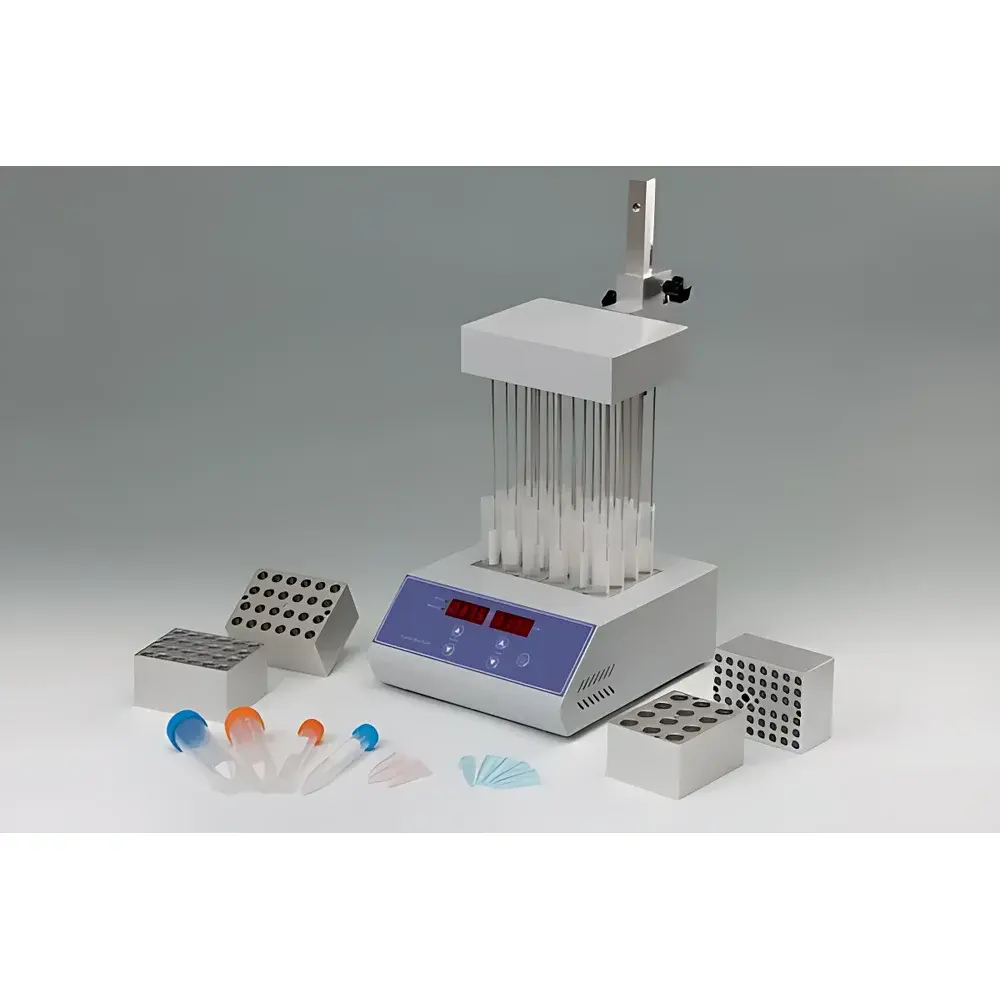
Jiayuan MD200-2 Dry-Block Nitrogen Evaporator
| Brand | Jiayuan |
|---|---|
| Origin | Beijing, China |
| Model | MD200-2 |
| Heating Method | Dry-block heating |
| Temperature Range | Ambient +5°C to 160°C |
| Temperature Stability | ±0.5°C (@40°C), ±1.0°C (@120°C) |
| Display Resolution | 0.1°C |
| Temperature Uniformity | ±0.5°C |
| Heating Power | 500 W |
| Gas Flow Rate | Up to 15 L/min |
| Max Gas Pressure | 0.02 MPa (≤16 needles), 0.05 MPa (>16 needles) |
| Sample Capacity | 24-position |
| Adjustable Height Travel | 200 mm |
| Timer Range | 1–99 h 59 min |
| Warm-up Time | ≤15 min (25°C → 160°C) |
| Dimensions (L×W×H) | 260 × 220 × 450 mm |
| Weight | 7.5 kg |
| Voltage | 220 V, 50/60 Hz |
| Interchangeable Modules | BK01–BK13 (including 1.5 mL & 2.0 mL centrifuge tubes, 10–40 mm OD glass tubes) |
Overview
The Jiayuan MD200-2 Dry-Block Nitrogen Evaporator is an engineered solution for parallel sample concentration in analytical laboratories performing preparative work prior to chromatographic or mass spectrometric analysis. Unlike water-bath nitrogen evaporators, this system employs a high-purity aluminum dry-block heating module as its thermal medium—ensuring rapid heat transfer, minimal contamination risk, and full compatibility with organic solvents that react with water or corrode stainless steel baths. The instrument operates on the principle of controlled inert-gas displacement: nitrogen (or compressed air, where appropriate) is delivered through independently adjustable gas needles to the surface of liquid samples, accelerating solvent evaporation while minimizing analyte degradation or oxidation. Its PID-based temperature control architecture enables precise thermal regulation across a broad operational range—from ambient +5°C up to 160°C—making it suitable for low-boiling solvents (e.g., dichloromethane, hexane) as well as higher-boiling media (e.g., ethyl acetate, acetonitrile).
Key Features
- Dual independent aluminum heating blocks with ±0.5°C uniformity across all 24 positions at 40°C, verified per ASTM E220 calibration practice;
- Individually controllable gas needle channels—enabling selective activation, pressure balancing, and cross-contamination prevention;
- Motorized vertical height adjustment (200 mm travel) with mechanical lock, accommodating varied vessel heights without manual repositioning;
- High-resolution digital display (0.1°C resolution) with real-time temperature feedback and user-accessible offset calibration;
- Programmable timer (1 min to 99 h 59 min) supporting unattended overnight operation under GLP-compliant conditions;
- Integrated over-temperature protection and gas-pressure monitoring circuitry compliant with IEC 61010-1 safety standards;
- Modular design supporting 13 interchangeable sample blocks (BK01–BK13), including configurations for 1.5 mL and 2.0 mL microcentrifuge tubes, standard culture tubes, and custom-diameter glassware.
Sample Compatibility & Compliance
The MD200-2 accommodates a wide spectrum of sample containers—including borosilicate glass test tubes (10–40 mm OD), polypropylene microcentrifuge tubes (1.5 mL and 2.0 mL), and custom-fabricated vessels—without requiring adapter rings or secondary fixtures. Its dry-block architecture eliminates condensation, microbial growth, and bath-fluid evaporation issues inherent in water-based systems. From a regulatory standpoint, the device supports workflows aligned with USP , ISO/IEC 17025:2017 (Clause 6.4.3 on equipment suitability), and FDA 21 CFR Part 11 when paired with validated electronic lab notebook (ELN) integration. While the unit itself does not include built-in audit trail functionality, its analog/digital interfaces allow connection to external data loggers certified for GxP environments.
Software & Data Management
The MD200-2 operates via embedded firmware with no proprietary software dependency—ensuring long-term maintainability and compatibility with legacy laboratory IT infrastructure. All operational parameters (setpoint temperature, elapsed time, gas flow status) are displayed locally and can be manually recorded for batch documentation. For automated data capture, optional RS-232 or USB-to-serial adapters enable integration with third-party SCADA or LIMS platforms. Temperature profiles may be exported as CSV files for trend analysis, and calibration logs—including date, technician ID, reference standard used (e.g., Fluke 724), and deviation values—can be maintained externally in accordance with ISO/IEC 17025 requirements.
Applications
- Residue analysis in food safety testing (e.g., pesticide multiresidue methods AOAC 2007.01, EN 15662);
- Pharmaceutical impurity profiling and stability-indicating assay development (ICH Q5C, Q1A);
- Environmental monitoring of PAHs, PCBs, and organochlorine pesticides in soil/water extracts (EPA Methods 3510C, 3620B);
- Forensic toxicology sample prep prior to GC-MS analysis of drugs of abuse;
- Biological matrix cleanup (plasma, urine, tissue homogenates) in clinical research protocols;
- Pre-concentration of trace metals after chelation extraction in atomic spectroscopy workflows.
FAQ
Is the MD200-2 compatible with oxygen-sensitive samples?
Yes—the system supports continuous nitrogen purging at adjustable flow rates (0–15 L/min), maintaining an inert atmosphere above samples during evaporation.
Can multiple modules be heated to different temperatures simultaneously?
No—both blocks share a single PID-controlled thermal zone; however, dual-zone variants (MD200-2DZ) are available upon request.
What is the recommended maintenance interval for gas distribution manifolds?
Inspect and clean needle orifices every 200 operating hours using 0.2 µm filtered nitrogen and isopropyl alcohol swabs; replace O-rings annually or after 500 cycles.
Does the unit meet CE or UL certification requirements?
It carries CE marking per Directive 2014/30/EU (EMC) and 2014/35/EU (LVD), with test reports available upon formal inquiry.
How is temperature accuracy verified during routine qualification?
Use a calibrated NIST-traceable probe (e.g., Fluke 1523) inserted into designated block wells at three locations (center, front-left, rear-right) per ISO/IEC 17025 Annex A.3.



