
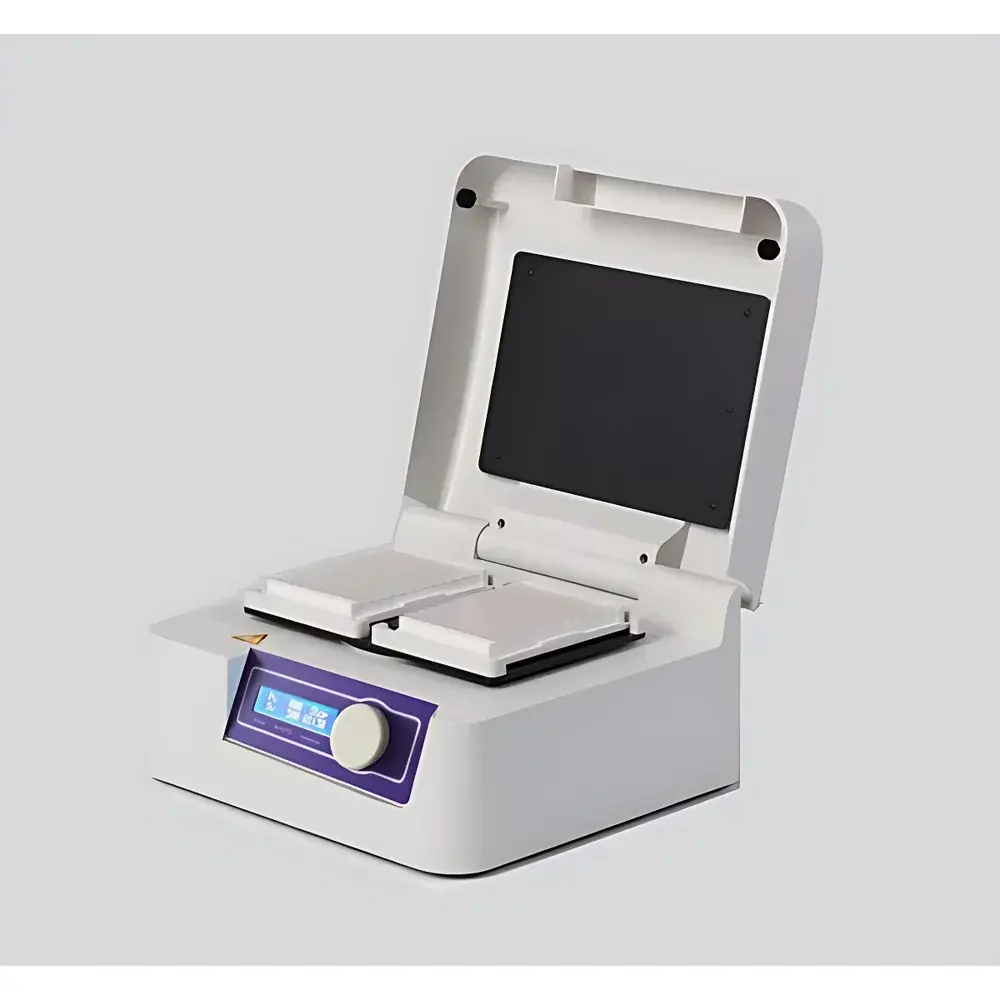
MENTS MB100-2A Microplate Incubator Shaker
| Brand | MENTS |
|---|---|
| Origin | Beijing, China |
| Manufacturer Type | Direct Manufacturer |
| Model | MB100-2A |
| Timer Range | 1 min – 99 h 59 min |
| Oscillation Frequency | 200–1600 rpm |
| Orbit Diameter | 2 mm (horizontal circular motion) |
| Temperature Range | Ambient +5 °C to 80 °C |
| Plate Capacity | 2 microplates (96-well, 384-well, deep-well, or cell culture plates) |
| Temperature Accuracy | ≤ ±0.5 °C |
| Display Resolution | 0.1 °C |
| Heating Time | ≤20 min (from ambient to 80 °C) |
| Input Power | 150 W |
| Dimensions (W×D×H) | 280 × 270 × 140 mm |
| Net Weight | 7.0 kg |
Overview
The MENTS MB100-2A Microplate Incubator Shaker is an integrated benchtop instrument engineered for precise temperature-controlled orbital agitation of standard microtiter formats—including 96-well, 384-well, deep-well, and multi-well cell culture plates. It operates on the principle of horizontal circular oscillation (2 mm orbit diameter) combined with PID-regulated resistive heating across a uniform thermal field. Designed specifically for life science workflows requiring simultaneous incubation and mixing—such as enzyme-linked immunosorbent assay (ELISA) development, antibody-antigen binding kinetics, microbial suspension culture, and suspension-based cell line maintenance—the MB100-2A delivers stable thermal homogeneity and reproducible rotational dynamics without mechanical backlash or speed drift. Its compact footprint (280 × 270 × 140 mm) and low mass (7.0 kg) support flexible placement in biosafety cabinets, cold rooms, or shared core facility benches.
Key Features
- DC brushless motor drive ensures maintenance-free operation, consistent torque delivery across the full 200–1600 rpm range, and acoustic noise levels below 45 dB(A) at maximum speed.
- PID-controlled dual-zone heating system maintains temperature uniformity within ±0.5 °C across the entire plate surface; independent sensor feedback loops prevent overshoot and minimize thermal lag.
- Intuitive rotary encoder interface with backlit LCD display enables real-time monitoring of setpoint temperature, actual chamber temperature, elapsed time, remaining timer duration, and current rotational speed.
- Programmable timer supports durations from 1 minute to 99 hours and 59 minutes; auto-shutdown with audible alert upon completion ensures protocol compliance and energy efficiency.
- Robust aluminum alloy platform with precision-machined clamping grooves accommodates two standard microplates simultaneously—compatible with ANSI/SLAS-compliant 96-well, 384-well, and deep-well plates (up to 15 mm well depth).
- Switch-mode power supply (150 W nominal) provides stable voltage regulation under variable load conditions and meets IEC 61000-3-2 harmonic emission standards.
Sample Compatibility & Compliance
The MB100-2A supports all common microplate formats used in molecular biology, immunology, and cell-based assays, including polypropylene, polystyrene, and cyclo-olefin copolymer (COC) plates. Its horizontal orbital motion minimizes shear stress on sensitive adherent or suspension cells while ensuring homogeneous reagent distribution. The device conforms to general laboratory safety requirements per IEC 61010-1:2010 (Safety Requirements for Electrical Equipment for Measurement, Control, and Laboratory Use). While not certified for ISO 13485 or FDA 21 CFR Part 11 out-of-the-box, its deterministic timer logic, non-volatile parameter storage, and auditable operational history (via manual logbook integration) support GLP/GMP-aligned documentation practices when deployed in regulated QC/QA environments.
Software & Data Management
The MB100-2A operates as a standalone instrument with no embedded firmware-based data logging or USB/Bluetooth connectivity. All operational parameters are retained in non-volatile memory following power interruption. For traceability in validated workflows, users may integrate external environmental monitoring systems (e.g., calibrated thermocouple arrays or wireless temperature loggers) placed directly beneath plate positions. Protocol documentation—including temperature setpoints, agitation speeds, timing windows, and plate identifiers—should be recorded manually or via LIMS-compatible electronic lab notebooks (ELNs) compliant with ALCOA+ principles (Attributable, Legible, Contemporaneous, Original, Accurate, Complete, Consistent, Enduring, Available).
Applications
- ELISA and immunoassay plate washing and incubation steps requiring uniform antigen–antibody interaction kinetics.
- Suspension culture of insect or mammalian cells (e.g., Sf9, CHO, HEK293) during transfection or protein expression phases.
- High-throughput screening (HTS) plate agitation prior to centrifugation or detection to prevent sedimentation artifacts.
- Bacterial or yeast growth curve analysis in 96-well format under controlled thermal and mixing conditions.
- Enzymatic reaction optimization (e.g., kinase assays, phosphatase activity) where temperature stability and mixing consistency directly impact Vmax and Km determination.
- Pre-analytical sample homogenization for downstream applications such as qPCR, NGS library preparation, or flow cytometry staining.
FAQ
Is the MB100-2A compatible with 384-well plates?
Yes—its platform geometry and clamping mechanism accommodate ANSI/SLAS-standard 384-well microplates, provided they conform to nominal footprint dimensions (127.76 × 85.48 mm) and maximum height specifications (≤15 mm).
Can the unit maintain temperature uniformity across both plates simultaneously?
Yes—the dual-plate configuration has been validated for ≤±0.8 °C inter-plate temperature deviation at 37 °C and ≤±1.2 °C at 80 °C under steady-state conditions.
Does the shaker support programmable ramping profiles (e.g., gradual temperature increase)?
No—the MB100-2A implements step-setpoint temperature control only; it does not offer gradient or slope-based thermal programming.
What is the recommended calibration interval for routine use?
We recommend annual verification using NIST-traceable PT100 probes placed at three locations across the plate surface (center, front-left, rear-right), per ISO/IEC 17025-aligned internal calibration SOPs.
Is condensation management included in the design?
No—this unit lacks active dew-point suppression; users working with cold plates or high-humidity environments should pre-equilibrate plates and consider desiccant placement inside enclosed incubation chambers if condensation is observed.





