
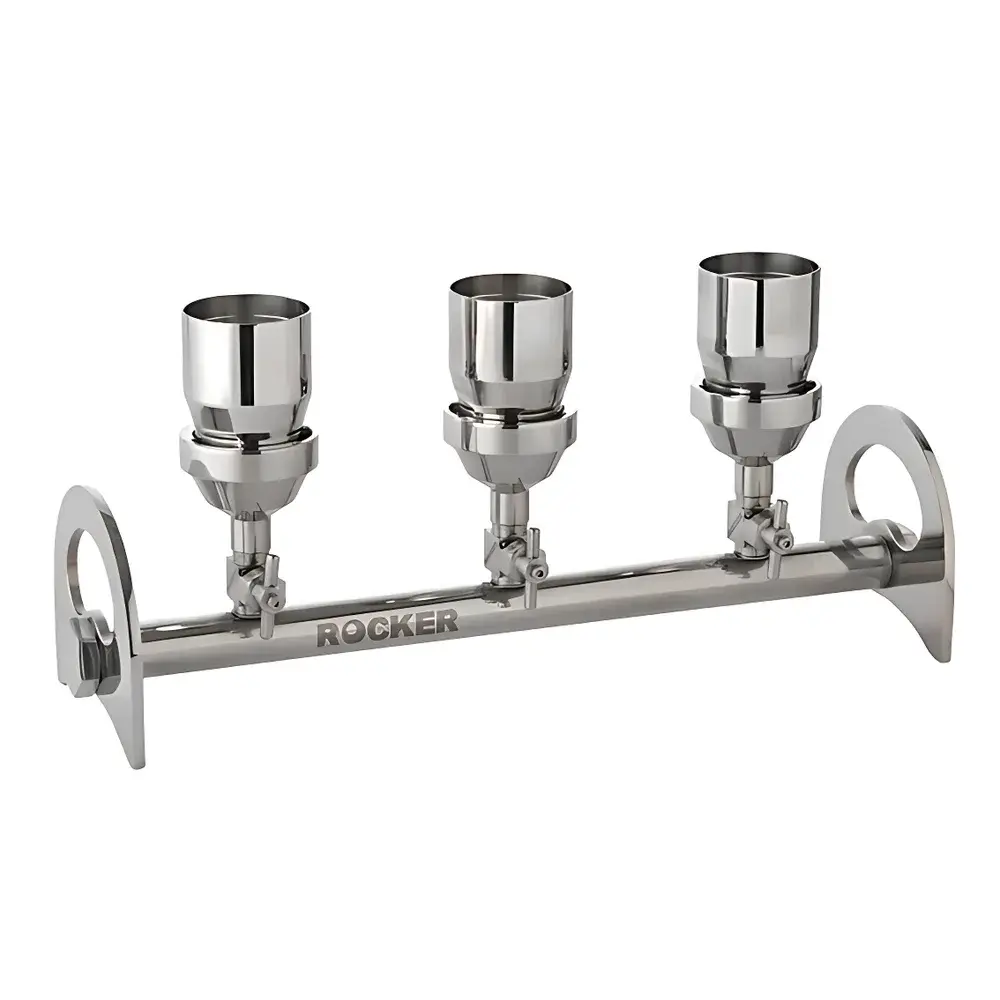
ROCKER BioVac 331 Triple-Position Stainless Steel Vacuum Filtration Manifold
| Brand | ROCKER |
|---|---|
| Origin | Taiwan |
| Model | BioVac 331 |
| Construction Material | Fully ASTM A240 Type 316 stainless steel |
| Number of Positions | 3 (independently controllable) |
| Maximum Operating Pressure | 3000 psi |
| Compatible Filter Cup Capacity | 100 mL |
| Supported Membrane Diameter | 47 mm / 50 mm |
| Hose ID Compatibility | 8 mm (5/16 in.) |
| Effective Filtration Area per Position | 9.6 cm² |
| Valve & Structural Components | 316 SS throughout |
| Sterilization Compatibility | Autoclave, dry heat oven, and flame sterilizable |
| Patent | TW M381450 |
Overview
The ROCKER BioVac 331 is a precision-engineered triple-position vacuum filtration manifold designed for rigorous laboratory environments where chemical resistance, thermal stability, and regulatory traceability are non-negotiable. Constructed entirely from ASTM A240 Type 316 stainless steel—including the manifold body, independent isolation valves, filter funnels, support plates, handles, and fluid-path fittings—the system delivers exceptional corrosion resistance against aggressive solvents, oxidizing agents, and biological residues. Its design adheres to fundamental principles of vacuum-driven cross-flow filtration: applying controlled negative pressure across a supported membrane to separate suspended particles, microorganisms, or precipitates from liquid or gaseous samples. Unlike polymer-based manifolds, the BioVac 331 maintains dimensional integrity under repeated sterilization cycles (autoclaving at 121 °C/15 psi for 20 min, dry heat up to 250 °C, or direct flame pass-through), making it suitable for aseptic processing, environmental monitoring, and GMP-aligned QC workflows.
Key Features
- Fully 316 stainless steel construction—no plastics, elastomers, or plated components in the fluid path—ensures long-term compatibility with HCl, HNO₃, NaOH, acetone, chlorinated solvents, and enzymatic digest buffers.
- Patented rotary bayonet locking mechanism (Taiwan Patent No. M381450) enables tool-free, leak-tight coupling of 100 mL stainless steel filter cups in under 3 seconds per position—eliminating clamps, O-rings, or torque-sensitive fasteners that degrade over time.
- Three independently actuated 316 SS diaphragm valves allow sequential or parallel filtration across positions without cross-contamination risk; each valve features tactile feedback and positive shutoff verified to <0.5 mL/min leakage at 3000 psi.
- Optimized flow geometry minimizes dead volume and channeling; the 9.6 cm² effective filtration area per position supports reproducible flux rates across ISO 4002-compliant 47 mm and 50 mm diameter membranes (e.g., mixed cellulose ester, PVDF, PTFE, nylon).
- Integrated 8 mm (5/16″) barbed inlet ports accept standard reinforced vacuum tubing; all wetted surfaces are electropolished to Ra ≤ 0.4 µm for reduced protein adsorption and simplified cleaning validation.
Sample Compatibility & Compliance
The BioVac 331 supports diverse sample matrices including aqueous suspensions, organic extracts, fermentation broths, air sampling impinger solutions, and pharmaceutical rinse fluids. It complies with material requirements outlined in USP , ASTM F899 (standard specification for stainless steels in surgical implants), and ISO 10993-1 (biocompatibility evaluation). When used with certified low-protein-binding membranes and validated cleaning procedures (e.g., 2% Alconox® followed by 70% ethanol rinse), the manifold meets GLP documentation standards for residue testing and environmental monitoring per EPA Method 1603 and ISO 9308-1 (coliform enumeration). Its metal-only architecture eliminates extractables concerns associated with polymeric manifolds—critical for LC-MS trace analysis and biologics process development.
Software & Data Management
As a standalone passive filtration platform, the BioVac 331 requires no embedded firmware, drivers, or software. All operational parameters—including applied vacuum level (monitored externally via calibrated gauge), filtration duration, and valve sequencing—are manually recorded in lab notebooks or integrated into ELN systems (e.g., LabArchives, Benchling) using standardized SOP templates. The absence of electronic components ensures full compliance with FDA 21 CFR Part 11 when paired with audit-trail-enabled documentation practices. Maintenance logs—including valve cycling counts, sterilization cycle records, and visual inspection reports for surface pitting or galling—can be archived alongside raw data for regulatory inspections.
Applications
- Microbial enumeration in pharmaceutical water systems (USP , EP 2.6.12) using membrane filtration with tryptic soy agar or R2A media.
- Particulate analysis in injectable formulations per USP and Ph. Eur. 2.9.19, where stainless steel manifolds prevent fiber shedding and static charge interference.
- Concentration of viral vectors or exosomes via tangential flow ultrafiltration pre-filtration steps.
- Environmental air sampling per ISO 14644-1 cleanroom monitoring protocols, utilizing gelatin or polycarbonate filters mounted on 47 mm stainless supports.
- Chemical synthesis workup—removal of catalysts (e.g., Pd/C), precipitated salts, or crystalline byproducts under inert atmosphere using compatible vacuum sources.
FAQ
Is the BioVac 331 compatible with aggressive acids such as concentrated nitric acid?
Yes—Type 316 stainless steel provides superior resistance to oxidizing acids compared to 304 SS, validated per ASTM G31 immersion testing protocols.
Can the manifold be sterilized in an autoclave without compromising structural integrity?
Yes—fully rated for repeated 121 °C, 15 psi saturated steam cycles; electropolished surfaces resist pitting and crevice corrosion post-sterilization.
What filter cup models are officially supported?
ROCKER part #167103-24 includes three 100 mL 316 SS filter cups with integrated 47/50 mm support grids; alternative cup geometries require mechanical verification of bayonet interface alignment.
Does the 2-year parts warranty cover labor or field service?
The warranty covers replacement of defective 316 SS components only; labor, calibration, or on-site support requires separate service agreement.
How is leak integrity verified during routine use?
Users perform a simple vacuum hold test: close all valves, apply ≥25 inHg vacuum, and monitor for >5% pressure rise over 5 minutes—indicative of seal degradation or microcracking.




