
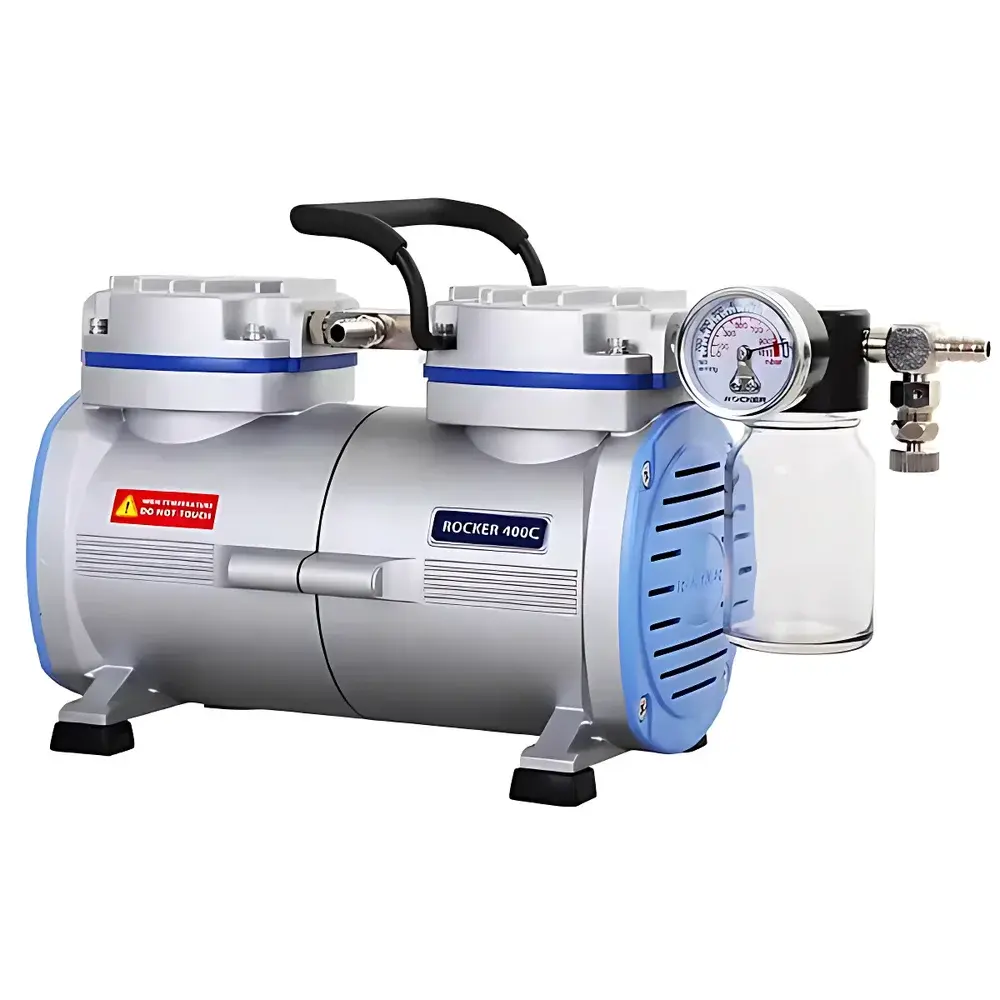
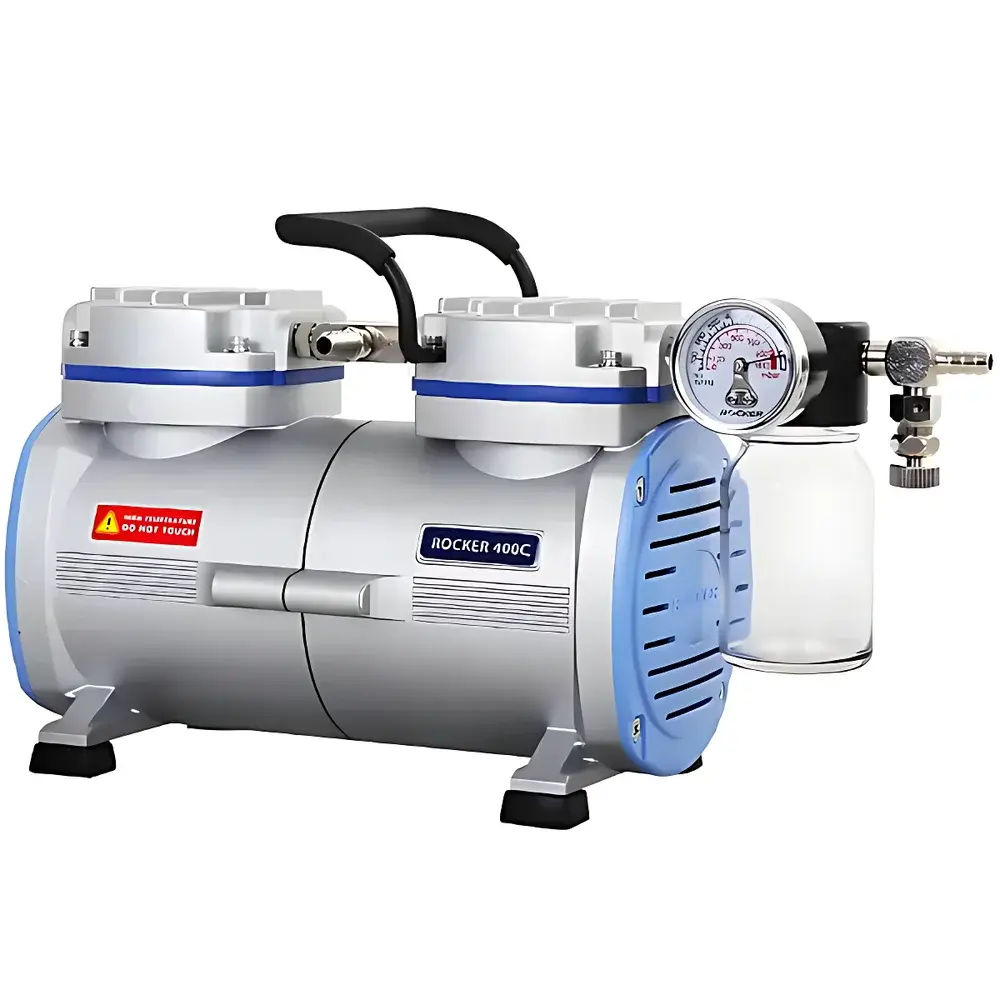
ROCKER Rocker400C PTFE-Coated Corrosion-Resistant Oil-Free Diaphragm Vacuum Pump
| Brand | ROCKER |
|---|---|
| Origin | Taiwan |
| Model | Rocker400C |
| Pump Type | Diaphragm Vacuum Pump |
| Lubrication | Oil-Free |
| Maximum Vacuum | 99 mbar |
| Flow Rate | 31 L/min |
| Dimensions (L×W×H) | 31 × 13.5 × 20.4 cm |
| Weight | 5.7 kg |
| Motor Power | 80 W |
| Speed | 1450 rpm |
| Noise Level | 52 dB(A) |
| Inlet Fitting | ID 8 mm (5/16″) |
| Vacuum Regulator Valve | Yes |
| Float Ball Filter Assembly | Yes |
| Thermal Overload Protection | Yes |
| Certifications | CE, RoHS, IP30 |
Overview
The ROCKER Rocker400C is an engineered oil-free diaphragm vacuum pump designed for reliable, low-maintenance operation in chemically demanding laboratory environments. Based on positive displacement via elastomeric diaphragm actuation, it generates vacuum without lubricating oil—eliminating oil carryover, vapor contamination, and routine oil replenishment. Its core architecture integrates a stainless steel (AISI 316) valve assembly and PTFE-coated wetted surfaces—including the diaphragm and pump chamber—ensuring consistent performance when handling aggressive solvents such as acetone, chloroform, methanol, acetonitrile, and diluted mineral acids. With a maximum vacuum level of 99 mbar (685 mmHg) and a free-air flow rate of 31 L/min at ambient conditions, the Rocker400C delivers sufficient suction capacity for routine filtration, degassing, and mobile phase preparation tasks across analytical and preparative workflows.
Key Features
- PTFE-coated diaphragm and pump chamber for broad chemical resistance against organic solvents and mildly corrosive vapors
- AISI 316 stainless steel valve plates and internal gas-path components for enhanced durability and inertness
- Integrated thermal overload protection: automatically interrupts motor power upon excessive temperature rise and resumes operation after passive cooling
- Onboard vacuum regulator valve enabling precise, real-time adjustment of vacuum pressure without external controllers
- Float-ball inlet filter assembly to prevent particulate ingress and protect internal components from clogging or abrasion
- CE-marked, RoHS-compliant, and rated IP30 for protection against solid objects ≥2.5 mm—suitable for standard laboratory benchtop use
- No oil required: eliminates risk of hydrocarbon contamination in sensitive applications such as HPLC solvent degassing or ultrafiltration
- Low-noise operation at 52 dB(A), minimizing acoustic disturbance in shared lab spaces
Sample Compatibility & Compliance
The Rocker400C is validated for continuous duty with aqueous solutions, polar and non-polar organic solvents, and low-concentration acidic or basic aqueous media. Its PTFE/stainless steel construction complies with material compatibility guidelines referenced in ASTM D471 (rubber property testing) and ISO 15203 (laboratory equipment corrosion resistance assessment). While not certified for explosive atmospheres (ATEX), its design meets general-purpose safety requirements under IEC 61010-1 for electrical equipment used in laboratory settings. The pump supports GLP-aligned documentation practices through traceable serial-number identification and conforms to EU Directive 2014/30/EU (EMC) and 2014/35/EU (LVD), evidenced by CE marking. RoHS compliance ensures restricted substance thresholds are maintained per Annex II of Directive 2011/65/EU.
Software & Data Management
The Rocker400C operates as a standalone analog device with no embedded microprocessor, firmware, or digital interface. As such, it does not incorporate data logging, remote control, or software-driven calibration functions. This architecture prioritizes operational simplicity, electromagnetic immunity, and long-term reliability—particularly advantageous in environments where EMI-sensitive instrumentation (e.g., mass spectrometers or NMR systems) is co-located. Vacuum regulation is performed manually via the front-panel needle valve; users may integrate external pressure transducers and data acquisition systems (e.g., LabVIEW-compatible sensors) for process monitoring where audit trails or electronic records are required under FDA 21 CFR Part 11 or ISO/IEC 17025 frameworks.
Applications
- Routine vacuum filtration of biological samples, environmental water extracts, and pharmaceutical suspensions using glass or polypropylene filter holders
- Preparation and degassing of HPLC and UHPLC mobile phases to prevent bubble formation in high-pressure fluidic paths
- Concentration of volatile analytes via rotary evaporation support (as secondary vacuum source)
- Vacuum-assisted drying of chromatographic columns and solid-phase extraction (SPE) cartridges
- Gas sampling and headspace evacuation prior to GC analysis
- Evacuation of desiccators and vacuum ovens operating above 100 mbar setpoints
FAQ
Is the Rocker400C suitable for use with strong acids such as concentrated HCl or HNO₃?
The PTFE coating provides resistance to many common laboratory solvents and dilute inorganic acids (≤10% v/v), but prolonged exposure to fuming or concentrated oxidizing acids is not recommended and may compromise diaphragm integrity over time.
Does the pump require periodic maintenance beyond filter replacement?
No scheduled maintenance is required. The float-ball filter should be inspected and cleaned regularly; the diaphragm and valves are designed for >10,000 hours of service life under typical intermittent use conditions.
Can the Rocker400C be operated continuously for 24/7 applications?
Yes—it is rated for continuous duty per IEC 60034-1, provided ambient temperature remains below 40°C and adequate ventilation is maintained around the motor housing.
What is the expected service life of the PTFE-coated diaphragm?
Under standard laboratory usage (≤8 hrs/day, moderate solvent load), the diaphragm typically exceeds 2 years of functional service before replacement is advised.
Is the Rocker400C compatible with vacuum controllers or automated lab platforms?
It lacks digital communication ports (e.g., RS-232, USB, or analog 0–10 V output); however, its vacuum regulator valve allows manual integration into semi-automated vacuum manifolds with external pressure feedback loops.



