
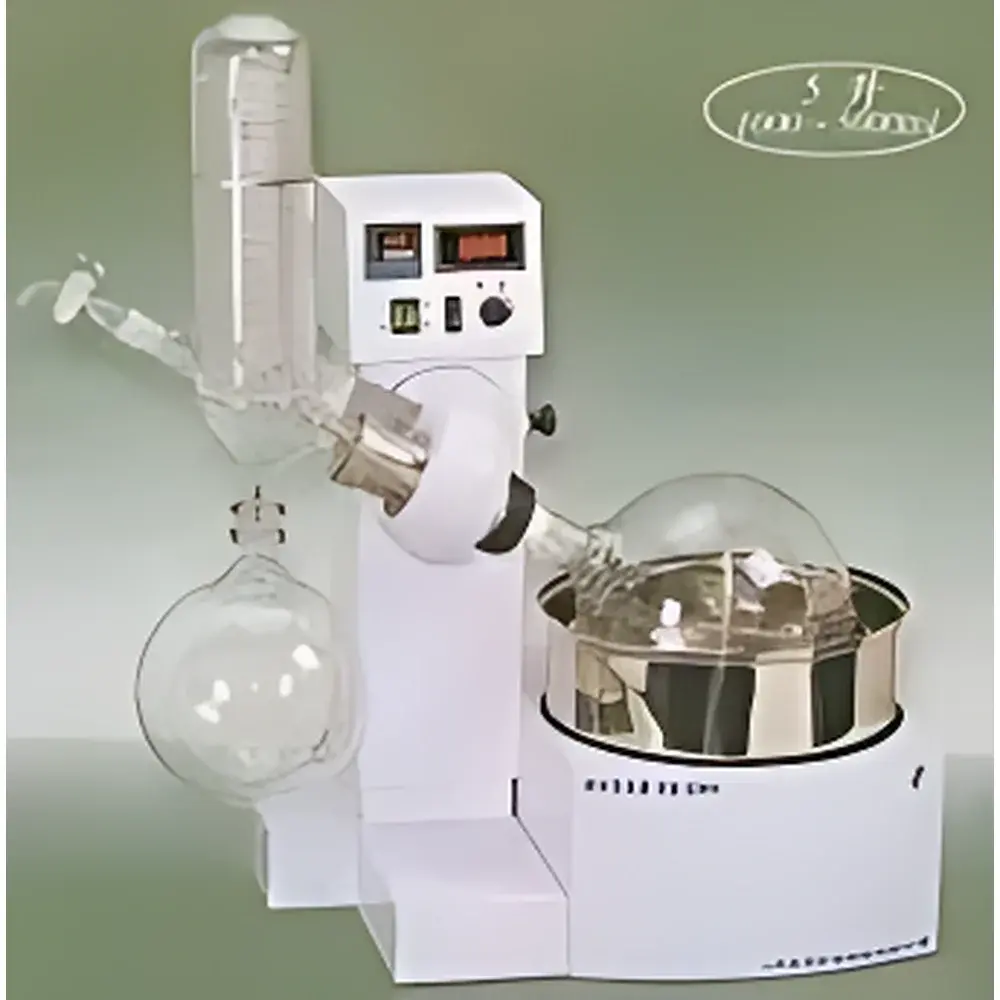
Yarong RE5000 Rotary Evaporator
| Brand | Yarong |
|---|---|
| Origin | Shanghai, China |
| Model | RE5000 |
| Capacity | 5 L |
| Ultimate Vacuum | 3 mmHg |
| Rotation Speed | 0–110 rpm |
| Heating Temperature Range | 0–100 °C |
| Cooling System | Vertical high-density dual coiled condenser |
| Collection Flask Capacity | 3 L |
| Power Consumption | 2120 W |
| Dimensions (W×D×H) | 600 × 400 × 850 mm |
| Lift Mechanism | Motorized tilting-type with push-button control |
| Temperature Control Accuracy | ±1 °C (typical for analog-controlled bath systems) |
| Condenser Surface Area | Not specified (standard vertical dual-coil design) |
Overview
The Yarong RE5000 Rotary Evaporator is an engineered solution for efficient solvent removal, concentration, and gentle compound recovery under reduced pressure. Based on the fundamental principle of rotary evaporation—where a rotating flask increases surface area and promotes uniform thin-film formation while simultaneous vacuum lowers boiling points—the RE5000 enables reproducible, scalable evaporation across academic research labs, QC environments, and small-scale pilot production. Its 5 L evaporation flask capacity supports medium-volume batch processing, while the integrated vertical dual-coil condenser ensures high-efficiency vapor condensation across a broad range of solvents including water, ethanol, acetone, ethyl acetate, and dichloromethane. Designed for compatibility with standard ground-glass joints (e.g., ISO-K 29/32 or NS 29/32), the system maintains mechanical stability during rotation and thermal cycling, minimizing risk of bumping or splashing.
Key Features
- Motorized tilting lift mechanism with push-button actuation for rapid, repeatable flask positioning—reducing manual handling and improving operator ergonomics.
- Digital RPM display with continuous 0–110 rpm adjustment, enabling precise control over film thickness and evaporation kinetics.
- Heating bath with temperature range from ambient to 100 °C, calibrated for aqueous and organic media; typical control accuracy is ±1 °C under steady-state conditions.
- Vertical high-density dual coiled condenser constructed from borosilicate glass—optimized for high thermal transfer efficiency and low-pressure operation down to 3 mmHg.
- Integrated 3 L round-bottom collection flask with standard ball-joint interface (29/32) for secure, leak-tight connection and easy solvent recovery.
- Robust aluminum alloy chassis and reinforced stainless-steel support frame ensure long-term structural integrity and vibration damping during rotation.
- Total power consumption rated at 2120 W, distributed between heating bath (1800 W), motor drive (120 W), and auxiliary controls (200 W).
Sample Compatibility & Compliance
The RE5000 accommodates thermally sensitive and volatile samples commonly processed in synthetic chemistry, natural product isolation, and pharmaceutical formulation workflows. Its vacuum capability (≤3 mmHg) permits low-temperature evaporation of heat-labile compounds such as terpenes, alkaloids, and certain peptides. While the unit itself does not carry CE, UL, or FDA certification, its construction adheres to general laboratory equipment safety norms (IEC 61010-1) and is compatible with external vacuum controllers and cold traps meeting ISO 8573-1 Class 4 purity standards. When operated within defined parameters and paired with appropriate PPE and fume hood ventilation, it supports GLP-aligned documentation practices for method transfer and batch recordkeeping.
Software & Data Management
The RE5000 operates via analog/digital hybrid controls—no embedded microprocessor or data logging capability is included. Temperature and rotation settings are manually configured and monitored using front-panel indicators. For laboratories requiring audit-trail compliance (e.g., 21 CFR Part 11), integration with external programmable vacuum controllers (e.g., Vacuubrand VRV) and digital bath controllers (e.g., Huber CC-K) is feasible via analog 0–10 V or 4–20 mA signal interfaces. Users may implement third-party LabVIEW or Python-based acquisition scripts to log RPM, bath temperature, and vacuum level when interfaced with compatible transducers.
Applications
- Solvent removal from reaction mixtures post-Suzuki coupling or Grignard synthesis.
- Concentration of crude plant extracts prior to HPLC fractionation or TLC analysis.
- Recovery of chiral solvents in asymmetric catalysis workflows.
- Preparative-scale dehydration of hygroscopic intermediates under nitrogen sweep.
- Removal of low-boiling solvents (e.g., diethyl ether, pentane) from lipid suspensions without phase separation.
- Parallel evaporation support when coupled with multi-position heating mantles or circulating chillers (e.g., Huber Unistat).
FAQ
What is the maximum recommended working vacuum for continuous operation?
The RE5000 is rated for ultimate vacuum ≤3 mmHg; however, for stable thin-film evaporation and condenser efficiency, operational vacuum should be maintained between 5–20 mmHg depending on solvent volatility and bath temperature.
Is the heating bath fluid-compatible with silicone oil or ethylene glycol?
Yes—the bath chamber accepts standard heat-transfer fluids up to 100 °C; viscosity and flash point must be verified per manufacturer specifications of the chosen medium.
Can the RE5000 be used with a dry ice/acetone cold trap?
Yes, though direct mounting requires custom adapter hardware; optimal performance is achieved with inline −20 °C to −40 °C recirculating chillers to prevent condenser icing and vacuum pump oil backstreaming.
Does the unit include a vacuum gauge or pressure sensor?
No—vacuum monitoring requires an external analog or digital vacuum gauge connected to the vapor path upstream of the condenser.
What ground-glass joint size is used for the main rotary assembly?
The evaporating flask and condenser utilize standard ISO-K 29/32 (or NS 29/32) taper joints, ensuring interchangeability with common labware from major suppliers including Schott Duran and Kimble Chase.



