
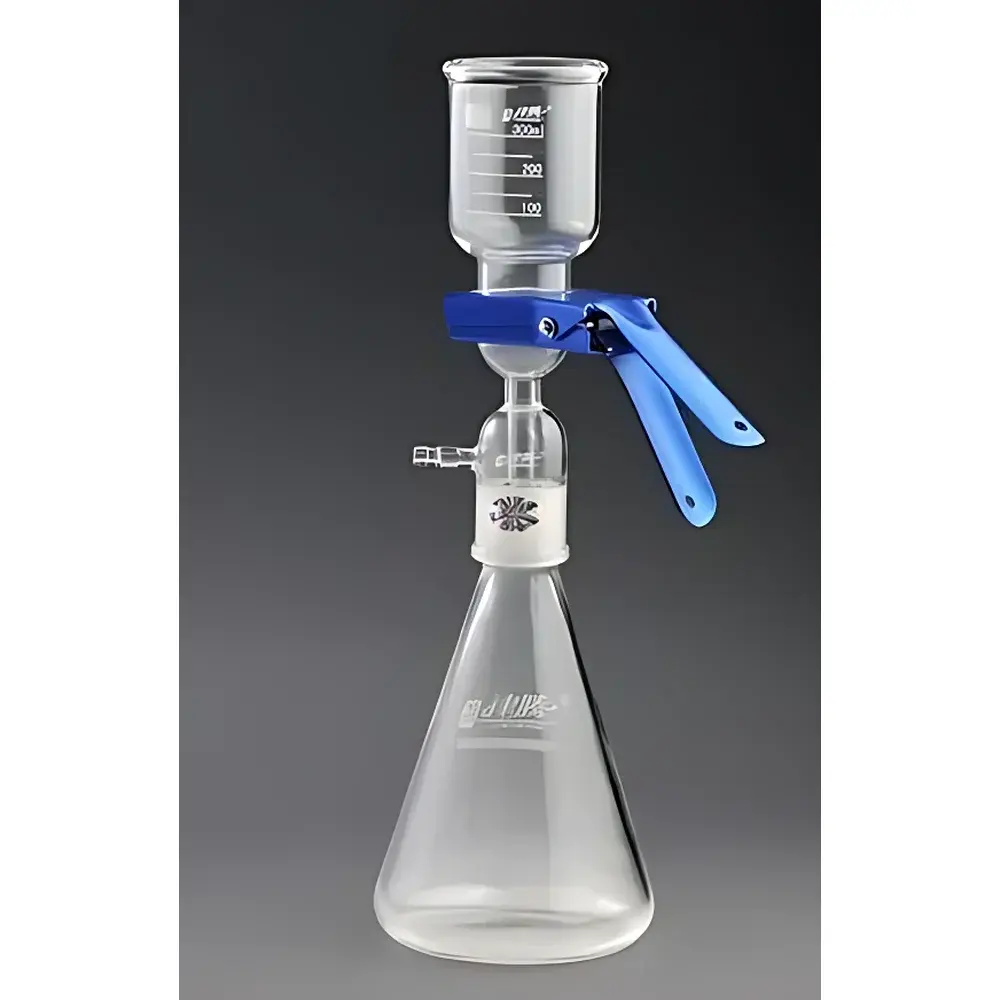
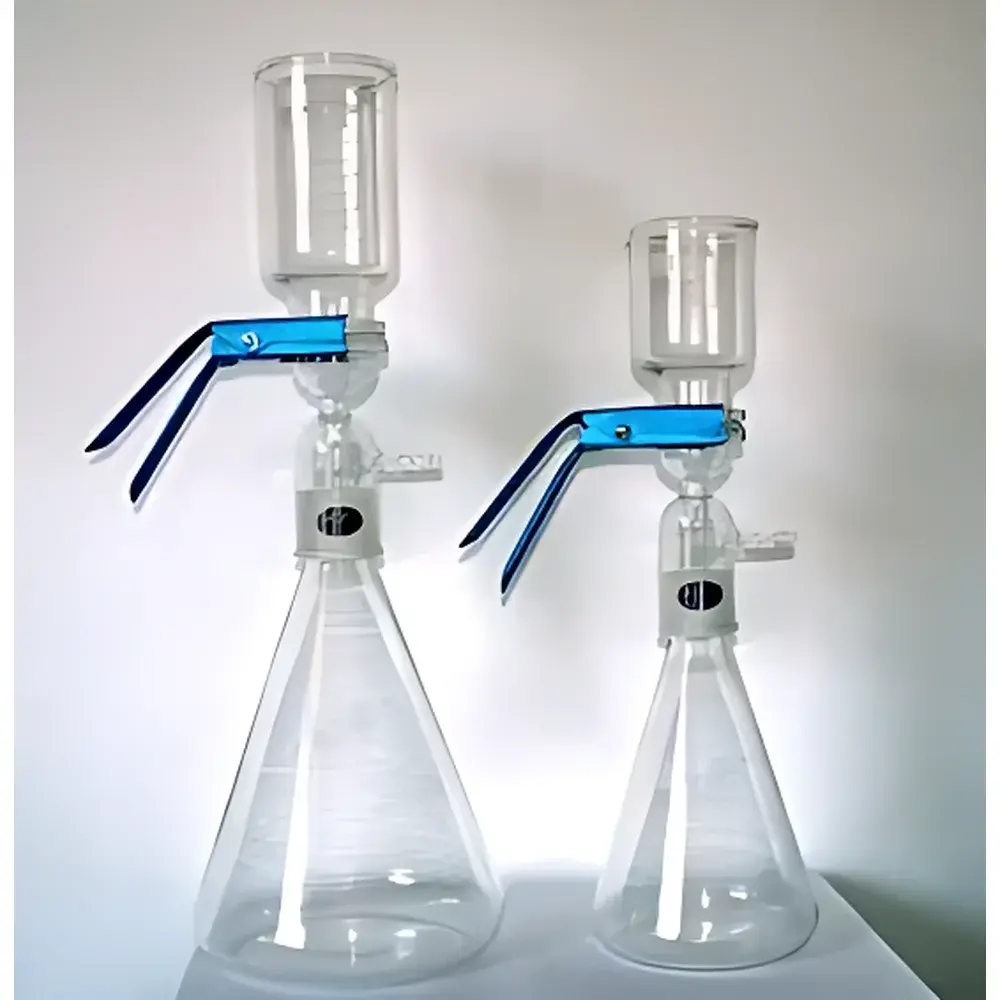
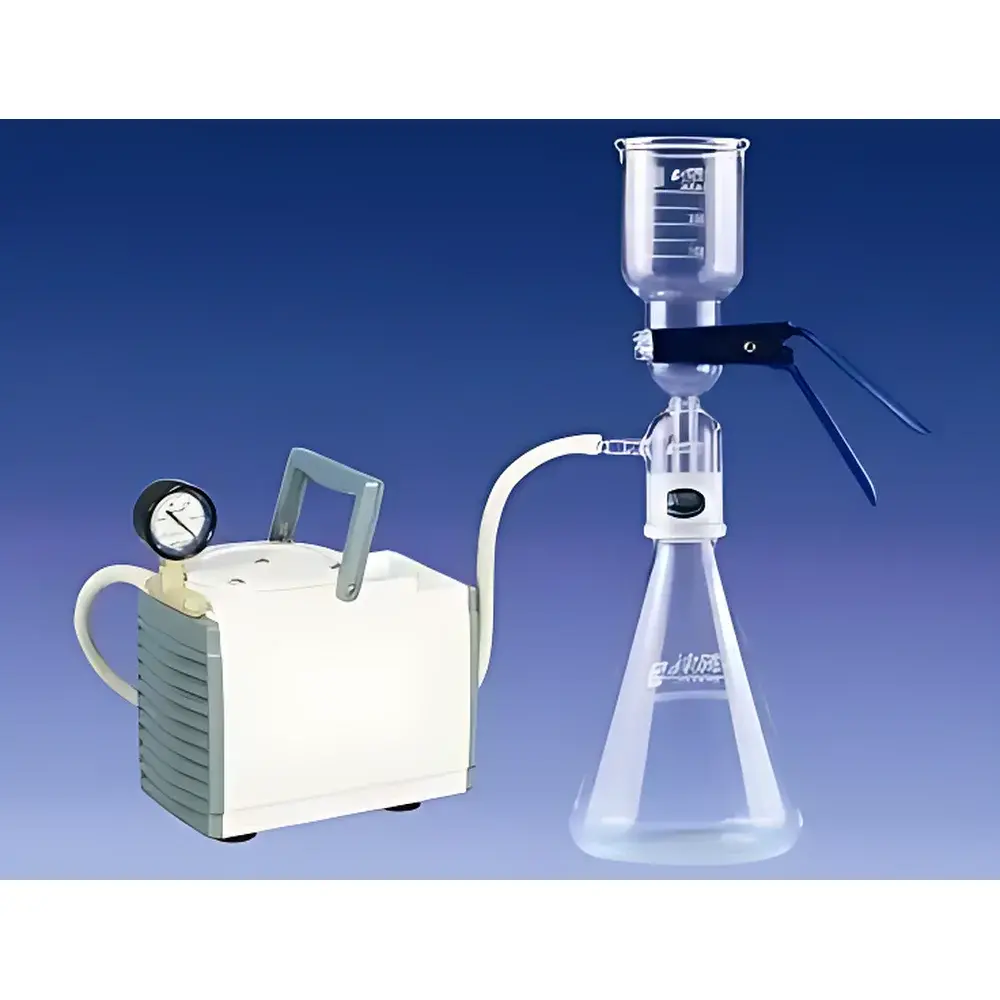
JINTENG Borosilicate Glass Fritted Filter Assembly T-50 (1 L Capacity)
| Brand | JINTENG |
|---|---|
| Origin | Tianjin, China |
| Manufacturer Type | Authorized Distributor |
| Regional Classification | Domestic (China) |
| Model | T-50 (1 L) |
| Price | USD 65 (excl. tax & shipping) |
| Filter Cup Volume | 300 mL |
| Receiving Bottle Capacity | 1000 mL |
| Frit Diameter | 50 mm |
| Frit Pore Size | 10 µm |
| Frit Material | High-Borosilicate Glass |
| Receiving Bottle Diameter | φ47 mm or φ50 mm |
| Connection Type | Standard Taper Ground Joint (ISO 2955 / DIN 12218 compatible) |
| Optional Frit Material | PTFE (20 µm, removable) |
| Clamp Material | Anodized Aluminum Alloy |
| Sterilization Compatibility | Autoclavable at 121 °C, 20 min, 1.1 bar |
| Chemical Resistance | Compatible with aqueous, organic, and corrosive solvents (including HCl, HNO₃, NaOH up to 1 M) |
Overview
The JINTENG Borosilicate Glass Fritted Filter Assembly T-50 is a precision-engineered vacuum filtration system designed for laboratory-scale sample preparation in analytical chemistry, pharmaceutical quality control, and life science research. Based on classical gravity- and vacuum-assisted dead-end filtration principles, the T-50 utilizes a sintered glass frit as a rigid, non-disposable depth filter medium—offering consistent pore geometry, minimal extractables, and high thermal and chemical stability. Its primary function is the particulate removal and degassing of mobile phases prior to HPLC, UHPLC, and LC-MS analysis, thereby preventing column fouling, pump seal wear, and detector baseline drift. The system operates under controlled negative pressure (typically −0.08 to −0.1 MPa), enabling rapid, reproducible filtration of volumes up to 1 L per cycle without membrane clogging or bypass.
Key Features
- High-purity borosilicate glass construction (DIN ISO 3585 compliant) ensures optical clarity, dimensional stability, and resistance to thermal shock (−20 °C to +500 °C intermittent).
- Sintered glass frit with nominal pore size of 10 µm (G3 grade per ISO 4793), providing uniform flow distribution and low backpressure across diverse solvent systems.
- Standard taper ground-joint interface (ISO 2955, 24/29 or 29/32 depending on configuration) guarantees leak-tight sealing and interchangeability with common vacuum manifolds and filtration flasks.
- Removable PTFE frit option (20 µm) enables aggressive chemical handling—including concentrated mineral acids, strong alkalis, and halogenated solvents—without glass corrosion risk.
- Anodized aluminum alloy clamp delivers >25 N clamping force, maintains structural integrity after repeated autoclaving, and resists torsional deformation during vacuum cycling.
- Autoclavable design supports GLP-compliant workflows: validated for 121 °C, 20 min, saturated steam sterilization per ISO 17665-1, with no degradation in frit porosity or joint tolerance.
Sample Compatibility & Compliance
The T-50 is validated for use with aqueous buffers (e.g., phosphate, acetate), polar organic solvents (acetonitrile, methanol, THF), and mixed mobile phases (e.g., water/acetonitrile gradients). It is routinely employed in USP , EP 2.2.46, and ASTM D854-compliant HPLC mobile phase preparation protocols. The borosilicate body meets ISO 1042 Class A volumetric tolerance for the 1000 mL receiving bottle (±5 mL), and all wetted surfaces are extractables-tested per USP . No silicone lubricants or adhesives are used in assembly—ensuring compliance with ICH Q5C biopharmaceutical excipient purity requirements.
Software & Data Management
As a manually operated, non-electronic filtration device, the T-50 requires no embedded firmware, drivers, or software. However, its design supports full traceability within regulated environments: each unit carries a permanent laser-etched batch ID and material certification (CoA) referencing raw glass lot numbers and frit sintering parameters. When integrated into electronic lab notebooks (ELN) such as LabArchives or Benchling, users may log filtration events—including solvent identity, volume filtered, vacuum pressure, duration, and post-filtration particle count (via optional inline light-scatter sensor)—to satisfy FDA 21 CFR Part 11 audit trail requirements.
Applications
- HPLC/UHPLC mobile phase clarification and degassing prior to system priming.
- Pre-filtration of biological samples (cell lysates, serum supernatants) before sterile filtration or centrifugal ultrafiltration.
- Removal of insoluble catalyst residues from synthetic reaction mixtures in medicinal chemistry.
- Preparation of calibration standards and reference materials in environmental testing labs (EPA Method 505, 525.3).
- In-process quality checks of nanoparticle suspensions via gravimetric residue analysis after filtration.
- Support of ISO 13485 cleanroom validation by filtering rinse water for particulate counting (ISO 14644-1 Class 5–8).
FAQ
Can the T-50 be used with hydrofluoric acid (HF)?
No. HF etches borosilicate glass; only the PTFE-frit variant (T-50 PTFE) is suitable for HF-containing solutions—and even then, exposure time and concentration must be strictly limited per manufacturer’s chemical compatibility chart.
Is the ground joint interchangeable with Schott Duran or Kimax components?
Yes. The T-50 adheres to ISO 2955 standard taper dimensions; it mates reliably with any ISO-compliant borosilicate glassware (e.g., Schott, Wheaton, DWK Life Sciences).
Does the 10 µm frit meet USP particulate matter testing requirements?
Not directly—it is not a test filter but a preparatory filter. For USP , certified 0.45 µm or 0.22 µm membrane filters in validated holders must be used; the T-50 serves upstream to protect those critical test membranes.
What is the maximum recommended vacuum pressure?
−0.095 MPa (≈710 torr); exceeding this may cause frit fracture or joint separation due to differential stress across the sintered surface.
Can the receiving bottle be calibrated for quantitative transfer?
Yes—the 1000 mL bottle is manufactured to ISO 1042 Class A tolerances and includes dual graduation marks (±5 mL accuracy) for volumetric verification under GLP conditions.




