
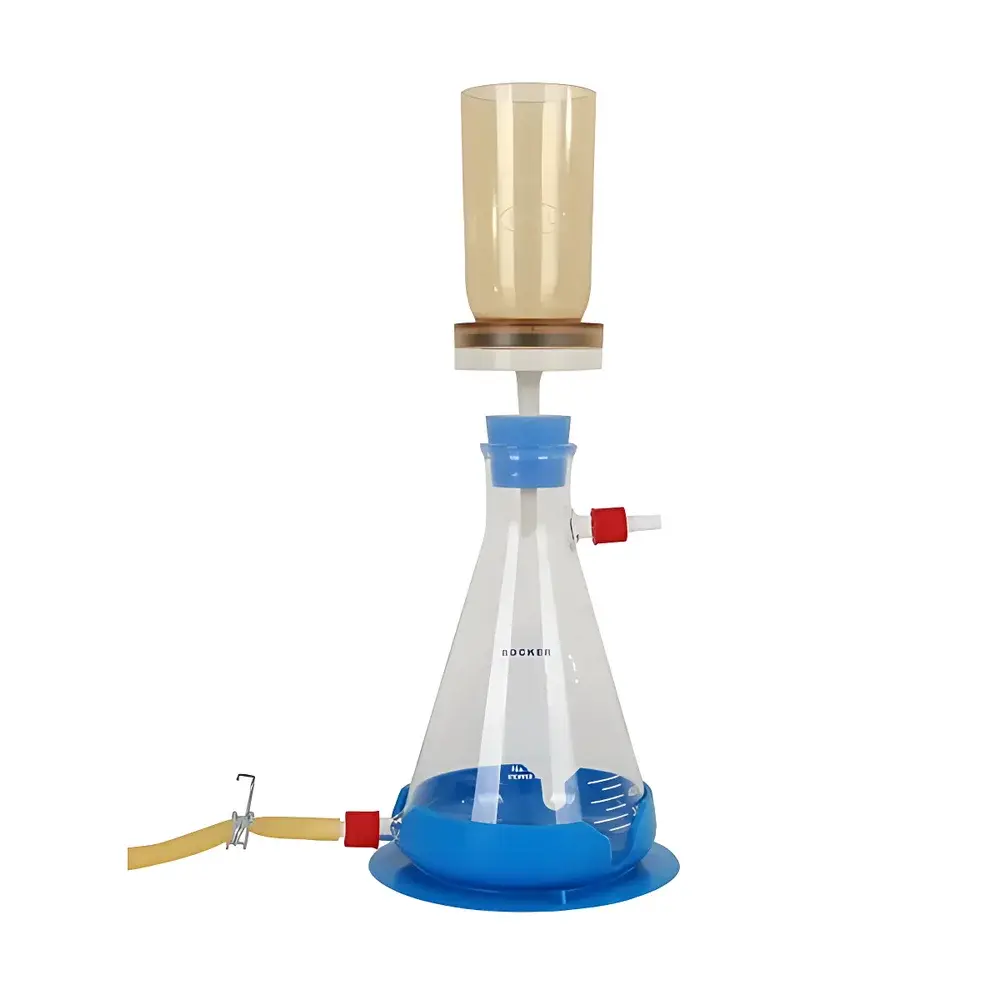
Rocker VF1 Vacuum Filtration Assembly
| Brand | Rocker |
|---|---|
| Origin | Taiwan |
| Model | VF1 |
| Funnel Capacity | 300 mL |
| Receiving Flask Capacity | 1000 mL |
| Compatible Filter Diameter | 47 mm |
| Tubing ID | 8 mm (5/16 in.) |
| Funnel Upper Cup Material | PSU |
| Funnel Base Material | PP |
| Filter Support Plate Material | PP |
| Stopper Material | Silicone (No. 16) |
| Receiving Flask Material | Borosilicate Glass |
| Magnetic Base Design | Weighted, Tool-Free Attachment |
| Drainage Mechanism | Integrated Quick-Release Valve |
| Compliance | Designed for GLP-aligned laboratory workflows |
| Packaging Includes | VF1 assembly kit (funnel, stopper, flask, magnetic base) |
Overview
The Rocker VF1 Vacuum Filtration Assembly is an engineered solution for routine and high-throughput liquid-phase separation in life science laboratories. Based on vacuum-driven dead-end filtration principles, the system enables rapid, controlled removal of suspended solids, microorganisms, and particulates from aqueous or organic solvents. Its modular architecture integrates a 300 mL magnetic funnel, a 1000 mL borosilicate glass receiving flask with integrated drainage valve, and a weighted magnetic base—eliminating reliance on clamps, stands, or external fixtures. Designed for compatibility with standard 47 mm diameter filter membranes (e.g., cellulose acetate, PVDF, PTFE), the VF1 supports both qualitative and quantitative filtration protocols across QC, bioprocessing, and environmental sample preparation applications.
Key Features
- Magnetic Tool-Free Mounting: The funnel secures to the receiving flask via embedded neodymium magnets within a reinforced polypropylene base—ensuring stable alignment under vacuum pressure up to −85 kPa without mechanical fasteners.
- Integrated Quick-Drain Valve: A precision-machined PTFE-tipped valve located at the flask base allows full waste evacuation without disassembly—reducing cross-contamination risk and enabling sequential filtration runs with minimal downtime.
- Protected Tubing Interface: The funnel’s inlet port features a recessed, strain-relieved connection geometry that prevents kinking or shearing of 8 mm ID vacuum tubing during repeated installation and pressurization cycles.
- Weighted Stability Architecture: The magnetic base incorporates high-density polymer mass distribution to resist lateral displacement during benchtop operation—critical when handling volatile solvents or performing multi-vessel setups.
- Chemically Resistant Construction: PSU (polyphenylsulfone) upper funnel body withstands repeated autoclaving (121°C, 20 min) and exposure to common solvents including ethanol, acetone, and dilute acids; borosilicate glass flask complies with ISO 3585 specifications.
Sample Compatibility & Compliance
The VF1 system accommodates diverse sample matrices—including cell culture supernatants, fermentation broths, buffer solutions, and environmental water extracts—provided viscosity remains below 20 cP and particulate load does not exceed 5% w/v. It supports membrane-based retention of particles ≥0.22 µm (sterile filtration) or ≥0.45 µm (clarification). All components meet USP Class VI biological safety requirements for non-implantable devices. While not certified as GMP equipment per se, the design facilitates audit-ready documentation: traceable part numbers (e.g., 167200-01), material certifications (PSU lot traceability, borosilicate composition reports), and compatibility with FDA 21 CFR Part 11–compliant electronic lab notebook (ELN) integration for procedural logging.
Software & Data Management
As a manually operated vacuum filtration system, the VF1 requires no embedded firmware or software drivers. However, its standardized component numbering (e.g., 167100-18 for the 300 mL funnel) enables seamless integration into inventory management systems (e.g., LabVantage, Quartzy) and digital SOP platforms. Users may log filtration parameters—including membrane type, batch number, vacuum pressure (via external gauge), volume processed, and elapsed time—in structured CSV or PDF templates aligned with ISO/IEC 17025 documentation practices. Optional Rocker vacuum pump controllers (e.g., RP-1000 series) provide analog/digital output signals for automated pressure logging.
Applications
- Sterile filtration of growth media, antibiotics, and enzyme solutions prior to cell culture use.
- Clarification of lysates and centrifuged supernatants in protein purification workflows.
- Pre-filtration of HPLC mobile phases and sample extracts to protect analytical columns.
- Environmental monitoring: suspended solids quantification in wastewater effluent per ASTM D5907.
- Pharmaceutical QC: particulate matter testing of injectables using membrane filtration per USP .
- Academic teaching labs: demonstration of vacuum physics, membrane selectivity, and fluid dynamics principles.
FAQ
Can the VF1 be used with corrosive solvents such as concentrated HCl or NaOH?
The PSU funnel body exhibits limited resistance to strong oxidizers and caustics above pH 12 or below pH 2; for such applications, Rocker recommends substituting with a PTFE-coated funnel (model VF1-PTFE, sold separately).
Is the magnetic base compatible with stainless steel or aluminum lab benches?
Yes—the base maintains secure adhesion on ferromagnetic surfaces; non-magnetic work surfaces require optional adhesive mounting pads (accessory kit #VF1-MPAD).
Does the quick-drain valve require periodic maintenance or replacement?
The valve seal is rated for ≥10,000 actuation cycles; Rocker advises inspecting the PTFE tip for deformation every 500 uses and replacing it using part #VF1-VALVE-KIT.
Can the 47 mm filter membrane be pre-sterilized in the assembled funnel?
Yes—autoclaving the fully assembled funnel (without flask) at 121°C for 20 minutes is validated; however, the silicone stopper must be removed prior to sterilization to prevent compression set.
What vacuum pump specifications are recommended for optimal VF1 performance?
A two-stage oil-lubricated pump delivering ≥40 L/min flow rate and ultimate vacuum ≤5 mbar ensures consistent filtration rates across all membrane types; diaphragm pumps are acceptable for low-viscosity aqueous samples only.




