
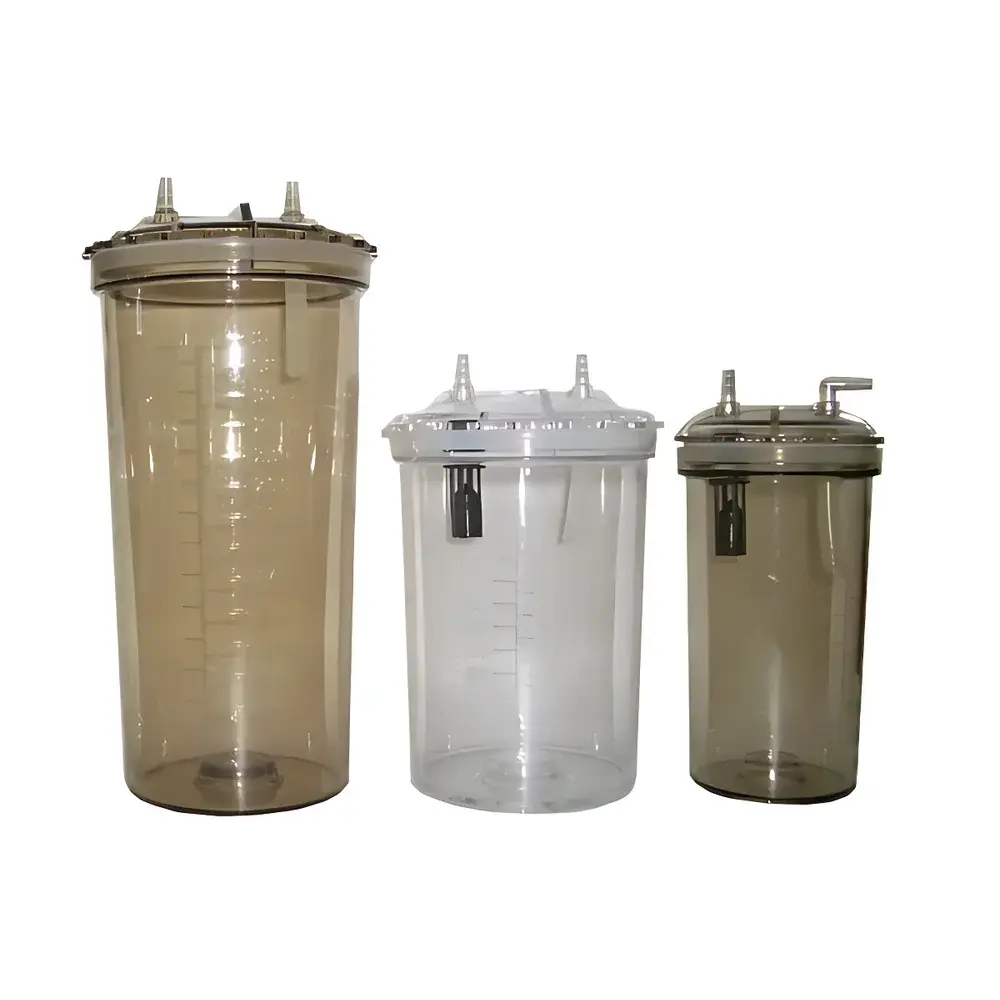
Rocker PC Waste Collection Bottle
| Brand | Rocker |
|---|---|
| Origin | Taiwan |
| Model | PC Waste Bottle |
| Capacity Options | 1000 mL, 2000 mL, 3000 mL |
| Material | Polycarbonate (bottle & cap), Silicone (O-ring), Polypropylene (overflow protection float assembly) |
| Compatible Tubing ID | 5/16 in. (8 mm) |
| Sterilization | Autoclavable at 121°C, 15 psi, 20–30 min |
| Overflow Protection | Integrated float-actuated gas-line shutoff mechanism |
| Distributor Status | Authorized Distributor |
Overview
The Rocker PC Waste Collection Bottle is an engineered component designed for integration into vacuum-driven liquid handling systems commonly deployed in life science laboratories, bioprocessing workflows, and cell culture facilities. Constructed from medical-grade polycarbonate (PC), this waste container serves as a critical interface between aspiration sources—such as vacuum filtration manifolds, centrifugal concentrators, or sterile tissue culture hoods—and vacuum pumps. Its operational principle relies on negative pressure differential to draw liquids through connected tubing into the bottle, while its integrated mechanical overflow protection system prevents pump contamination and system failure during extended or unattended operation. Unlike disposable alternatives, the Rocker PC Waste Bottle is designed for repeated use under rigorous decontamination protocols, including full-cycle autoclaving—a requirement aligned with Good Laboratory Practice (GLP) and current Good Manufacturing Practice (cGMP) environments where traceability and material integrity are essential.
Key Features
- Autoclavable Construction: Entire assembly—including bottle, cap, and O-ring—is rated for repeated sterilization at 121°C, 15 psi for 20–30 minutes without deformation, leaching, or loss of seal integrity.
- Mechanical Overflow Protection: A polypropylene float mechanism activates when liquid reaches a predefined level; upward displacement physically occludes the gas inlet port, halting further vacuum transmission and protecting downstream pumps from liquid ingress.
- Chemical & Impact Resistance: Polycarbonate body provides superior resistance to common laboratory solvents (e.g., 70% ethanol, diluted acids/bases) and mechanical shock compared to glass or acrylic alternatives.
- Precision Sealing System: Dual-seal configuration features a silicone O-ring seated within a machined groove on the cap, ensuring leak-tight performance across variable vacuum levels (up to –90 kPa typical operating range).
- Standardized Tubing Interface: Designed for secure, low-leakage connection with 5/16 in. (8 mm) ID vacuum tubing—compatible with industry-standard peristaltic and diaphragm pump manifolds.
Sample Compatibility & Compliance
The Rocker PC Waste Bottle supports collection of aqueous biological fluids (e.g., spent culture media, buffer washes, clarified lysates), mild chemical solutions, and saline-based reagents. It is not intended for highly corrosive agents (e.g., concentrated HCl, organic solvents such as chloroform or THF) or viscous suspensions exceeding 100 cP without prior dilution or filtration. The polycarbonate material complies with USP Class VI biocompatibility standards for short-term fluid contact applications. As a non-electronic, passive component, it requires no electrical certification but conforms to ISO 13485-aligned manufacturing controls under Rocker’s quality management system. Documentation packages include material traceability certificates and autoclave validation support data upon request—facilitating internal audit readiness for FDA 21 CFR Part 11–governed environments where equipment qualification records are maintained.
Software & Data Management
This is a standalone mechanical device with no embedded electronics, firmware, or software interface. Consequently, it does not generate digital logs, require calibration files, or integrate with LIMS or ELN platforms. However, its design enables seamless inclusion in validated system documentation: users may assign unique asset IDs, record sterilization cycles in logbooks, and reference batch-specific material certifications during IQ/OQ/PQ protocols. For laboratories implementing electronic recordkeeping, metadata fields (e.g., “Waste Bottle Model,” “Last Autoclave Date,” “Associated Vacuum Manifold ID”) can be mapped into existing SOP-driven tracking templates without modification.
Applications
- Vacuum-assisted filtration in molecular biology workflows (e.g., DNA/RNA purification columns, membrane filter assemblies)
- Cell culture hood waste evacuation during media changes or trypsinization steps
- Buffer exchange and diafiltration in benchtop ultrafiltration systems
- Sample preparation for HPLC, LC-MS, or NGS library construction where solvent-compatible, sterile waste containment is required
- Bioreactor harvest clarification lines requiring intermittent or continuous vacuum draw with fail-safe overflow control
FAQ
Can the Rocker PC Waste Bottle be used with aggressive organic solvents?
No. Polycarbonate exhibits limited resistance to aromatic hydrocarbons, ketones, and halogenated solvents. Use only with aqueous buffers, alcohols ≤70%, and dilute acids/bases.
Is the silicone O-ring replaceable?
Yes. Rocker supplies OEM-matched silicone O-rings (Part No. 167200-O1) for scheduled replacement after 50 autoclave cycles or visible compression set.
Does the overflow protection mechanism require maintenance or recalibration?
No. The PP float assembly operates passively via buoyancy and contains no moving parts beyond the float itself. Visual inspection for debris accumulation is recommended before each sterilization cycle.
What vacuum pressure range is compatible with this bottle?
Rated for continuous operation at –60 to –90 kPa (absolute). Transient spikes up to –95 kPa are tolerated but not recommended for prolonged use.
Are custom volume options available beyond 1000/2000/3000 mL?
Not as standard catalog items. Custom configurations may be evaluated under Rocker’s OEM engineering services program, subject to minimum order quantities and lead time assessment.



