
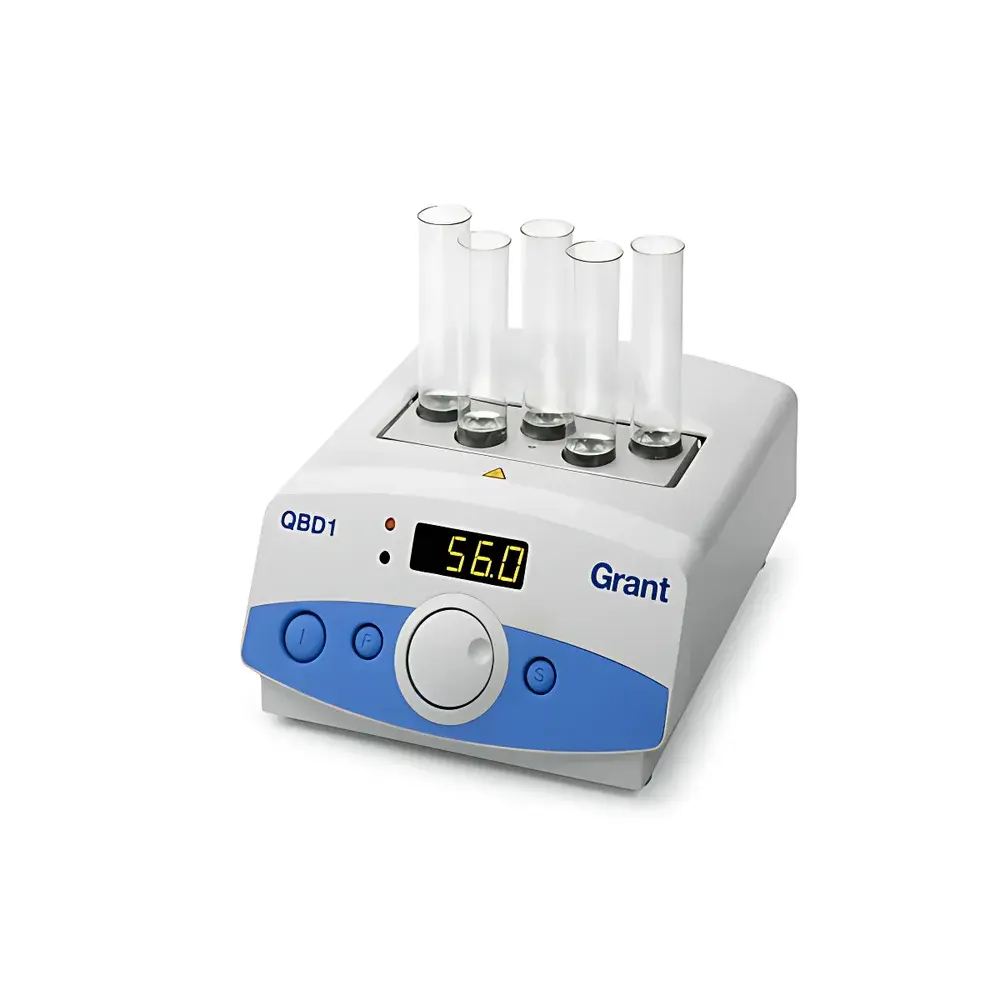

Grant QBD1 Digital Metal Bath with Temperature-Controlled Tube Holder
| Brand | Grant |
|---|---|
| Origin | UK |
| Model | QBD1 |
| Temperature Range | Ambient +5°C to 130°C |
| Temperature Accuracy | ±0.1°C @ 37°C |
| Temperature Uniformity (within module) | ±0.1°C @ 37°C |
| Set Resolution | 0.1°C |
| Heating Time | 15 min (25°C → 100°C) |
| Dimensions (W×D×H) | 230 × 200 × 100 mm |
| Net Weight | 2 kg |
| Power | 150 W |
| Voltage | 120 V or 230 V AC |
| Safety | Over-temperature cut-off fuse |
| Programmable | 3-step temperature/time profile + timer (1–999 min) + extended heating mode (up to 72 h) |
| Calibration | Dual-point (internal/external probe) |
| Alarms | Adjustable high/low temperature deviation (±0.5°C from setpoint) |
| Display | LED, 0.1°C resolution |
Overview
The Grant QBD1 Digital Metal Bath is a compact, precision-engineered dry block heater designed for consistent thermal control of sample tubes in life science, clinical diagnostics, and analytical laboratories. Unlike water baths, the QBD1 employs a solid aluminum heating block—engineered for rapid thermal response and exceptional spatial uniformity—to deliver stable, contamination-free temperature environments across a wide operational range (ambient +5°C to 130°C). Its core architecture follows the principles of conductive heat transfer through high-purity aluminum alloy, minimizing thermal gradients and ensuring reproducible incubation, enzyme activation, DNA denaturation, or reagent equilibration without evaporation or cross-contamination risks. The unit operates under microprocessor-based PID temperature regulation, enabling real-time correction against ambient drift and load-dependent thermal inertia—critical for applications requiring strict adherence to ISO/IEC 17025 or CLIA-compliant workflows.
Key Features
- Digital PID temperature control with ±0.1°C accuracy at 37°C and ±0.1°C intra-block uniformity—validated per ASTM E2209-21 for dry block performance verification.
- Three-stage programmable ramp-and-hold protocol: users define sequential temperature setpoints and dwell times (1–999 minutes each), supporting complex thermal profiles such as PCR pre-incubation or stepwise enzyme kinetics assays.
- Extended heating mode enables unattended operation up to 72 hours, with automatic power retention after brief interruptions—essential for overnight hybridization or slow-cooling protocols.
- Integrated dual-point calibration capability using both internal sensor and external reference probe (e.g., NIST-traceable RTD), fulfilling GLP documentation requirements for instrument qualification (IQ/OQ).
- Configurable audible alarm triggers when actual temperature deviates by ≥0.5°C from setpoint—customizable for both upper and lower thresholds to safeguard thermolabile samples.
- Over-temperature safety cut-off via redundant thermal fuse (independent of main controller), compliant with IEC 61010-1:2010 for laboratory electrical equipment.
- LED display with 0.1°C resolution and intuitive button navigation—designed for glove-compatible operation in biosafety cabinets or cleanroom environments.
Sample Compatibility & Compliance
The QBD1 accommodates standard tube formats—including 0.2 mL, 0.5 mL, 1.5 mL, and 2.0 mL microcentrifuge tubes—via interchangeable aluminum blocks (sold separately). Each block is CNC-machined to ISO 8573-1 tolerances for precise bore geometry and optimal thermal contact. The system meets CE marking requirements under the EU Machinery Directive 2006/42/EC and Electromagnetic Compatibility Directive 2014/30/EU. It supports audit-ready documentation for FDA 21 CFR Part 11 compliance when paired with Grant’s optional data logging software (Q-Link), which records timestamps, setpoints, actual temperatures, and alarm events with user-defined electronic signatures.
Software & Data Management
While the QBD1 operates as a standalone instrument, it is compatible with Grant’s Q-Link PC interface software (Windows only) for real-time monitoring, remote parameter adjustment, and export of time-stamped CSV datasets. All logged data includes metadata: operator ID, method name, block serial number, and environmental conditions (if connected to optional ambient sensor). Audit trails are immutable and support full traceability—aligning with ALCOA+ principles (Attributable, Legible, Contemporaneous, Original, Accurate, Complete, Consistent, Enduring, Available) required under GxP frameworks.
Applications
- Enzyme-linked immunosorbent assay (ELISA) plate pre-warming and substrate incubation.
- Thermal equilibration of restriction enzymes, ligases, and polymerases prior to reaction setup.
- Controlled denaturation of nucleic acid samples for hybridization or library preparation in NGS workflows.
- Standardization of viscosity reference standards in QC labs per ASTM D445.
- Stability testing of pharmaceutical formulations per ICH Q1A(R2) guidelines (short-term accelerated conditions).
- Cell culture reagent thawing and media pre-warming under sterile hood conditions.
FAQ
Is the QBD1 suitable for use with PCR tubes requiring precise 95°C denaturation steps?
Yes—the QBD1 achieves and maintains 95°C with ≤±0.15°C deviation over 60 minutes, verified using calibrated thermocouple mapping per ISO/IEC 17025 clause 5.10.3.
Can multiple QBD1 units be synchronized for parallel temperature programs?
No native synchronization exists; however, individual units can be operated identically via identical Q-Link configuration files—ideal for multi-lab method harmonization.
Does the QBD1 support validation documentation for ISO 13485-certified medical device manufacturing?
Yes—Grant provides Factory Acceptance Test (FAT) reports, IQ/OQ templates, and calibration certificates traceable to UKAS-accredited standards.
What maintenance is required to ensure long-term temperature fidelity?
Annual verification using an external Class A PT100 probe is recommended; no consumables or routine servicing beyond cleaning the block surface with ethanol.
Are custom block geometries available for non-standard tube formats?
Grant offers OEM block design services—lead time typically 6–8 weeks following dimensional specifications and material certification requirements.



