
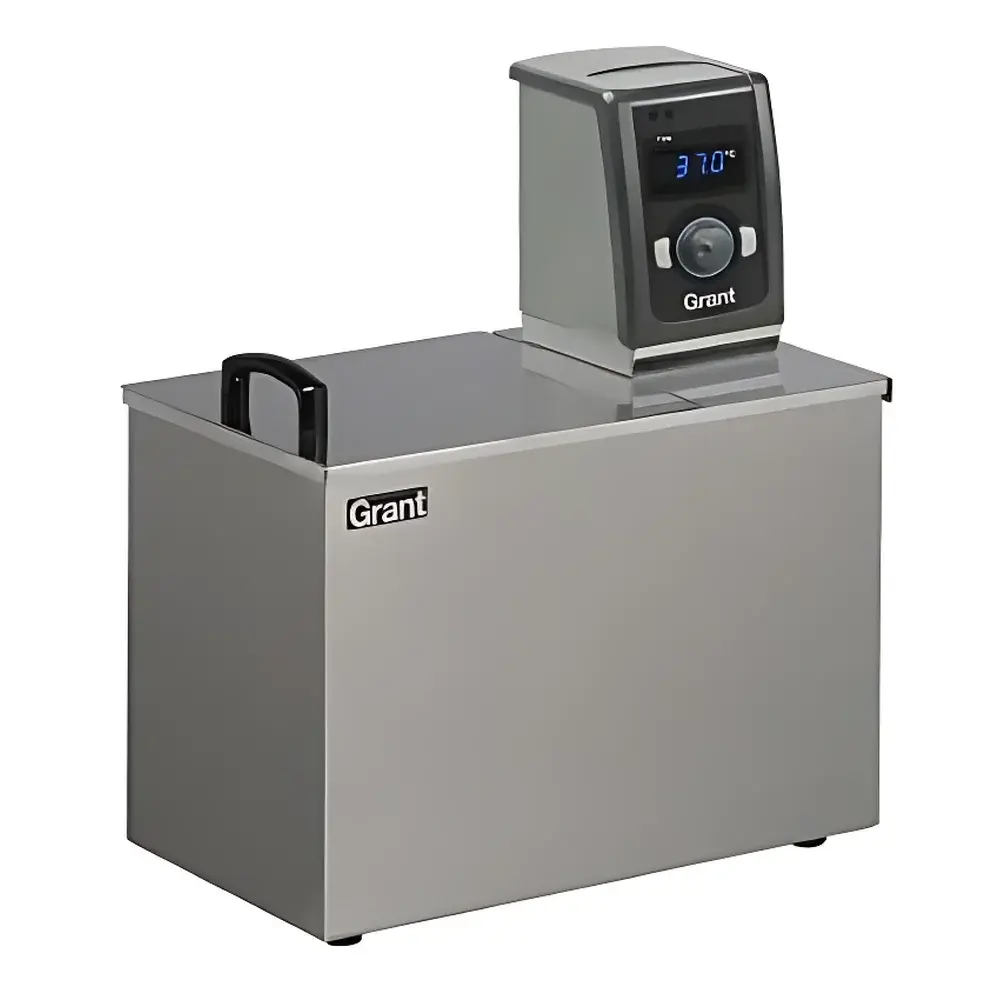
Gerber Water Bath T100-MST20
| Origin | UK |
|---|---|
| Manufacturer Type | Authorized Distributor |
| Origin Category | Imported |
| Model | T100-MST20 |
| Price | Upon Request |
| Temperature Range | RT + 5°C to 100°C |
| Temperature Stability | ±0.05°C |
| Display | 4-digit LED |
| Temperature Resolution | 0.1°C |
| Heating Power | 1.3 kW (230 V) / 1.4 kW (120 V) |
| Bath Opening | 240 × 210 mm |
| Bath Capacity | 20 L |
| Minimum/Maximum Liquid Depth | 185 / 225 mm |
| Total Power Consumption | 1.4 kW (230 V, 50/60 Hz) / 1.5 kW (120 V, 50/60 Hz) |
| Max. Gerber Fat Meter Capacity | 36 units (3 × H1-25M racks, 12 per rack) |
| Safety Features | Fixed overtemperature cut-off, low-level fluid alarm |
| Control System | Detachable digital PID controller with adaptive tuning, 3 programmable setpoints, flywheel + dual-button interface |
| Construction | Acid-resistant stainless steel inner tank and outer housing, removable stainless steel lid with ergonomic handles |
| Immersed Components | Acid-resistant heater, float switch, and Pt100 temperature sensor |
| Calibration | User-executable self-calibration routine |
Overview
The Gerber Water Bath T100-MST20 is a precision-engineered constant-temperature immersion system designed exclusively for standardized fat determination in dairy products according to the Gerber method (ISO 1211, IDF 1b, AOAC 920.117). Operating on the principle of controlled thermal equilibrium in a liquid medium, it maintains a stable, uniform bath temperature across its full working volume—critical for consistent hydrolysis and separation of milk fat in Gerber lactometers. Unlike generic water baths, the T100-MST20 integrates application-specific engineering: optimized bath geometry for full submersion of Gerber tubes, acid-resistant wetted materials compatible with concentrated sulfuric acid (≥96%) and amyl alcohol reagents, and calibrated thermal inertia to minimize overshoot during setpoint transitions. Its temperature stability of ±0.05°C at setpoints between RT + 5°C and 100°C meets the repeatability requirements of ISO/IEC 17025-accredited dairy testing laboratories.
Key Features
- Application-optimized bath dimensions (240 × 210 mm opening, 20 L capacity, 185–225 mm adjustable liquid depth) accommodate three H1-25M universal racks—totaling 36 Gerber fat meters—with full vertical immersion of the graduated neck.
- Detachable digital PID controller with adaptive tuning algorithm ensures rapid thermal equilibration and long-term drift compensation; supports three user-programmable temperature setpoints for multi-step assay protocols.
- All immersed components—including heating element, float-level switch, and Pt100 Class A temperature sensor—are constructed from acid-resistant alloys (e.g., Hastelloy C-276 cladding or equivalent), validated for continuous exposure to Gerber reagent mixtures without degradation.
- Robust 304 stainless steel inner tank and reinforced outer housing provide structural integrity under repeated thermal cycling; removable stainless steel lid with integrated ergonomic handles enables safe handling during high-temperature operation.
- Dual safety architecture: hardware-based fixed overtemperature cut-off (independent of control electronics) and software-monitored low-fluid-level alarm prevent dry-heating and thermal runaway.
- User-executable self-calibration routine allows on-site verification of temperature accuracy against traceable NIST-traceable reference thermometers—supporting internal audit readiness and GLP compliance.
Sample Compatibility & Compliance
The T100-MST20 is validated for use with standard Gerber lactometers (DIN 10126-1, ISO 1211), including glass tubes conforming to 10 mL and 20 mL nominal volumes. Its acid-resistant construction complies with material compatibility requirements specified in ISO 17025 Clause 6.4.2 for equipment used in corrosive chemical environments. The bath’s thermal performance adheres to ASTM E1112 (Standard Specification for Constant-Temperature Liquid Baths) for stability and uniformity. It supports laboratory accreditation under ISO/IEC 17025, FDA 21 CFR Part 11 (when paired with compliant data logging systems), and EU Regulation (EC) No 882/2004 for official feed and food controls.
Software & Data Management
While the T100-MST20 operates as a standalone analog-digital hybrid instrument, its controller features RS-232 serial output (optional adapter available) for integration with LIMS or electronic lab notebooks. Temperature logs—including setpoint, actual reading, alarm status, and calibration timestamps—can be exported in CSV format. The user self-calibration function generates a dated, signed calibration record that satisfies internal quality documentation requirements. Audit trails are maintained locally via non-volatile memory, supporting GxP-aligned record retention policies.
Applications
- Routine fat quantification in raw milk, pasteurized milk, cream, whey, and fermented dairy products per Gerber methodology.
- Validation and verification of fat-testing workflows in dairy processing QA/QC labs and third-party certification bodies.
- Reference temperature source for calibrating secondary thermometers used in dairy analysis.
- Controlled thermal conditioning of reagents and standards prior to Gerber assay execution.
- Supporting interlaboratory comparison studies requiring metrologically traceable thermal environments.
FAQ
What standards does the T100-MST20 comply with for dairy fat testing?
It supports ISO 1211, IDF 1b, AOAC 920.117, and national implementations such as GB 5413.3–2010 and EN ISO 1211:2010.
Can the bath be used with non-Gerber sample formats?
Yes—its open bath geometry and broad temperature range support general-purpose incubation, but acid resistance and rack compatibility are optimized for Gerber tubes.
Is the self-calibration function traceable to national standards?
The procedure requires a NIST-traceable reference thermometer; calibration records include operator ID, date, reference value, and deviation—sufficient for ISO/IEC 17025 documentation.
How is acid resistance verified during manufacturing?
Each unit undergoes 72-hour accelerated immersion testing in 96% H₂SO₄ + amyl alcohol (1:1 v/v) at 65°C; post-test inspection confirms zero pitting, discoloration, or dimensional change in wetted surfaces.
What maintenance intervals are recommended for GLP-compliant operation?
Daily visual inspection of fluid level and lid seal; quarterly verification of temperature uniformity across bath volume using 9-point mapping; annual recalibration of the Pt100 sensor by an accredited metrology lab.



