
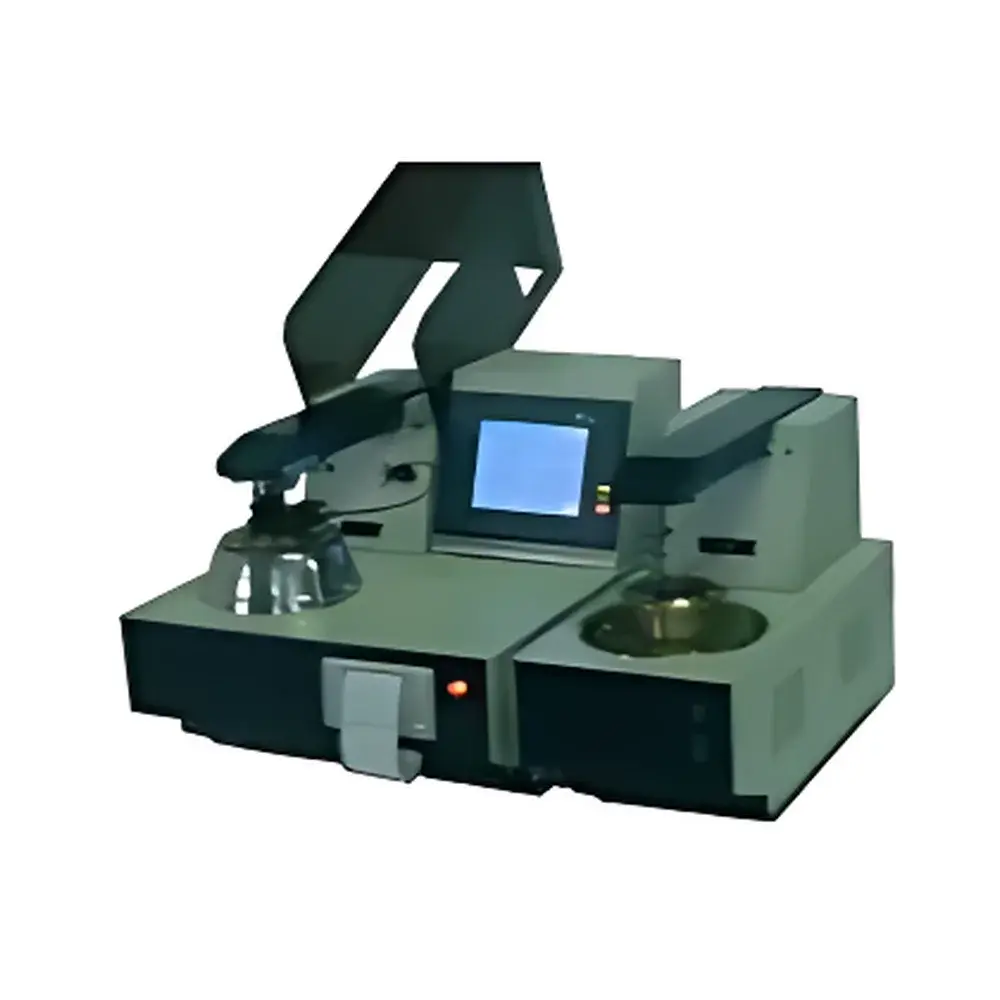
Xufeng XF-2S Dual-Cup Automated Flash Point Tester (Open Cup & Closed Cup)
| Brand | Xufeng |
|---|---|
| Origin | Shanghai, China |
| Model | XF-2S |
| Detection Method | Closed-Cup Method |
| Temperature Control Accuracy | ±0.1 °C |
| Operating Temperature Range (Closed Cup) | 0–300 °C |
| Operating Temperature Range (Open Cup) | 0–400 °C |
| Compliance | ASTM D56, ASTM D92, ASTM D93, GB/T 261-2008, GB/T 3536-2008, GB/T 21929-2008, GB/T 267 |
| Display | Large LCD Screen |
| Data Output | Built-in Dot-Matrix Printer |
| Interface | RS-232C Serial Port |
| Power Consumption | 800 W × 2 |
| Dimensions (W×D×H) | 400 × 380 × 350 mm |
| Weight | ~20 kg |
Overview
The Xufeng XF-2S Dual-Cup Automated Flash Point Tester is a benchtop, dual-furnace analytical instrument engineered for precise and repeatable flash point determination across multiple standardized test methods—including closed-cup (ASTM D56, ASTM D93, GB/T 261, GB/T 21929) and open-cup (ASTM D92, GB/T 3536, GB/T 267) protocols. It operates on the fundamental principle of controlled heating and ignition source interaction with volatile vapors above a liquid sample surface, detecting the lowest temperature at which vapor-air mixture ignites under defined atmospheric and geometric conditions. Designed for laboratories requiring method flexibility without hardware reconfiguration, the XF-2S integrates two independent thermal zones—each with programmable ramp rates, target temperatures, and detection logic—enabling simultaneous or sequential execution of distinct flash point procedures. Its architecture complies with international safety and metrological requirements for petroleum product testing, supporting regulatory workflows in refinery QC, aviation fuel certification, lubricant formulation, and third-party inspection laboratories.
Key Features
- Dual independent test furnaces permit concurrent operation of two different flash point methods—e.g., ASTM D93 and GB/T 3536—without cross-contamination or thermal interference.
- Five standardized test modes pre-configured: Pensky-Martens closed cup (ASTM D93/GB/T 261), Cleveland open cup (ASTM D92/GB/T 3536), Tag closed cup (ASTM D56/GB/T 21929), standard open cup (GB/T 267), and specialized low-temperature Tag mode with optional Peltier cooling (down to 0 °C).
- High-precision temperature control: ±0.1 °C stability over full ranges—0–300 °C for closed-cup modes, 0–400 °C for open-cup modes—achieved via PID-regulated stainless-steel heating blocks and calibrated Pt100 sensors.
- Two ignition options: user-selectable electronic spark ignition (no external gas supply required) or traditional pilot flame using LPG/propane (with integrated pressure regulator and safety shutoff).
- Flame ionization detection (FID) for open-cup tests and high-sensitivity thermocouple-based vapor ignition sensing for closed-cup tests ensure reliable, low-noise endpoint identification.
- Self-diagnostic system monitors heater status, sensor integrity, gas flow (if applicable), lid closure, and ignition sequence—triggering real-time alerts and halting operation upon fault detection.
- RS-232C interface supports bidirectional communication with LIMS or central QA servers; data export includes timestamp, method ID, ambient pressure correction factor, observed flash point, and operator ID.
Sample Compatibility & Compliance
The XF-2S accommodates standard ASTM and ISO-compliant sample cups—including Pensky-Martens, Cleveland, Tag, and modified Tag vessels—with automatic cup recognition logic based on thermal response profiling. It accepts liquid hydrocarbon samples with viscosities up to 150 cSt at 40 °C and volatility ranges spanning light naphthas to heavy residual fuels. All operational parameters adhere strictly to the procedural constraints defined in ASTM D56-22, ASTM D92-22, ASTM D93-22, GB/T 261-2008, GB/T 3536-2008, GB/T 21929-2008, and GB/T 267-88. The instrument’s design meets mechanical safety requirements per IEC 61010-1 for laboratory electrical equipment and incorporates pressure-compensated algorithms aligned with ASTM E1861 for barometric correction. Routine calibration verification follows ASTM D6413 guidelines using certified reference materials traceable to NIST SRMs.
Software & Data Management
The embedded firmware implements audit-trail functionality compliant with FDA 21 CFR Part 11 principles: all parameter changes, test initiations, result modifications, and system events are time-stamped, user-logged, and non-erasable within internal memory. Each test record stores raw thermal profiles (temperature vs. time), ignition event timestamps, and calculated flash points with uncertainty estimates derived from repeatability studies per ISO 4256. Up to 100 test results per method can be stored locally; data retrieval is accessible via front-panel navigation or remote query through ASCII command protocol. Optional PC software provides graphical trend analysis, batch reporting (PDF/CSV), and integration with enterprise quality management systems (QMS) via ODBC drivers.
Applications
- Refinery process control: real-time flash point verification of crude cuts, gasoline blends, jet fuels (Jet A-1, JP-8), and diesel fractions.
- Aerospace maintenance: compliance testing of hydraulic fluids, turbine oils, and de-icing fluids per SAE AS5780 and MIL-PRF-23699 specifications.
- Power generation: insulation oil monitoring in transformers per IEEE C57.106 and IEC 60156.
- Regulatory submission: generation of GLP-compliant reports for customs clearance (e.g., UN GHS Category 2/3 classification) and EPA fuel registration dossiers.
- R&D laboratories: comparative volatility screening during additive development or biofuel blend optimization.
FAQ
Does the XF-2S support both manual and automated pressure correction?
Yes—ambient atmospheric pressure is either entered manually or measured via an optional integrated digital barometer; all flash point calculations apply automatic correction per ASTM E1861.
Can the instrument perform ASTM D93 and ASTM D92 simultaneously?
Yes—the dual-furnace architecture allows fully independent execution of one closed-cup and one open-cup test in parallel, with separate temperature ramps and detection logic.
Is electronic ignition compatible with all test methods?
Electronic spark ignition is supported for all closed-cup methods (ASTM D56, D93, GB/T 261, GB/T 21929); open-cup methods (ASTM D92, GB/T 3536, GB/T 267) require pilot flame ignition unless modified with custom FID-compatible spark modules.
What is the minimum sample volume required per test?
Standard Pensky-Martens cup: 70 mL; Cleveland cup: 75 mL; Tag cup: 50 mL—volumes conform to respective ASTM and GB standards.
How is calibration verified and maintained?
Calibration is performed using certified flash point standards (e.g., n-decane, n-dodecane, tetralin) traceable to NIST; verification intervals follow ISO/IEC 17025 recommendations and internal SOPs—typically before each shift or after 20 consecutive tests.




