
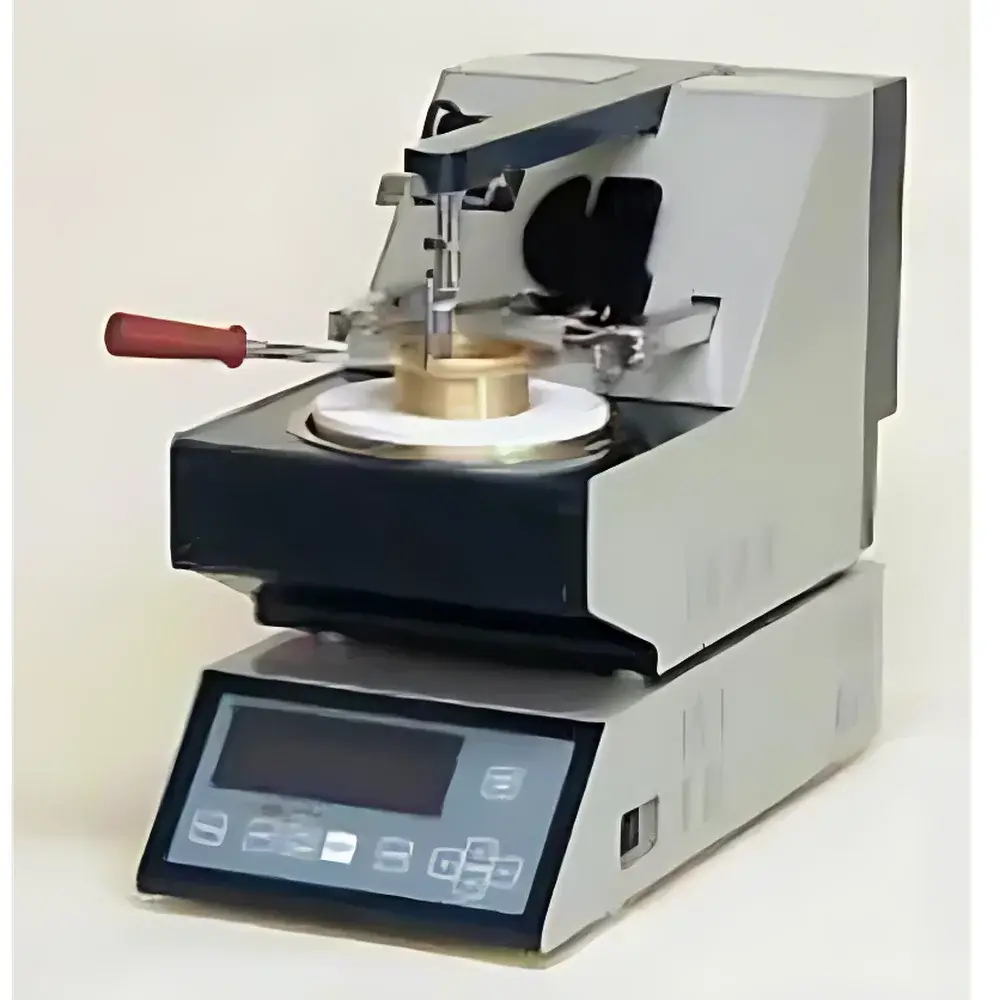
Xufeng FP92 Automated Cleveland Open Cup (COC) Flash Point Tester
| Brand | Xufeng |
|---|---|
| Origin | Shanghai, China |
| Model | FP92 |
| Detection Method | Cleveland Open Cup (ASTM D92 / ISO 2592) |
| Operation Mode | Fully Automatic |
| Temperature Range | 80–400 °C |
| Ignition Method | Fully Automatic Gas Flame |
| Compliant Standards | GB/T 3536-2022, ISO 2592:2021, ASTM D92-22, IP 36/07, JIS K 2265:2014 |
| Display | VFD Fluorescent Screen |
| Temperature Sensor | Pt100 Platinum Resistance Thermometer |
| Flash Detection | Ionization Ring (O-Ring Type) |
| Fire Point Capability | Yes (FIRE Mode with Integrated Extinguishing Function) |
| Pressure Compensation | Manual (ACOC) or Auto (ACOCH) |
| Data Storage | 50 Test Records |
| Interface | RS-232C Serial Port |
| Power Supply | AC 230 V, 50 Hz, 1000 W |
| Dimensions | 231 × 456 × 386 mm (W × D × H) |
| Net Weight | 20 kg |
Overview
The Xufeng FP92 Automated Cleveland Open Cup (COC) Flash Point Tester is an engineered solution for precise, repeatable flash point determination of petroleum products—including lubricating oils, bituminous materials, and heavy fuel oils—according to internationally recognized open-cup methodologies. Based on the Cleveland Open Cup principle (defined in ASTM D92, ISO 2592, and GB/T 3536), the instrument heats a standardized brass test cup under controlled conditions while introducing a calibrated flame at prescribed intervals. Flash point is identified when the vapor-air mixture above the sample ignites momentarily upon exposure to the flame—a thermodynamic threshold critical for safety classification, transportation regulation (e.g., UN TDG Class 3), and quality control in refinery, petrochemical, and asphalt production environments. The FP92 implements a closed-loop microcontroller (MCU)-driven thermal ramp profile, ensuring compliance with required heating rates (e.g., 5–6 °C/min up to 200 °C, then 2–3 °C/min thereafter per ASTM D92). Its architecture integrates real-time ionization-based flame detection, eliminating subjective visual interpretation and enhancing measurement objectivity.
Key Features
- Fully automated test execution: Pre-set expected flash point initiates full sequence—controlled heating, timed flame application, ionization-triggered detection, audible end-of-test alert, and forced-air cooling.
- Ionization ring flash detection system: O-ring geometry ensures stable, low-noise signal acquisition; field-replaceable and solvent-cleanable without calibration drift.
- Dual-mode operation: Standard mode for known-sample testing and SEP (Screening & Estimation Protocol) mode for unknown or highly viscous samples requiring adaptive temperature ramping.
- Integrated fire point measurement: After flash point confirmation, activation of FIRE mode triggers automatic flame application at increasing 2 °C increments until sustained ignition (>5 s), followed by immediate gas cutoff via solenoid valve.
- Barometric pressure compensation: Manual input (ACOC configuration) or auto-sensed correction (ACOCH configuration) adjusts flash point calculation per ISO 2592 Annex A, improving accuracy across elevation zones.
- Safety-critical interlocks: Thermal runaway protection halts heating if sample exceeds preset flash point by >30 °C or reaches 400 °C; fault logging covers Pt100 sensor failure, ionization circuit error, fuse blowout, or MCU watchdog timeout.
- VFD display with persistent result lock: High-contrast fluorescent screen retains final flash/fire point values post-test; simultaneous dual-temperature display available during FIRE mode.
Sample Compatibility & Compliance
The FP92 accommodates standard Cleveland Open Cup (COC) test cups per ASTM D92 and ISO 2592 specifications, supporting both liquid hydrocarbons (e.g., base oils, residual fuels) and semi-solid bituminous binders when configured as FP92B (ACOCH variant). Its thermal design enables uniform cup wall heating and minimizes thermal lag, essential for reproducible results in high-viscosity matrices. All operational parameters—including heating rate profiles, flame dwell time, sweep frequency, and ignition timing—are programmatically aligned with the latest revisions of GB/T 3536-2022, ISO 2592:2021, ASTM D92-22, IP 36/07, and JIS K 2265:2014. The instrument supports GLP-compliant workflows through RS-232C data export, enabling traceable record generation for internal audit or regulatory submission (e.g., EPA, DOT, or EU REACH documentation).
Software & Data Management
While the FP92 operates as a standalone unit with embedded firmware, its RS-232C serial interface allows integration into laboratory information management systems (LIMS) or custom QA/QC software via ASCII protocol. Each test record includes timestamp, sample ID (user-input), ambient pressure, observed flash point, fire point (if measured), and system status flags. Fifty test results are retained in non-volatile memory with overwrite protection. Exported data conforms to ASTM E1382-18 guidelines for digital flash point reporting and may be parsed for statistical process control (SPC) analysis—supporting trends monitoring, repeatability assessment (per ISO 4256), and method validation per ISO/IEC 17025 requirements. No proprietary drivers or cloud dependency is required; communication uses standard null-modem configuration at 9600 baud, 8N1.
Applications
- Refinery QC labs verifying flash point compliance of lubricants, hydraulic fluids, and transformer oils against ASTM D92 and GB/T 3536 pass/fail limits.
- Asphalt production facilities assessing binder safety thresholds prior to hot-mix manufacturing (FP92B variant with enhanced cup preheat and extended ramp stability).
- Third-party testing laboratories performing accredited flash point determinations under ISO/IEC 17025 scope, including uncertainty budgeting per EURACHEM/CITAC Guide CG4.
- Regulatory agencies conducting surveillance testing of fuel shipments per UN Manual of Tests and Criteria, Part III, Section 32.3.
- R&D departments evaluating thermal stability of bio-based lubricants or synthetic esters where conventional closed-cup methods underestimate hazard potential.
FAQ
What standards does the FP92 fully support?
The FP92 complies with ASTM D92-22, ISO 2592:2021, GB/T 3536-2022, IP 36/07, and JIS K 2265:2014 for Cleveland Open Cup flash point testing.
Can the FP92 measure fire point automatically?
Yes—after flash point detection, pressing START again activates FIRE mode, which performs incremental flame application and automatic flame cutoff upon sustained ignition.
Is barometric pressure compensation mandatory?
Not mandatory, but strongly recommended for accuracy; manual entry is supported in ACOC configuration, while ACOCH adds integrated pressure sensing and real-time correction.
What safety certifications apply to the FP92?
The instrument meets IEC 61010-1:2010 requirements for electrical safety in laboratory equipment and incorporates redundant thermal fusing, gas shutoff, and fault-logging per EN 61508 SIL1 principles.
How is data exported for audit purposes?
Via RS-232C port using ASCII-formatted strings; output includes test ID, date/time, flash/fire points, pressure value, and system error codes—compatible with CSV import into LIMS or Excel-based QA tracking.





