
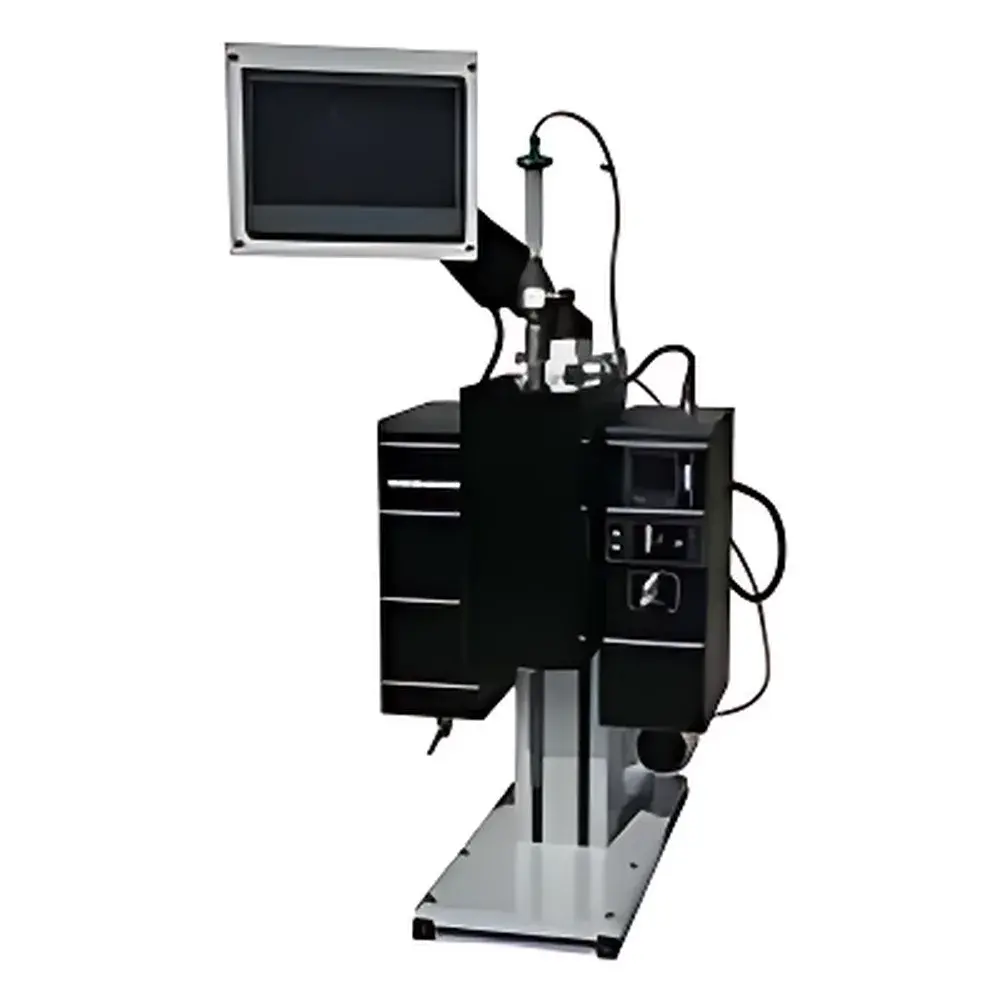
Xufeng XF-5481 HTHS High-Temperature High-Shear Dynamic Viscosity Tester (Multicell Capillary Viscometer)
| Brand | Xufeng |
|---|---|
| Origin | Shanghai, China |
| Model | XF-5481 |
| Instrument Type | Multicell Capillary Viscometer |
| Viscosity Range | 2–7 mPa·s (cP) |
| Test Temperature | Up to 150 °C ±0.1 °C |
| Capillary Diameter | 0.15 mm |
| Capillary Length | 15–18 mm |
| Pressure Range | 350–3500 kPa (±0.1% control accuracy) |
| Sample Volume | 7–10 mL |
| Power Supply | AC 220 V, 50 Hz |
| Dimensions (L×W×H) | 420 × 360 × 830 mm |
| Weight | 26 kg |
| Compliant Standards | ASTM D5481, SH/T 0703 |
Overview
The Xufeng XF-5481 HTHS High-Temperature High-Shear Dynamic Viscosity Tester is a precision-engineered multicell capillary viscometer designed to determine the apparent dynamic viscosity of lubricating oils under rigorously controlled high-temperature and high-shear-rate conditions—specifically at 150 °C and shear rates approximating 10⁶ s⁻¹. This measurement directly yields the High-Temperature High-Shear (HTHS) viscosity value, a critical rheological parameter defined in ASTM D5481 and SH/T 0703 for evaluating oil performance in modern engine bearings, particularly under boundary-lubrication regimes where film strength and resistance to shear thinning are decisive. The instrument operates on the principle of pressure-driven flow through calibrated fused-silica capillaries; viscosity is calculated from measured efflux time, applied nitrogen or CO₂ pressure, capillary geometry, and fluid density—using the Hagen–Poiseuille relationship adapted for non-Newtonian correction where required. Its design reflects strict adherence to metrological traceability requirements, with all capillaries manufactured to ASTM-specified dimensional tolerances (0.15 mm ID, 15–18 mm length) and certified via NIST-traceable reference oils.
Key Features
- Thermostatically stabilized test chamber with ±0.1 °C accuracy at 150 °C, achieved via high-reliability imported heating rods and dual-stage PID feedback control.
- High-precision pressure regulation system (350–3500 kPa, ±0.1% full-scale accuracy), enabling reproducible shear rate generation across the full HTHS range.
- Single-unit multicell capillary assembly constructed from U.S.-sourced borosilicate glass capillaries, fully compliant with ASTM D5481 dimensional specifications.
- Integrated Windows-based HTHS calculation software with automated pressure recommendation, real-time flow monitoring, and built-in calibration curve management per capillary cell.
- No solvent cleaning required: post-test purge uses only 1–2 mL of fresh sample, minimizing operator intervention and cross-contamination risk.
- Robust aluminum chassis (420 × 360 × 830 mm) with industrial-grade thermal insulation and EMI-shielded electronics for continuous 24/7 operation under GLP-compliant laboratory conditions.
- 10.1-inch capacitive touchscreen interface displaying live temperature, pressure, elapsed time, flow status, and real-time viscosity trend—fully configurable for multi-user access control.
- Full audit trail capability: software logs all parameter changes, test start/stop events, calibration updates, and user actions in timestamped format—supporting FDA 21 CFR Part 11 compliance when deployed with validated IT infrastructure.
Sample Compatibility & Compliance
The XF-5481 accommodates both Newtonian and non-Newtonian lubricant formulations, including mineral oils, synthetic polyalphaolefins (PAOs), ester-based fluids, and formulated engine oils (e.g., SAE 0W-20, 5W-30). It is validated for use with ASTM-certified reference standards (e.g., Chevron HTNN-1, HTNN-2) and commercially available calibration oils traceable to NIST SRMs. All testing procedures conform strictly to ASTM D5481 – 13 and SH/T 0703–2001, ensuring data interoperability with global OEM specifications (e.g., API SP, ILSAC GF-6, ACEA C6). The instrument meets IEC 61000-4 electromagnetic compatibility requirements and is rated for Installation Category II, Pollution Degree 2 environments (15–30 °C, RH ≤75%, non-condensing).
Software & Data Management
The proprietary HTHS Calculation Software (v3.2, Windows 10/11 compatible) provides full workflow automation—from method setup and pressure optimization to raw data reduction and report generation. Each test session automatically records pressure, temperature, efflux time, dwell time, and calculated viscosity (mPa·s). Results are exportable in native Excel (.xlsx) format with embedded metadata (operator ID, instrument serial number, calibration date, standard used). The software supports multi-point calibration using up to six certified reference oils, with polynomial fitting (R² ≥ 0.9999) for pressure–viscosity interpolation. Audit logs are encrypted and tamper-evident, satisfying GLP/GMP documentation requirements for regulated laboratories.
Applications
- Quality control of finished engine oils against OEM HTHS specifications (e.g., minimum 2.6 mPa·s at 150 °C/10⁶ s⁻¹ for low-viscosity grades).
- R&D evaluation of base stock shear stability and additive package efficacy under simulated bearing shear conditions.
- Regulatory compliance testing for API licensing and JASO DL-1 certification.
- Formulation screening for low-HSAP (High Shear Absorption Potential) lubricants targeting fuel economy and emission reduction.
- Root-cause analysis of viscosity loss in field-failed oils via comparative HTHS trending.
FAQ
What standards does the XF-5481 comply with?
ASTM D5481 – 13 and SH/T 0703 – 2001 are fully implemented in hardware design, software algorithms, and calibration protocols.
Is nitrogen the only acceptable pressurizing gas?
No—CO₂ may also be used; both gases must be supplied at ≥3500 kPa with integrated pressure-reducing regulators meeting ISO 8573-1 Class 2 purity requirements.
How often must capillaries be recalibrated?
Capillaries are factory-calibrated and require no routine recalibration; verification is performed annually using certified reference oils per ASTM D5481 Section 8.4.
Can the instrument operate unattended overnight?
Yes—designed for continuous duty with thermal runaway protection, pressure fault shutdown, and automatic cooldown sequencing.
Does the software support LIMS integration?
Yes—via configurable CSV/Excel export templates and optional OPC UA server module (hardware-dependent) for direct connection to enterprise laboratory information management systems.



