
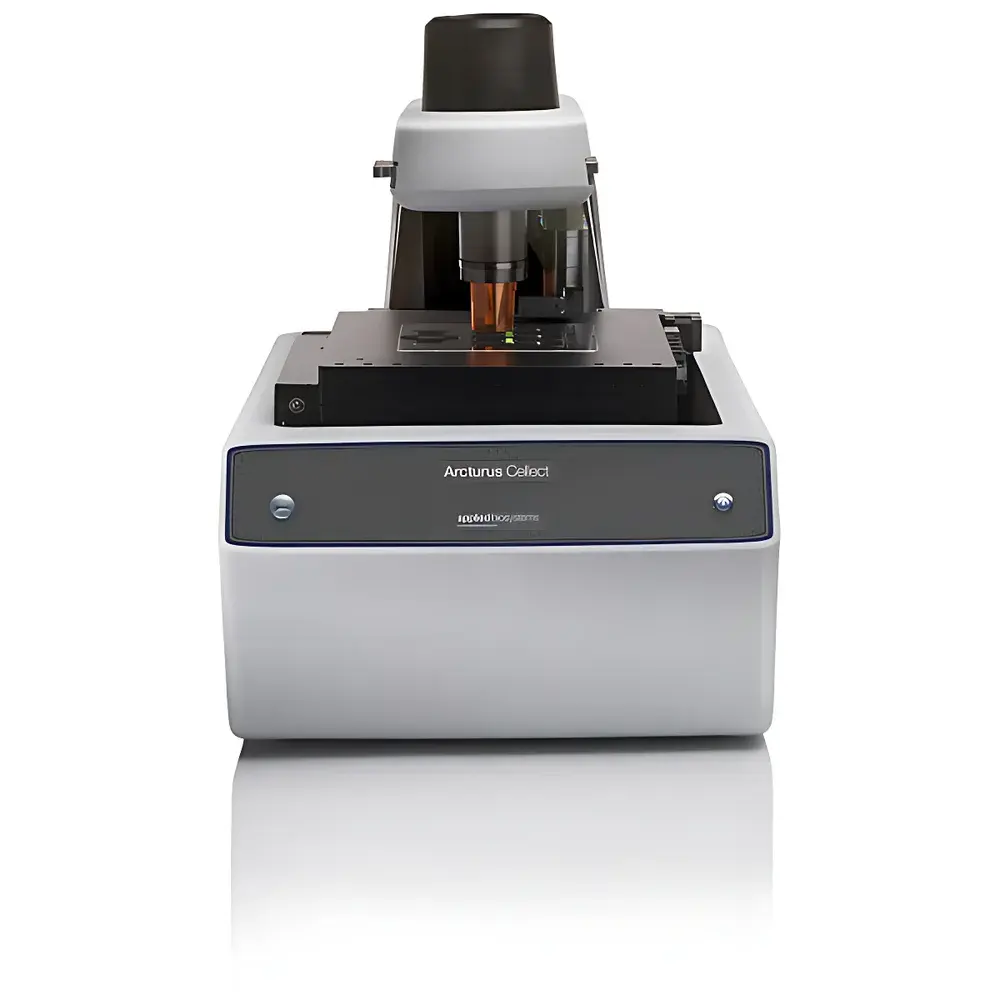
Thermo Fisher Scientific Arcturus Cellect Laser Capture Microdissection System
| Brand | Thermo Fisher Scientific |
|---|---|
| Origin | USA |
| Manufacturer | Thermo Fisher Scientific |
| Import Status | Imported |
| Model | LCM |
| Separation Method | Automated |
| Dimensions | Compact design (32% smaller footprint vs. comparable LCM platforms) |
| Laser Configuration | Dual-solid-state laser system (IR capture + UV cutting) |
| Software | Arcturus LCM Software (5-step workflow, full instrument control, QC-integrated imaging, audit-ready metadata logging) |
Overview
The Thermo Fisher Scientific Arcturus Cellect Laser Capture Microdissection (LCM) System is an engineered platform for precise, contamination-free isolation of morphologically defined cell populations directly from heterogeneous tissue sections under microscopic visualization. Built upon the foundational principles of infrared (IR) laser-induced thermoplastic polymer activation and ultraviolet (UV) laser ablation, the system enables spatially resolved molecular analysis without compromising cellular integrity or introducing mechanical artifacts. Unlike contact-based microdissection methods, Arcturus Cellect employs a non-contact, dual-laser architecture: a solid-state 1480 nm IR laser selectively activates ethylene-vinyl acetate (EVA)–coated caps to adhere target cells, while a high-precision 355 nm UV laser performs clean, sub-micron incisions in dense or calcified tissues. This orthogonal laser strategy ensures compatibility across diverse sample types—from frozen and FFPE sections to thick decalcified bone or lipid-rich brain tissue—while preserving native RNA, DNA, and protein conformation for downstream omics workflows.
Key Features
- Dual-Solid-State Laser Architecture: Independent IR capture (1480 nm) and UV cutting (355 nm) lasers operate with synchronized optical path control, enabling simultaneous adhesion and sectioning without thermal cross-talk or morphological distortion.
- Compact Benchtop Form Factor: Engineered for space-constrained core facilities; occupies 32% less bench area than legacy LCM platforms while maintaining full optical resolution and motorized stage precision.
- Arcturus LCM Software Suite: A validated, Windows-based application supporting FDA 21 CFR Part 11–compliant audit trails, timestamped image capture, QC overlay annotation, and automated metadata tagging (slide ID, operator, date/time, laser parameters, ROI coordinates).
- Universal Slide Compatibility: Supports standard glass slides, PEN-membrane slides, metal-frame non-contact membranes, and sterile culture dishes—enabling integration with histopathology, live-cell imaging, and co-culture workflows.
- Workflow Flexibility: Compatible with routine H&E, immunohistochemistry (IHC), and fluorescence staining protocols; validated for use with RNase-free, protease-inhibitor–treated preparations per ISO 15189 and CLIA guidelines.
Sample Compatibility & Compliance
The Arcturus Cellect system accommodates a broad spectrum of specimen formats, including formalin-fixed paraffin-embedded (FFPE) tissue sections (4–10 µm), cryosections (5–20 µm), cytospins, blood smears, and even intact organotypic cultures. Its IR capture mechanism maintains nucleic acid integrity—validated by >95% full-length mRNA recovery in post-LCM qRT-PCR assays—and its UV ablation yields clean edges with minimal charring (<1 µm heat-affected zone), critical for mass spectrometry imaging (MSI) and spatial proteomics. The platform meets essential regulatory expectations for clinical and translational research: software supports electronic signatures, session logs, and change history tracking aligned with GLP/GMP documentation standards. All consumables—including EVA-coated caps and PEN membrane slides—are manufactured under ISO 13485-certified processes and supplied with CoA documentation.
Software & Data Management
Arcturus LCM Software implements a five-stage operational sequence: (1) slide registration and focus calibration, (2) ROI selection via annotated digital preview, (3) laser parameter assignment (pulse energy, dwell time, spot size), (4) cap transfer and bonding verification via real-time IR reflectance imaging, and (5) automated collection confirmation with thumbnail archive. Every step generates machine-readable metadata embedded in TIFF/OME-TIFF files, exportable to LIMS or ELN systems via standardized XML schema. The software includes built-in QC tools: contrast-enhanced overlay masks, automatic ROI boundary validation, and pixel-level intensity histograms for stain uniformity assessment. All user actions are logged with operator ID, timestamp, and parameter set hash—ensuring traceability for ISO/IEC 17025 accreditation audits.
Applications
- Single-cell and small-population transcriptomics (scRNA-seq, targeted NGS panels)
- Spatially resolved proteomic profiling via LC-MS/MS following on-cap digestion
- Mutation detection in tumor subclones isolated from heterogeneous glioblastoma or melanoma biopsies
- Neurodegenerative disease research: selective isolation of tau-positive neurons from Alzheimer’s-affected hippocampal sections
- Developmental biology: lineage-specific cell harvesting from embryonic tissue sections for ATAC-seq and ChIP-qPCR
- Clinical biomarker discovery: enrichment of circulating tumor cells (CTCs) from stained cytology preparations
FAQ
What laser wavelengths does the Arcturus Cellect system use, and why are they selected?
The system uses a 1480 nm infrared laser for gentle, non-destructive cell capture via localized EVA polymer melting, and a 355 nm ultraviolet laser for high-resolution ablation of tough or mineralized tissues—both solid-state sources ensure long-term stability and minimal maintenance.
Is the software compliant with FDA 21 CFR Part 11 requirements?
Yes—Arcturus LCM Software includes electronic signature capability, audit trail generation, role-based access control, and immutable session logs, supporting regulated environments in pharmaceutical development and clinical diagnostics.
Can the system be integrated into existing histopathology workflows?
Absolutely—the platform accepts standard glass slides, PEN-membrane slides, and IHC-stained preparations without protocol modification; optional integration kits enable direct connection to Leica, Zeiss, and Olympus upright microscopes.
What downstream analytical techniques are validated for Arcturus-isolated samples?
Over 1,400 peer-reviewed publications demonstrate successful application in qPCR, microarray hybridization, whole-exome sequencing, methylation arrays, MALDI-TOF MS, and single-cell multi-omics platforms—including 10x Genomics and NanoString nCounter.
Does Thermo Fisher provide application support and method development assistance?
Yes—customers receive on-site installation training, SOP development workshops, and priority technical support with guaranteed response within 48 business hours for critical workflow interruptions.




