
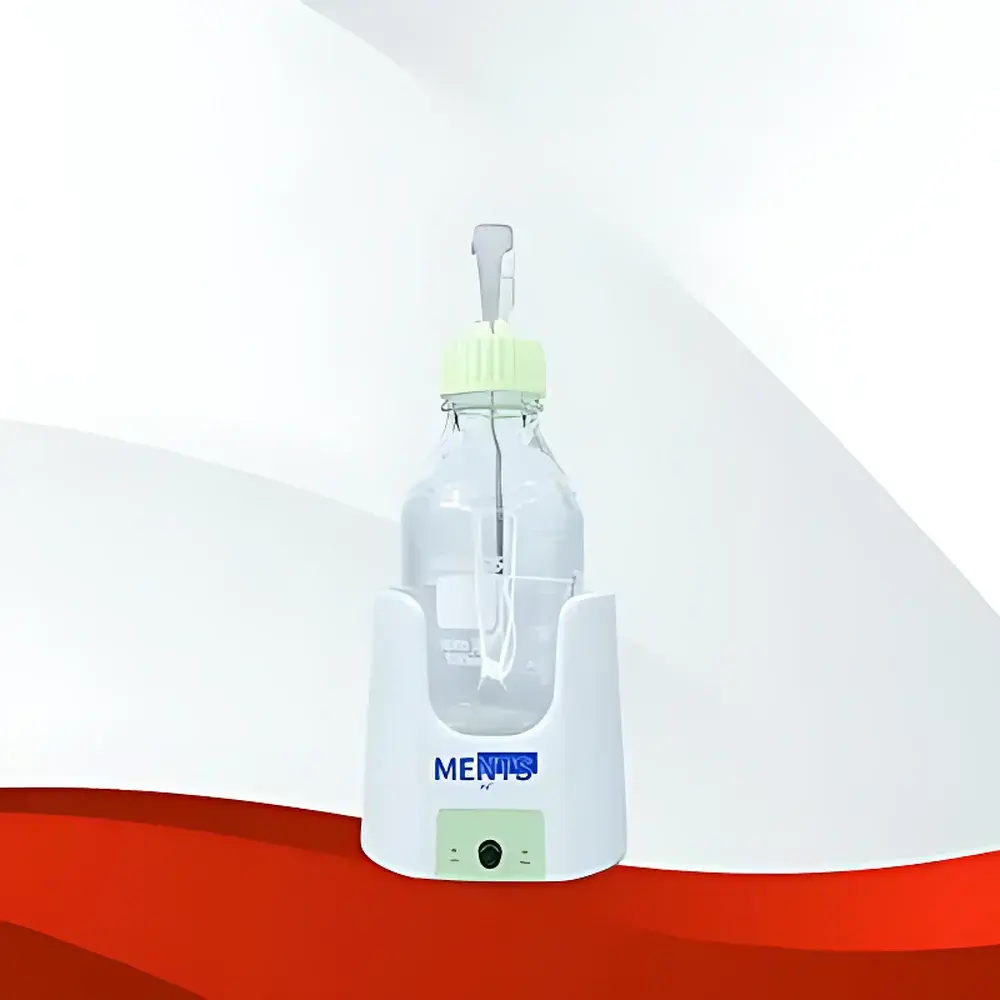
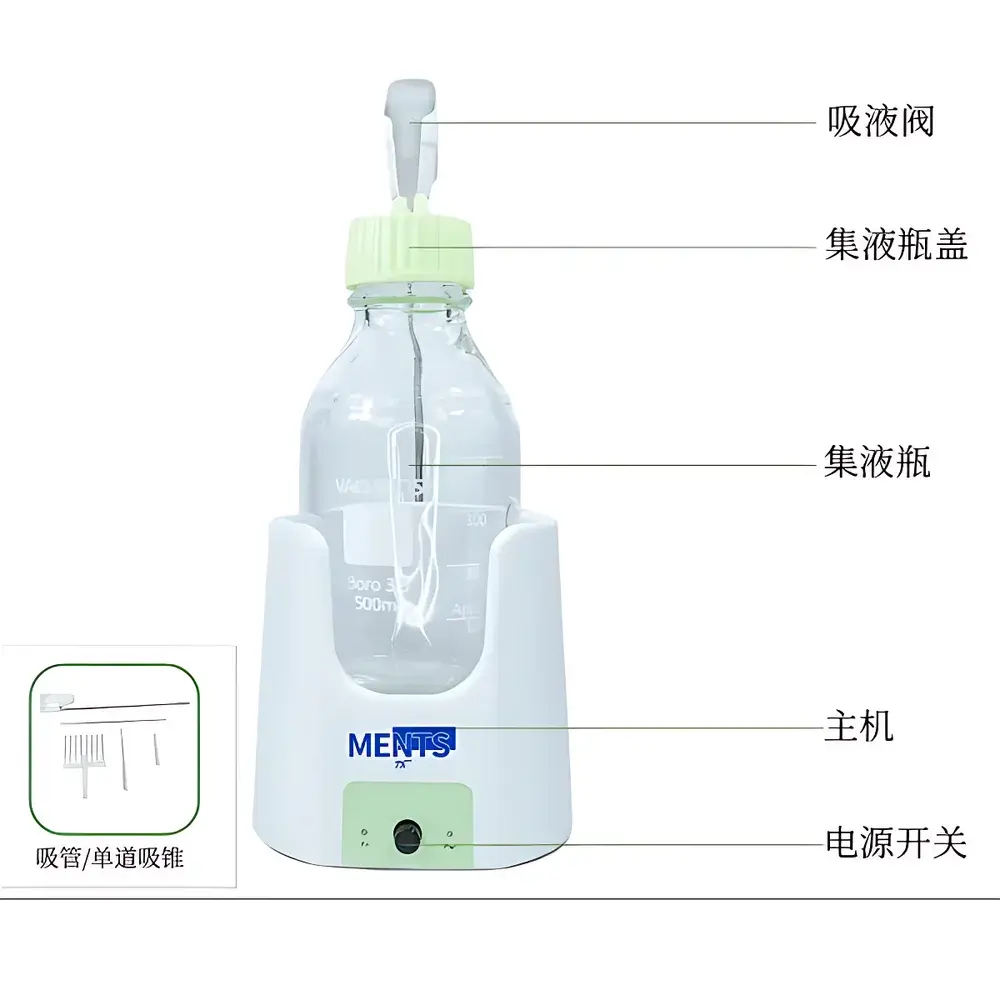
MENTS BV1000 Desktop Smart Vacuum Liquid Aspiration System
| Brand | MENTS |
|---|---|
| Origin | Beijing, China |
| Manufacturer Type | Direct Manufacturer |
| Product Origin | Domestic (China) |
| Model | BV1000 |
| Ultimate Vacuum | 300 mbar |
| Maximum Aspiration Rate | 150 mL/min |
| Dimensions (W×D×H) | 105 × 110 × 160 mm |
| Power Supply | 5 V DC, 2 A |
| Bottle Capacity Options | 500 mL or 1000 mL (standard: 1000 mL borosilicate glass) |
| Intelligent Start/Stop | Yes |
| Overflow Protection | Yes |
| Continuous Dry-Run Alarm | Yes |
| Dual Status Indicators (Pwr & Fn) | Yes |
| Included Accessories | Power cable, main unit, 1000 mL glass waste bottle, fine-bore tube, coarse-bore tube, 8-channel manifold, single-channel tip adapter compatible with standard 200 µL pipette tips |
Overview
The MENTS BV1000 is a compact, intelligent desktop vacuum liquid aspiration system engineered for precision, safety, and ergonomic efficiency in routine laboratory liquid handling workflows. It operates on the principle of controlled negative pressure generation via an integrated diaphragm vacuum pump, delivering stable suction across variable fluid viscosities and container geometries. Unlike traditional fixed-speed aspirators, the BV1000 employs real-time vacuum feedback control to dynamically modulate pump activity—activating only when suction demand exceeds threshold pressure (set at ≤300 mbar absolute), thereby minimizing acoustic noise, energy consumption, and mechanical wear. Its 150 mL/min maximum aspiration rate is optimized for rapid removal of supernatants, wash buffers, cell culture media, and other low-to-moderate viscosity aqueous solutions without splashing or aerosol generation. Designed specifically for benchtop integration, the system’s footprint of just 105 × 110 mm ensures compatibility with laminar flow hoods, biosafety cabinets, and crowded multi-instrument workstations.
Key Features
- Intelligent vacuum regulation with auto-start/stop logic based on real-time pressure sensing—reduces operational noise to <45 dB(A) during standby and intermittent use
- Dual-status LED indicators (Pwr and Fn) provide immediate visual confirmation of power state and functional readiness
- Integrated overflow protection and dry-run monitoring: triggers audible and visual alerts upon waste bottle fill-level detection or prolonged no-load operation (>60 sec)
- Modular aspiration interface supporting four distinct configurations: fine-bore tubing (for viscous or low-volume samples), coarse-bore tubing (for high-flow buffer exchange), 8-channel manifold (for multiwell plate processing), and single-channel tip adapter compatible with ANSI/SBS-standard 200 µL pipette tips
- Borosilicate glass 1000 mL waste bottle included as standard; chemically resistant and autoclavable up to 121°C (optional 500 mL variant available for space-constrained applications)
- Low-voltage DC operation (5 V, 2 A) enhances electrical safety and eliminates need for grounded AC outlets—ideal for mobile lab carts and regulated environments requiring SELV compliance
Sample Compatibility & Compliance
The BV1000 is validated for aspiration of aqueous buffers (e.g., PBS, Tris-HCl), cell culture media (DMEM, RPMI), ethanol/water mixtures (up to 70% v/v), and dilute acidic or basic solutions (pH 2–12). It is not rated for organic solvents (e.g., chloroform, acetone), highly viscous liquids (>100 mPa·s), or particulate-laden suspensions without inline filtration. The system conforms to IEC 61010-1:2010 for electrical safety in laboratory equipment and incorporates design elements aligned with GLP documentation requirements—including non-volatile event logging capability (via optional firmware upgrade) for audit-ready operational records. While not certified to ISO 13485 or FDA 21 CFR Part 11 out-of-the-box, its deterministic control architecture supports validation protocols required under GMP Annex 11 and USP .
Software & Data Management
The BV1000 operates as a standalone hardware platform with embedded firmware; no host PC or proprietary software is required for basic functionality. All operational parameters—including vacuum setpoint, alarm thresholds, and runtime counters—are stored in non-volatile memory and persist through power cycles. An optional UART-based serial interface (TTL level, 9600 baud) enables integration into custom LabVIEW or Python-controlled workflows for automated aspiration sequencing and timestamped event capture. Firmware updates are delivered via USB-C connection using vendor-provided configuration utilities, ensuring traceability and version control per ISO/IEC 17025 clause 5.9.
Applications
- Cell culture maintenance: gentle aspiration of spent media from adherent monolayers and suspension cultures
- Molecular biology workflows: removal of wash buffers during ELISA plate processing, DNA binding/elution steps in column-based purification, and post-lysis supernatant clearance
- Histology and pathology labs: aspiration of staining reagents and dehydration solvents in tissue processing workflows
- Quality control laboratories: standardized liquid decanting in raw material testing and stability studies per ASTM E2500-13 guidance
- Educational settings: safe, quiet, and intuitive aspiration tool for undergraduate teaching labs emphasizing aseptic technique and equipment validation principles
FAQ
Is the BV1000 compatible with vacuum filtration manifolds?
Yes—when used with the optional coarse-bore tubing or 8-channel manifold, it interfaces directly with standard 47-mm and 90-mm filter holders and multiwell vacuum manifolds.
Can the waste bottle be sterilized between uses?
Yes—the supplied borosilicate glass bottle is autoclavable at 121°C for 20 minutes; ensure all tubing and adapters are removed prior to sterilization.
Does the system support continuous aspiration over extended periods?
It is designed for intermittent duty cycles typical of manual lab workflows; continuous operation beyond 15 minutes requires active monitoring due to thermal limits of the diaphragm pump.
What maintenance is required?
No scheduled maintenance is needed; periodic inspection of tubing integrity and cleaning of the bottle neck seal is recommended every 50 hours of cumulative use.
Is regulatory documentation available for IQ/OQ validation?
Yes—MENTS provides a Factory Acceptance Test (FAT) report, calibration certificate traceable to NIM (National Institute of Metrology, China), and a URS-aligned validation support package upon request.
Related Products



