
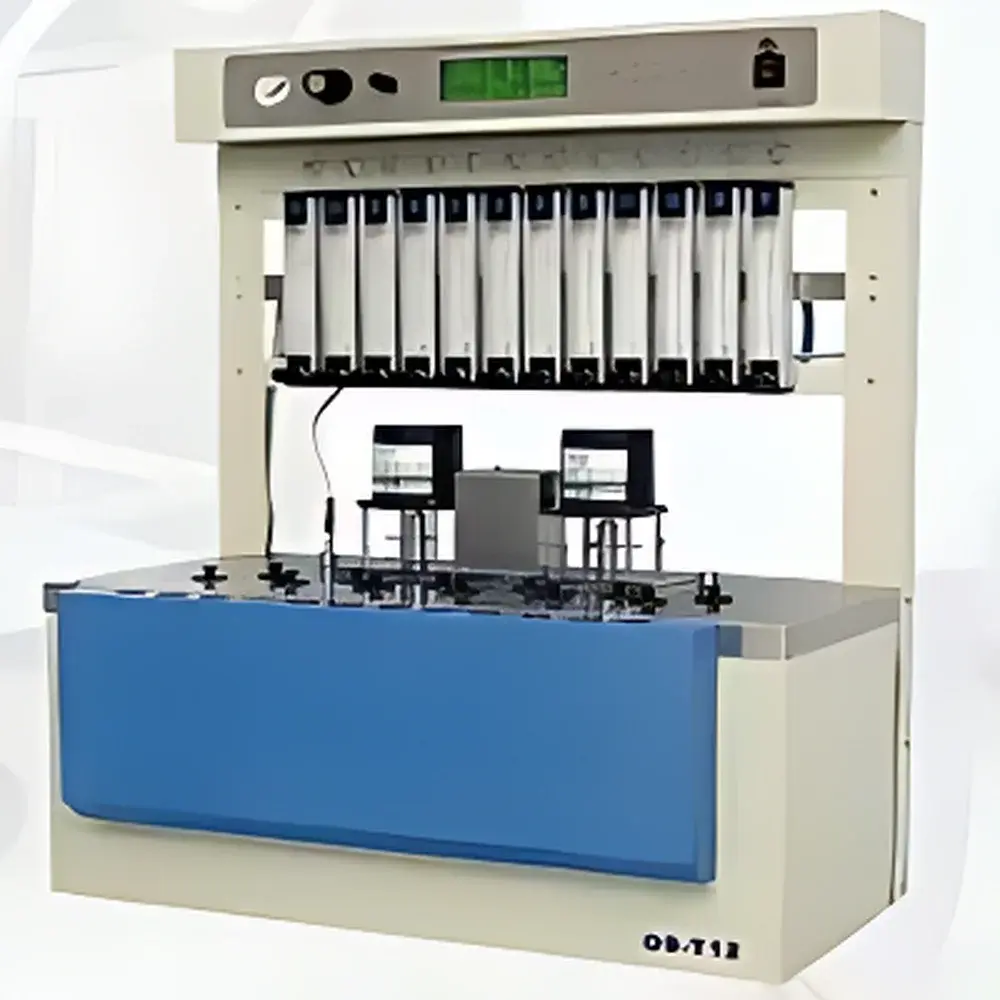
Xufeng OS-T12 Transformer Oil Oxidation Stability Tester
| Brand | Xufeng |
|---|---|
| Origin | Shanghai, China |
| Model | OS-T12 |
| Standard Compliance | SH/T 0206, IEC 61125:1992, ASTM D2440 |
| Bath Dimensions | 550 W × 220 D × 250 H mm |
| Overall Dimensions | 650 W × 320 D × 900 H mm |
| Oxidation Tube Capacity | 12 positions |
| Heating Power | 2.4 kW |
| Heating Medium | Silicone oil or mineral oil (open-cup flash point > 200 °C) |
| Pressure Regulation Range | 0–588 kPa (0–6 kgf/cm²) |
| Air Flow Rate Adjustment | 5–50 mL/min |
| Temperature Control Range | (Ambient + 10) °C to 120 °C |
| Temperature Stability | ≤ ±0.1 °C |
| Temperature Uniformity | ≤ ±0.1 °C |
| Control System | Microprocessor-based with real-time diagnostics, auto-timing, and fault logging |
| Optional Configuration | OS-T12+ with imported precision mass flow meter |
Overview
The Xufeng OS-T12 Transformer Oil Oxidation Stability Tester is a dedicated benchtop instrument engineered for the accelerated oxidation testing of mineral insulating oils—primarily transformer oils—under standardized thermo-oxidative stress conditions. It operates on the principle of forced-air oxidation in sealed, heated oxidation tubes containing oil samples, where oxygen flow, temperature, and pressure are precisely regulated to simulate long-term aging behavior in service environments. Designed in strict accordance with SH/T 0206 (China’s national standard equivalent to IEC 61125:1992), and fully compatible with ASTM D2440 (“Standard Test Method for Oxidation Stability of Mineral Insulating Oil”), the OS-T12 delivers reproducible, traceable, and auditable test data essential for quality assurance, formulation development, and life-cycle prediction of electrical insulating fluids. Its architecture supports extended-duration tests up to 164 hours, enabling evaluation of induction periods, sludge formation, acid number increase, and interfacial tension decline—all critical failure indicators defined in international specifications.
Key Features
- Twelve parallel oxidation tube positions for high-throughput comparative testing under identical thermal and gaseous conditions.
- High-stability thermostatic bath constructed from corrosion-resistant imported stainless steel, equipped with dual heating/stirring assemblies mounted on a removable maintenance plate for rapid servicing.
- Precision air delivery system featuring calibrated needle valves and (optionally) certified mass flow meters (OS-T12+ variant) ensuring flow accuracy within ±1% of setpoint across the full 5–50 mL/min range—even under ambient temperature fluctuations or supply pressure drift.
- Integrated pressure regulation module capable of maintaining stable backpressure from 0 to 588 kPa, enabling simulation of pressurized equipment environments and improving oxidation kinetics fidelity.
- Microprocessor-based controller with real-time monitoring of temperature, airflow, pressure, and operational status; supports automatic shutdown upon power interruption, gas supply failure, or sensor anomaly.
- Comprehensive time-logging functionality: records actual elapsed test time, start/end timestamps, and interruption events—including date/time-stamped recovery logs after power or gas resumption.
Sample Compatibility & Compliance
The OS-T12 is validated for use with refined mineral insulating oils meeting IEC 60296 and ASTM D3487 specifications. It accommodates standard 50-mL oxidation tubes per SH/T 0206 and ASTM D2440, and supports optional tube adapters for alternative geometries. All operational parameters—including temperature ramp profiles, dwell times, flow rates, and pressure setpoints—are configurable to align with method-specific requirements. The instrument’s design and documentation support GLP-compliant laboratory workflows, with built-in diagnostic alerts (e.g., heater open-circuit detection, RTD sensor deviation > ±0.5 °C, pressure loss > 10 kPa/min) providing audit-ready event logs. While not inherently 21 CFR Part 11 compliant, its digital control unit outputs timestamped CSV files suitable for integration into validated LIMS or ELN platforms requiring electronic record retention.
Software & Data Management
The OS-T12 employs an embedded firmware interface with a high-contrast LCD display and tactile keypad navigation. No external PC software is required for routine operation; however, all test metadata—including setpoints, real-time sensor values, alarm history, and cumulative runtime—is stored in non-volatile memory and exportable via USB port in plain-text CSV format. Each record includes ISO 8601-formatted timestamps, instrument ID, operator code (user-configurable), and calibration verification flags. For laboratories operating under GMP or ISO/IEC 17025 accreditation, the system permits manual annotation of sample IDs and batch numbers prior to test initiation, ensuring full traceability from raw material to final report. Firmware updates are delivered via secure USB load, with version history and checksum validation embedded in the bootloader.
Applications
- Quality control of new transformer oil batches against SH/T 0206 pass/fail criteria (e.g., ≤0.2 mg KOH/g acid number increase after 164 h at 110 °C).
- Comparative stability assessment of antioxidant formulations (e.g., DBPC, 2,6-Di-tert-butyl-p-cresol) during R&D screening.
- Condition monitoring of in-service oils recovered from aged transformers, identifying incipient degradation prior to dielectric failure.
- Validation of reclamation processes by quantifying residual oxidative capacity post-treatment.
- Supporting technical submissions to regulatory bodies such as State Grid Corporation of China (SGCC) or IEEE standards committees requiring documented oxidation resistance data.
FAQ
What standards does the OS-T12 comply with?
It is fully aligned with SH/T 0206, IEC 61125:1992, and ASTM D2440 for mineral insulating oil oxidation stability testing.
Is the OS-T12 suitable for testing synthetic ester-based insulating fluids?
While primarily optimized for mineral oils, preliminary validation per ASTM D7873 may be conducted; users must verify thermal stability limits of the fluid under test against the instrument’s 120 °C maximum operating temperature.
How is temperature uniformity verified across the 12-position bath?
Uniformity is confirmed during factory calibration using NIST-traceable PT100 probes at nine spatial locations; a certificate of conformance with ≤±0.1 °C deviation is supplied with each unit.
Can test data be exported directly to LIMS?
Yes—CSV exports contain structured fields compatible with common LIMS ingestion protocols; custom mapping templates are available upon request.
What maintenance intervals are recommended for the air flow system?
Needle valves and flow meters require annual verification against certified reference standards; silicone oil bath medium should be replaced every 18 months or after 500 operational hours, whichever occurs first.



