
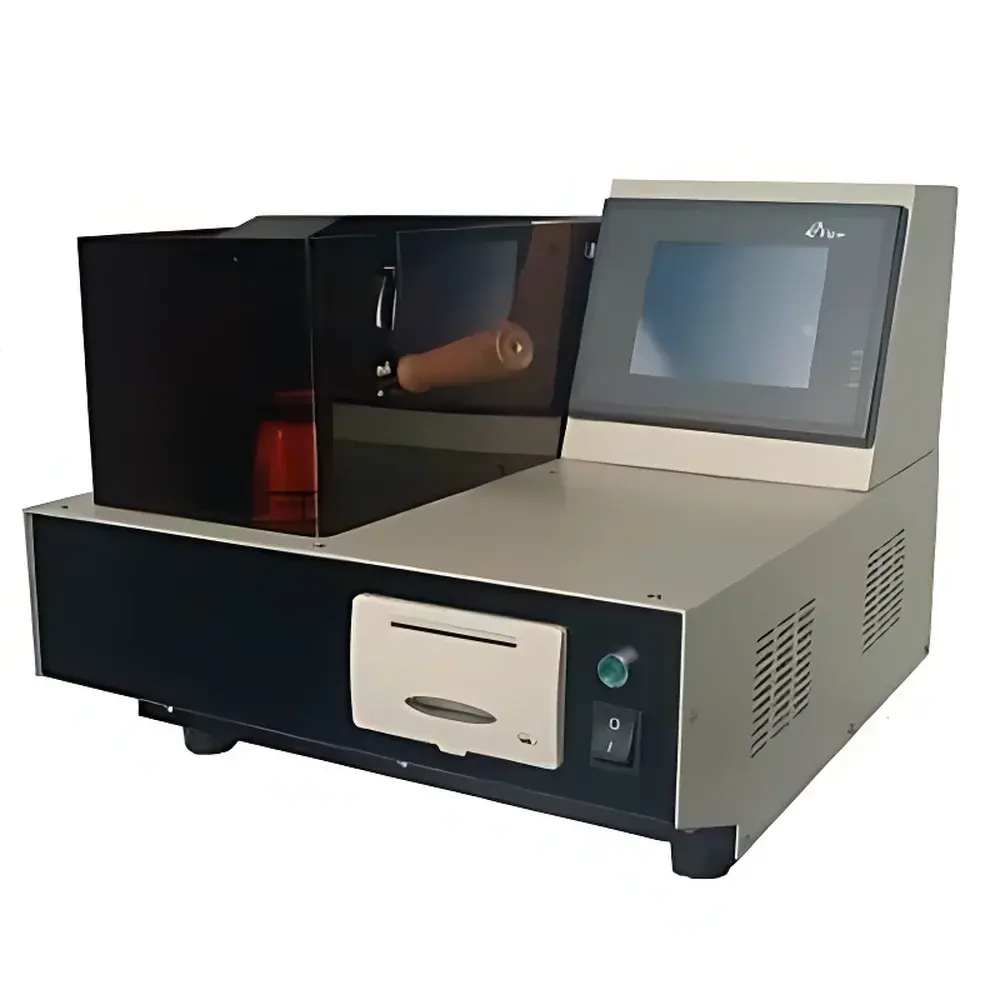
Xufeng XF-56 Automatic Tag Closed-Cup Flash Point Tester
| Brand | Xufeng |
|---|---|
| Origin | Shanghai, China |
| Model | XF-56 |
| Detection Method | Closed-Cup (Tag) |
| Applicable Standards | ASTM D56, SH/T 0733, GB/T 21929-2008, ISO 1523, IP 304, JIS K 2265 |
| Temperature Control Range | 0 °C to 300 °C |
| Control Accuracy | ±0.1 °C |
| Standard Test Range | Ambient to 95 °C (water bath) |
| Cooling Source | Imported Semiconductor Cold Trap |
| Display | Full-Touch 7-inch LCD |
| Ignition Detection | Automated Flame Ignition + High-Sensitivity Thermocouple |
| Power Consumption | 2 × 800 W |
| Dimensions | 400(W) × 380(D) × 350(H) mm |
| Weight | ~20 kg |
| Interface | RS-232C |
| Printer | Integrated Dot-Matrix Printer |
Overview
The Xufeng XF-56 Automatic Tag Closed-Cup Flash Point Tester is a precision-engineered instrument designed for the accurate and repeatable determination of flash point temperatures of volatile petroleum products, solvents, lubricants, and related hydrocarbon-based liquids using the standardized Tag closed-cup method. It operates on the fundamental principle of controlled heating under sealed conditions, followed by automated intermittent ignition and thermal detection of vapor ignition—consistent with the physical definition of flash point as the lowest temperature at which vapors above a liquid sample ignite momentarily when exposed to an ignition source. The XF-56 implements rigorous thermal ramping profiles and ignition timing sequences defined in ASTM D56, SH/T 0733, and GB/T 21929-2008, ensuring regulatory alignment across global refinery, quality control, and safety compliance laboratories.
Key Features
- Multi-standard programmable test modes: User-selectable protocols for ASTM D56 (Tag), SH/T 0733 (Chinese Tag variant), and GB/T 21929-2008 (Tager closed-cup), each with distinct heating rate, stir speed, and ignition frequency logic.
- High-precision temperature control: PID-regulated heating system with ±0.1 °C stability over 0–300 °C range; water-bath configuration supports routine testing from ambient to 95 °C with integrated semiconductor cold trap for rapid cooldown between runs.
- Automated ignition and detection: Microprocessor-controlled spark generation synchronized with thermocouple-based flame confirmation—eliminating subjective visual observation and reducing operator dependency.
- Full-touch 7-inch LCD interface: Intuitive graphical workflow navigation; real-time display of setpoint temperature, actual bath temperature, expected flash point, atmospheric pressure compensation value, and diagnostic status.
- Modular expandability: Optional integration with XF-2S/XF-4S multi-test-unit configurations enables parallel closed-cup or hybrid open/closed cup testing without hardware duplication—ideal for high-throughput QC environments.
- Self-diagnostic architecture: Real-time monitoring of heater integrity, thermocouple continuity, gas valve operation (for models with external fuel supply), and ignition circuit performance—with on-screen fault codes and audible alerts.
- Regulatory-ready connectivity: Standard RS-232C port compliant with laboratory information management systems (LIMS); supports ASCII data export for audit trails and electronic record retention per FDA 21 CFR Part 11 requirements when paired with validated software.
Sample Compatibility & Compliance
The XF-56 is validated for use with flammable and combustible liquids having initial boiling points above 40 °C and flash points below 95 °C—covering gasoline fractions, kerosene, diesel blends, biodiesel intermediates, and industrial solvents. Its stainless-steel benchtop enclosure meets IP20 environmental rating and complies with electrical safety standards IEC 61010-1. Instrument validation documentation supports adherence to ISO/IEC 17025:2017 calibration traceability requirements. Routine operation satisfies mandatory reporting criteria under OSHA 29 CFR 1910.1200 (HazCom), EPA 40 CFR Part 79, and CLP Regulation (EC) No 1272/2008 for classification of flammability hazards.
Software & Data Management
While the XF-56 operates autonomously via embedded firmware, its RS-232C interface enables bidirectional communication with third-party LIMS or custom QA platforms. All test parameters—including date/time stamp, atmospheric pressure input, selected standard, final flash point result, and pass/fail status per ASTM D56 Section 8—are transmitted as structured ASCII strings. When deployed in GLP- or GMP-regulated facilities, the instrument’s internal non-volatile memory retains the last 100 test records with full metadata. Optional PC-based companion software (sold separately) provides trend analysis, certificate generation (PDF/CSV), and electronic signature support aligned with ALCOA+ data integrity principles.
Applications
- Petroleum refining QC: Final product verification of gasoline, naphtha, and jet fuel flash point against specification limits (e.g., ASTM D439, D1655).
- Chemical manufacturing: Stability assessment of solvent blends, paint thinners, and adhesive formulations prior to packaging and transport.
- Regulatory submission testing: Generation of flash point data required for SDS authoring (Section 9), UN transport classification (UN 1203, 1202), and REACH dossier preparation.
- Research & development: Screening of bio-derived fuels and synthetic lubricants for volatility behavior under controlled thermal stress.
- Educational laboratories: Teaching core concepts of vapor pressure, flammability limits, and standardized test methodology in chemical engineering curricula.
FAQ
Does the XF-56 require external fuel gas for ignition?
Yes—standard configuration uses butane/propane fuel supplied via external regulator and tubing. An optional electronic ignition head variant eliminates the need for combustible gas and is recommended for inert-atmosphere labs or locations with strict gas storage restrictions.
Can the instrument compensate for barometric pressure deviations?
Yes—users manually enter local atmospheric pressure (in kPa or mmHg) prior to test initiation; the firmware applies empirically derived correction factors per ASTM D56 Annex A1.
Is calibration traceable to NIST or other national standards?
The instrument accepts certified reference materials (CRMs) such as NIST SRM 2721 (flash point standards); temperature calibration is performed using traceable PT100 probes per ISO 17025-accredited procedures.
What maintenance is required for long-term reliability?
Routine tasks include cleaning the Tag cup and lid after each test, verifying thermocouple response with ice-point checks quarterly, and replacing the dot-matrix print ribbon and thermal paper as needed. Semiconductor cooler performance should be verified annually using thermal imaging or delta-T diagnostics.
How does the XF-56 handle samples with suspended particulates or high viscosity?
Samples must be filtered to ≤75 µm and preheated to ensure homogeneity; viscosity >150 cSt at test temperature requires extended equilibration time (per SH/T 0733 Section 6.3) and may necessitate manual stir speed adjustment to maintain uniform vapor concentration.



