
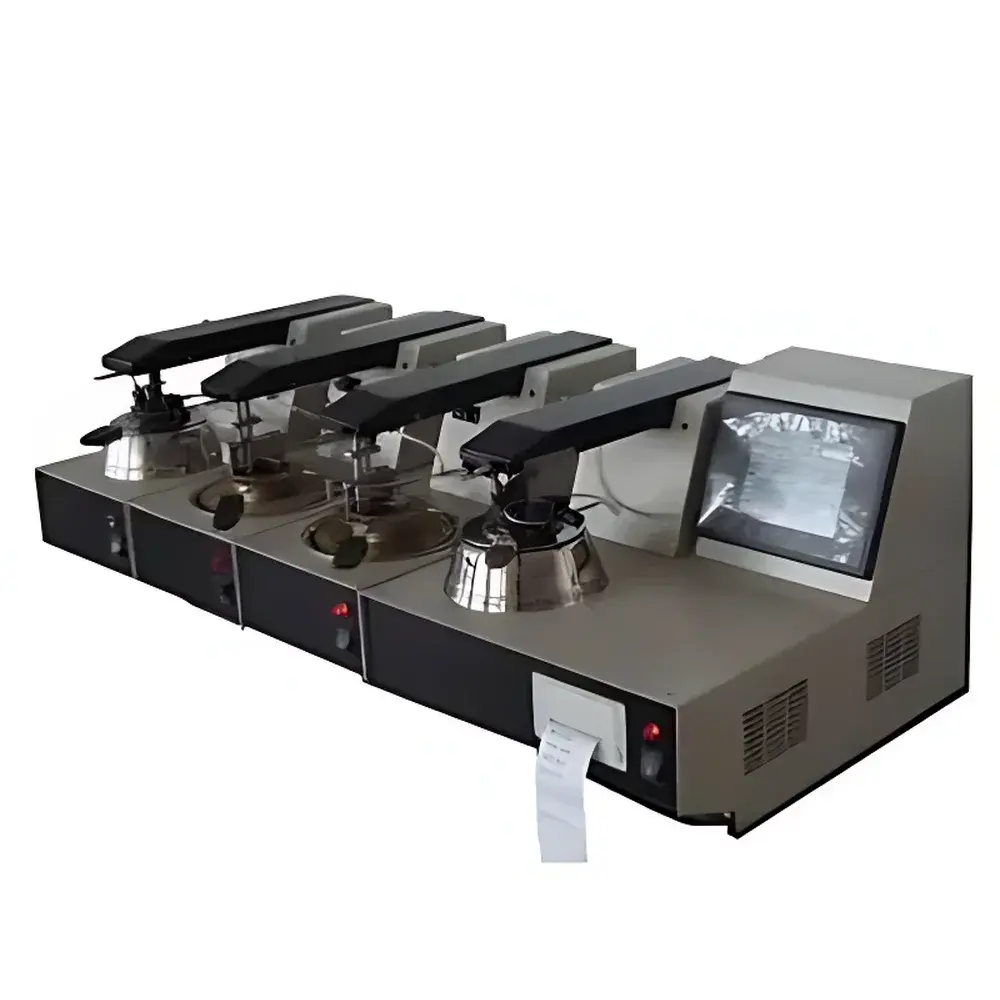
Xufeng XF-4S Automated Multi-Cup Flash Point Tester (Open/Closed Cup Method)
| Brand | Xufeng |
|---|---|
| Origin | Shanghai, China |
| Model | XF-4S |
| Detection Method | Cleveland Open-Cup (COC), Pensky-Martens Closed-Cup (PMCC), Tag Closed-Cup (TAG) |
| Temperature Control Range | 0–400 °C (Open-Cup), 0–300 °C (Closed-Cup), ±0.1 °C accuracy |
| Sample Capacity | Up to 8 simultaneous cups (configurable per test standard) |
| Compliance | ASTM D92, ASTM D93, ASTM D56, GB/T 261, GB/T 3536, GB/T 267 |
| Interface | RS-232C |
| Power | 2 × 800 W |
| Dimensions | 400 × 380 × 350 mm (W×D×H) |
| Weight | ~20 kg |
| Detection Principle | Flame Ionization (open-cup), High-Sensitivity Thermocouple (closed-cup) |
| Data Storage | 100 test records per method configuration |
| Display | Large LCD with real-time temperature, setpoint, and fault diagnostics |
| Printer | Built-in dot-matrix |
Overview
The Xufeng XF-4S Automated Multi-Cup Flash Point Tester is a benchtop, dual-furnace analytical instrument engineered for precise, standardized flash point and fire point determination across petroleum-based liquids, lubricants, biodiesel blends, transformer oils, and industrial solvents. It implements three internationally recognized test methodologies—Cleveland Open-Cup (ASTM D92 / GB/T 3536), Pensky-Martens Closed-Cup (ASTM D93 / GB/T 261), and Tag Closed-Cup (ASTM D56)—within a single, modular platform. Unlike single-test flash point analyzers, the XF-4S employs independent thermal control zones and parallel cup positioning to enable concurrent execution of heterogeneous test protocols. Its core measurement architecture integrates flame ionization detection for open-cup tests and high-resolution thermocouple-based vapor-phase monitoring for closed-cup methods—ensuring traceable response to incipient ignition events without reliance on visual observation. Designed for laboratories operating under ISO/IEC 17025, ASTM-compliant quality systems, or refinery QA/QC workflows, the instrument delivers repeatable results aligned with regulatory reporting requirements for safety classification (e.g., OSHA 29 CFR 1910.1200, GHS Category 1–4 flammability assignment).
Key Features
- Configurable multi-cup operation: Supports up to eight sample cups simultaneously, with user-defined allocation across ASTM D92, D93, and D56 test modes—enabling side-by-side comparison, statistical replication (e.g., triplicate PMCC + single COC), or sequential batch testing without manual reconfiguration.
- Dual independent furnace system: Stainless-steel insulated heating blocks maintain ±0.1 °C temperature stability over full ranges—0–400 °C for open-cup, 0–300 °C for closed-cup—including extended low-range capability (0–95 °C) for TAG method with optional Peltier cooling module.
- Automated ignition selection: Integrated electronic spark igniter (standard) or optional gas pilot burner—both synchronized to ASTM-specified timing windows and flame dwell durations to eliminate operator variability.
- Real-time diagnostics & safety interlocks: Self-diagnostic firmware continuously monitors cup seal integrity, thermocouple continuity, flame sensor responsiveness, and furnace thermal gradient; halts test progression upon deviation from ASTM-defined ramp rate tolerances or unexpected pressure fluctuation.
- Full RS-232C integration: Enables bidirectional communication with LIMS or centralized QC servers for automated data logging, audit trail generation, and remote parameter validation—supporting FDA 21 CFR Part 11 compliant electronic signatures when paired with validated software environments.
- Intuitive human-machine interface: Backlit LCD displays live temperature curves, predicted flash point convergence, statistical summaries (mean, SD, CV%), and contextual fault codes—reducing interpretation ambiguity during GLP/GMP audits.
Sample Compatibility & Compliance
The XF-4S accommodates viscous and volatile samples ranging from light naphthas (flash point 350 °C), provided they meet ASTM-defined volatility and residue limits for each method. Its stainless-steel cup holders and corrosion-resistant furnace linings ensure long-term compatibility with sulfur-containing fuels, chlorinated solvents, and bio-derived esters. All operational modes are rigorously validated against primary reference standards traceable to NIST SRM 1484 (mineral oil) and NIST SRM 2722 (diesel). The instrument satisfies mandatory compliance requirements for petroleum product certification under API RP 2543, EN ISO 2719, and China’s CNAS-CL01:2018 accreditation criteria. Test reports generated by the built-in dot-matrix printer include method identifier, atmospheric pressure correction factor, observed flash point, repeatability assessment per ASTM E180, and operator ID—fulfilling documentation mandates for third-party inspection bodies.
Software & Data Management
While the XF-4S operates autonomously via embedded firmware, its RS-232C port supports structured ASCII data export in ASTM E1319-compliant format: timestamp, method code (D92/D93/D56), cup ID, initial temperature, ramp rate, flash point value (°C), atmospheric pressure (kPa), and pass/fail flag. When interfaced with laboratory middleware (e.g., Thermo Fisher SampleManager, LabVantage), raw datasets populate relational databases with immutable timestamps and user-authenticated metadata. Audit trails record all parameter changes—including calibration date, cup type selection, and pressure offset adjustments—meeting ALCOA+ principles for data integrity. Optional PC-based configuration software allows method template creation, statistical process control (SPC) charting, and automatic outlier detection using Grubbs’ test at α = 0.05.
Applications
- Petroleum refining QC: Routine flash point verification of crude fractions, gasoline blending components, jet fuels (ASTM D1655 Annex A2), and marine distillates prior to shipment.
- Power generation: Dielectric fluid screening for transformers and switchgear per IEEE C57.106, ensuring compliance with flash point ≥ 140 °C for Class A insulating oils.
- Aviation maintenance: On-site verification of hydraulic fluid flammability (MIL-PRF-83282) and turbine oil stability (ASTM D6185) in hangar environments.
- Regulatory submission: Generation of GLP-compliant datasets for REACH registration dossiers, EPA Tier II chemical inventory reporting, and DOT 49 CFR hazmat classification.
- Research & development: Screening of biofuel blends (e.g., FAME, HVO) for flash point depression effects during oxidation aging studies.
FAQ
Does the XF-4S support both manual and automated pressure correction?
Yes—barometric pressure can be entered manually or acquired via optional external digital barometer (RS-232 input); all flash point values are automatically corrected per ASTM D93 Annex A1.
Can test methods be validated independently per cup position?
Yes—each cup station retains individual calibration coefficients and method-specific ramp profiles, enabling IQ/OQ documentation per ASTM E2554.
Is the instrument suitable for testing water-miscible metalworking fluids?
It is not recommended for emulsions or high-water-content formulations, as vapor-phase interference may compromise thermocouple detection sensitivity in closed-cup mode.
What maintenance intervals are specified for critical components?
Flame ionization sensor cleaning every 200 tests; thermocouple verification quarterly using NIST-traceable dry-block calibrator; O-ring replacement annually or after 500 sealing cycles.
How does the system handle borderline flash point determinations near method-specific repeatability limits?
The firmware applies ASTM E180 consensus rules—automatically triggering duplicate analysis if initial result deviates >2 °C from historical mean for that matrix, with final report indicating “confirmed” or “non-reproducible” status.
Related Products







