
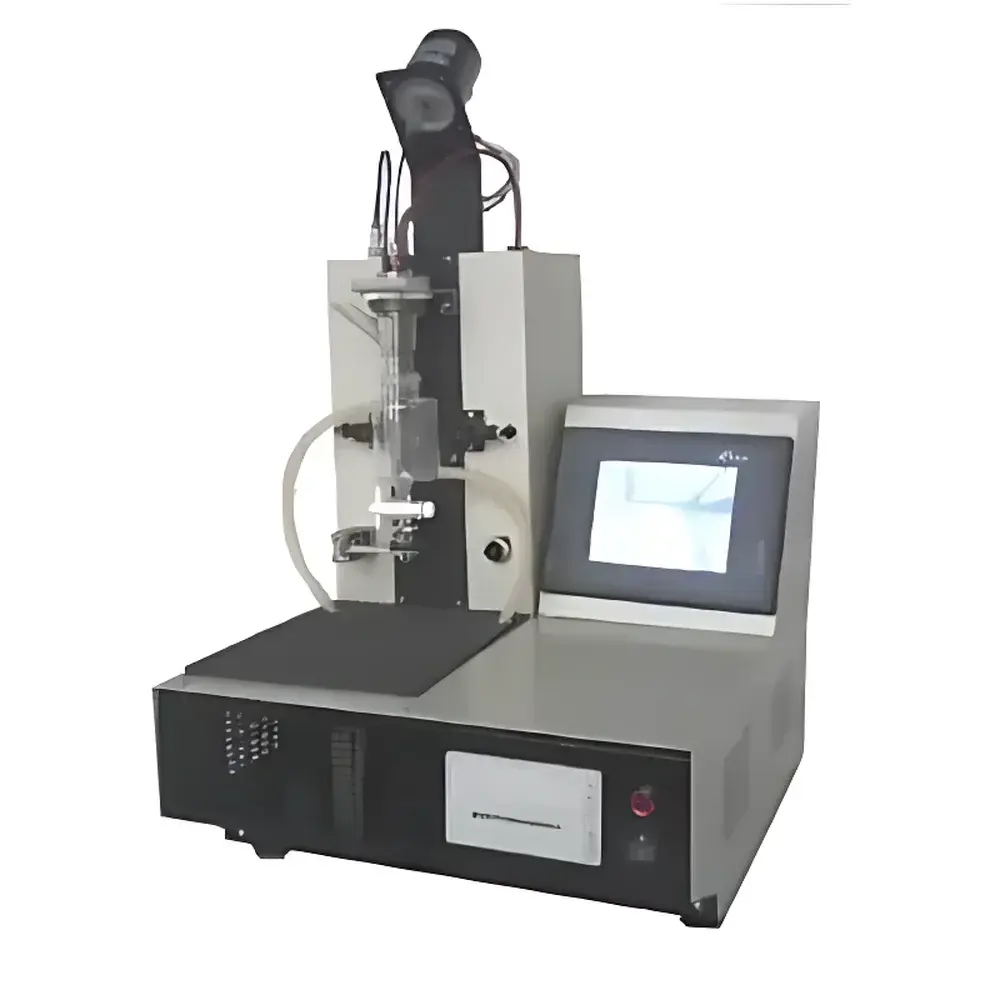
Xufeng AP-L1 Automatic Aniline Point Tester
| Brand | Xufeng |
|---|---|
| Origin | Shanghai, China |
| Model | AP-L1 |
| Temperature Range | Ambient to 170 °C |
| Repeatability | ±0.2 °C (light-colored petroleum), ±0.4 °C (dark-colored petroleum, ASTM Color > 8.0) |
| Temperature Sensor | Pt100 Platinum Resistance Thermometer |
| Heating Power | 30 W |
| Stirring Motor Power | 6 W |
| Display | Large Touchscreen LCD |
| Data Storage | 99 test records |
| Interface | RS-232C |
| Dimensions (Controller) | 230 × 430 × 110 mm (W×D×H) |
| Dimensions (Testing Unit) | 230 × 340 × 540 mm (W×D×H) |
| Weight | 20 kg |
Overview
The Xufeng AP-L1 Automatic Aniline Point Tester is a precision-engineered instrument designed for the standardized determination of aniline point and mixed aniline point in petroleum products and hydrocarbon solvents. Based on the principle of liquid-phase miscibility equilibrium between aniline and the test sample, the instrument automatically identifies the lowest temperature at which the two phases form a homogeneous solution upon cooling — defined as the aniline point. This thermodynamic property serves as a critical indicator of aromatic content, polarity, and solvent compatibility in fuels and lubricants, directly correlating with ignition quality in diesel, detergent formulation efficiency, and refining process optimization. The AP-L1 complies fully with GB/T 262, ASTM D611, and ISO 2977, ensuring methodological consistency across global laboratory and quality control environments.
Key Features
- Four programmable test modes: Standard Protocol (SP), Quick Protocol (QP), Search Protocol (SR), and Special Sample Protocol (TP) — enabling adaptive methodology for light distillates, heavy residuals, oxidized fractions, and high-color-number samples (ASTM Color > 8.0).
- Automated thermal control system with precise Pt100-based temperature sensing, integrated heating (30 W), and mechanical stirring (6 W) for uniform phase mixing and reproducible endpoint detection.
- Real-time optical monitoring of phase clarity via controlled illumination and photometric feedback, eliminating subjective visual interpretation.
- Self-diagnostic firmware with hardware fault detection, thermal runaway protection, and automatic cooldown safety protocols.
- Onboard data management: 99-test memory buffer with timestamped records, including sample ID, test mode, target/actual aniline point, photometric intensity, and system status logs.
- Integrated thermal printer with RS-232C serial interface for GLP-compliant hardcopy output and external LIMS integration.
Sample Compatibility & Compliance
The AP-L1 accommodates a broad spectrum of petroleum-based materials — from colorless naphthas and kerosenes to dark, viscous fuel oils and cracked stocks — without manual intervention or reconfiguration. Its optical detection algorithm is calibrated to distinguish true phase separation endpoints even in highly colored or turbid matrices (ASTM D1500 Color ≥ 8.0), a capability validated per ASTM D611 Annex A2. Regulatory alignment includes full traceability to GB/T 262 (China National Standard), ASTM D611 (U.S. standard for aniline point and mixed aniline point), and ISO 2977 (international specification for petroleum products). All temperature measurements are referenced to NIST-traceable Pt100 sensors, supporting audit readiness under ISO/IEC 17025 and GMP/GLP frameworks.
Software & Data Management
The embedded touchscreen interface provides intuitive navigation through test setup, real-time monitoring, and post-analysis review. Each test record stores date/time stamp, operator ID (manually entered), sample identification, selected protocol, measured aniline point, optical signal intensity, and diagnostic flags. Printed reports include all required fields per ASTM D611 Section 10: test date, sample number, protocol type, expected aniline point (where applicable), final reported value, and measurement method. RS-232C output supports bidirectional communication with laboratory information management systems (LIMS), enabling automated data archiving, electronic signature workflows, and compliance with FDA 21 CFR Part 11 requirements when paired with validated software layers.
Applications
- Diesel fuel quality assurance: Correlation of aniline point with cetane number and aromatic saturation levels.
- Refinery process monitoring: Tracking aromatic content changes across hydrotreating, catalytic reforming, and solvent extraction units.
- Lubricant base oil classification: Differentiation of Group I–III base stocks based on polarity and solvency behavior.
- Hydrocarbon solvent evaluation: Assessment of compatibility with elastomers, coatings, and cleaning formulations.
- Research & development: Screening of alternative fuels, bio-blends, and synthetic hydrocarbons for compositional fingerprinting.
FAQ
What standards does the AP-L1 comply with?
The instrument is fully compliant with GB/T 262, ASTM D611, and ISO 2977 for both aniline point and mixed aniline point determinations.
Can the AP-L1 test dark-colored fuels such as residual fuel oil?
Yes — it supports samples with ASTM D1500 color number up to and exceeding 8.0 using the TP (Special Sample) mode, which adjusts optical sensitivity and thermal ramp profiles.
Is temperature calibration traceable to national standards?
All temperature measurements derive from Pt100 sensors calibrated against NIST-traceable references; calibration certificates are available upon request.
Does the system support electronic data integrity requirements?
With RS-232C connectivity and structured ASCII output, the AP-L1 integrates into validated LIMS environments meeting 21 CFR Part 11 and ISO/IEC 17025 data governance criteria.
How is repeatability verified during routine operation?
Repeatability is maintained through daily verification using certified reference materials (e.g., NIST SRM 2721); built-in diagnostics monitor sensor drift, heater response time, and photometric stability.




