
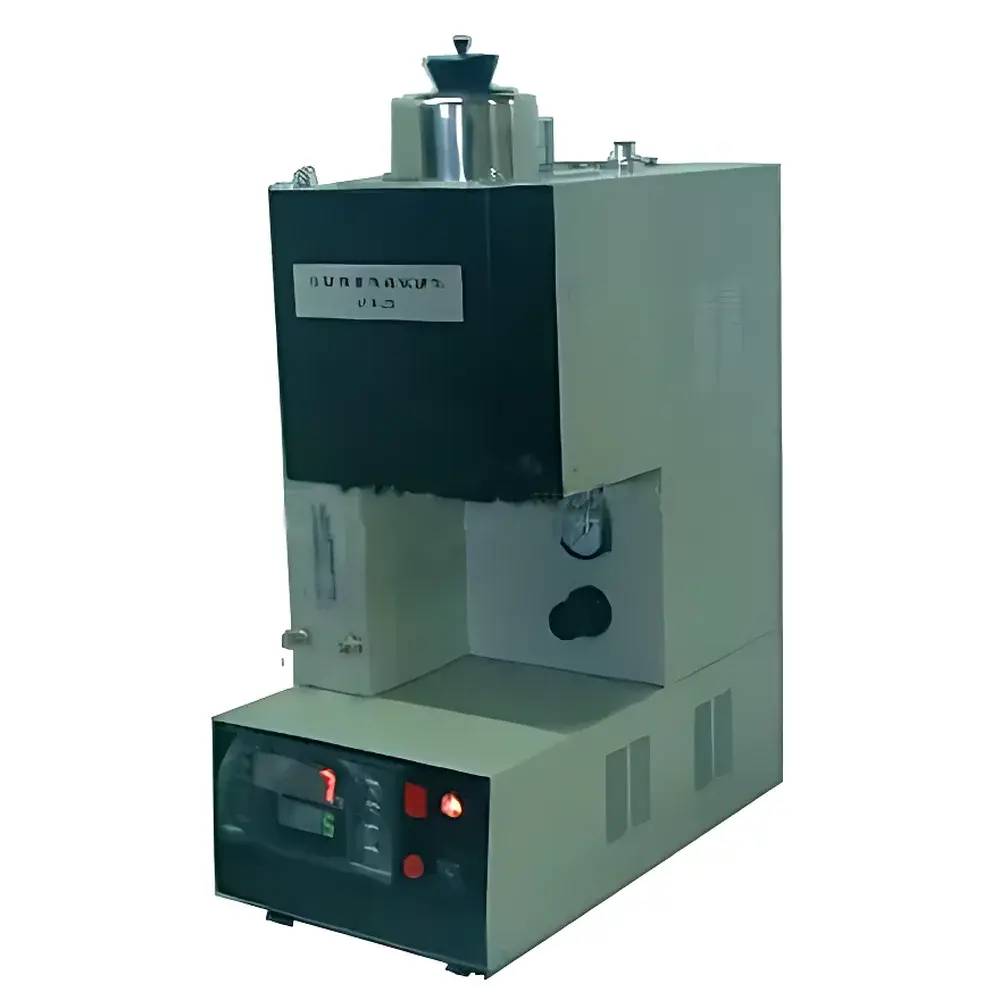
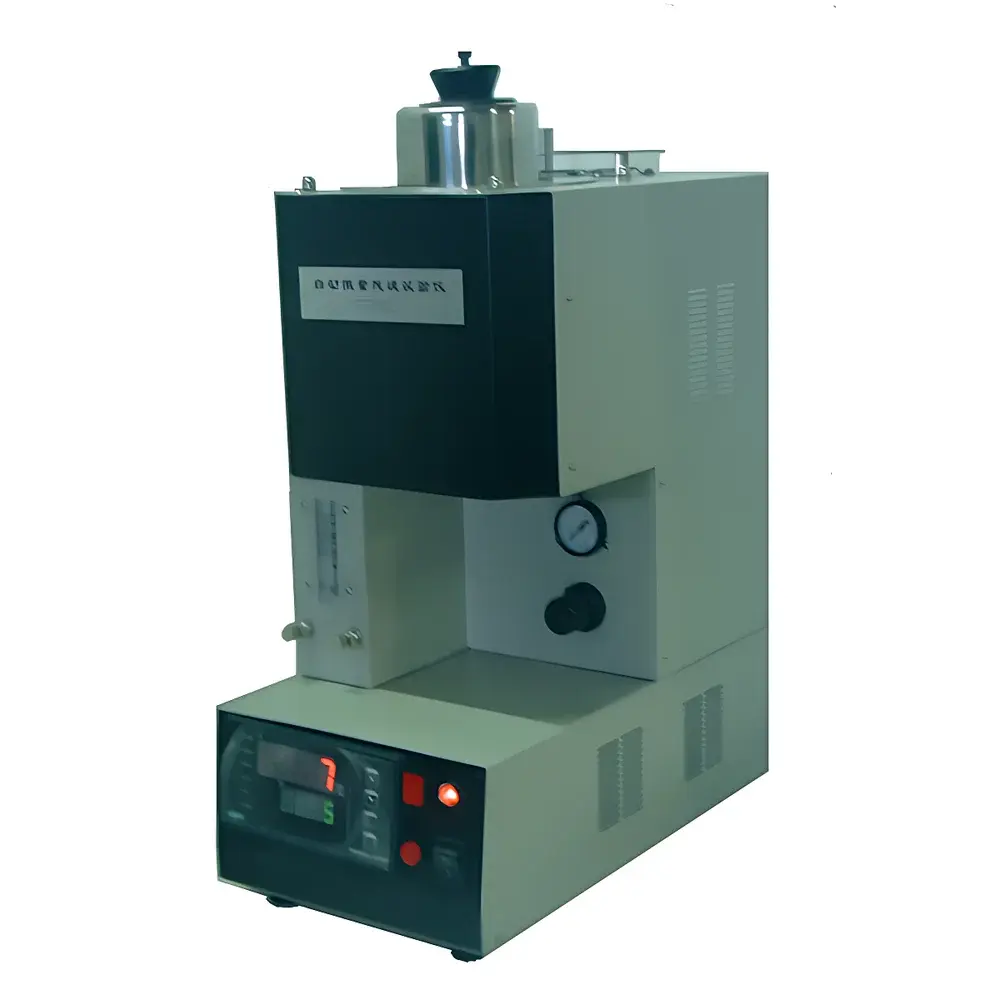
Xufeng CR-M12 Automated Micro Carbon Residue Tester for Organic Heat Transfer Fluids (GB/T 41733-2022 Compliant)
| Brand | Xufeng |
|---|---|
| Origin | Shanghai, China |
| Model | CR-M12 GBT41733 |
| Standards Compliance | GB/T 41733-2022, GB/T 17144-2008, ASTM D4530, ISO 10370, ASTM D189, GB/T 268 |
| Measuring Range | 0.10–30.0 wt% carbon residue |
| Temperature Control | Ambient to 500 °C, ±2.0 °C at 500 °C (15 min hold) |
| Gas Flow Control | 100–1000 mL/min, auto-switching between 150 mL/min and 600 mL/min |
| Pressure Regulation | 0–392 kPa (0–4 kg/cm²) |
| Sample Tube Options | Φ20×72 mm (GB/T 41733), Φ12×72 mm & Φ12×35 mm (GB/T 17144) |
| Combustion Chamber Dimensions | Φ85×105 mm |
| Heating Power | 1000 W |
| Waste Bottle Capacity | 200 mL threaded glass bottle |
| Exhaust Port Diameter | Φ12 mm |
| Instrument Weight | 15 kg |
| Dimensions (W×D×H) | 410×250×700 mm |
| N₂ Consumption | ~100 tests per standard 14.7 MPa (150 kg/cm²) cylinder |
Overview
The Xufeng CR-M12 Automated Micro Carbon Residue Tester is a precision-engineered laboratory instrument designed specifically for quantitative determination of carbon residue in organic heat transfer fluids (OHTFs) and petroleum products in accordance with GB/T 41733-2022 “Method for Determination of Carbon Residue of Organic Heat Transfer Fluids — Nitrogen Purge Method”, as well as the internationally harmonized micro-method standards GB/T 17144-2008, ASTM D4530, ISO 10370, and ASTM D189. The instrument implements the controlled pyrolysis principle under inert nitrogen atmosphere: a precisely weighed sample is heated in a sealed quartz or ceramic tube within a high-stability furnace, subjected to programmed thermal decomposition at 500 °C for 15 minutes, followed by cooling and gravimetric analysis of the non-volatile carbonaceous residue. This methodology eliminates oxidative interference and ensures reproducible quantification of coke-forming tendency—critical for monitoring thermal degradation stability of synthetic and mineral-based heat transfer oils used in industrial heating systems, solar thermal plants, and chemical process units.
Key Features
- Integrated vertical architecture with front-access combustion chamber and directly aligned 200 mL threaded-glass waste collection bottle—eliminating bent gas pathways that cause condensate trapping and simplifying maintenance.
- Dedicated pneumatic system featuring compact, modular layout with Japanese-sourced mass flow controllers, solenoid valves, and micro-needle valves for precise, repeatable gas delivery and switching between purge (150 mL/min) and combustion (600 mL/min) flow rates.
- Microprocessor-based control system with embedded self-diagnostic routines, automatic temperature ramping, dual-stage gas flow sequencing, and real-time fault detection—including overtemperature cutoff and pressure deviation alerts.
- High-fidelity thermal management: 1000 W heating element with PID-controlled furnace capable of maintaining 500 °C ±2.0 °C over a 15-minute dwell period; temperature uniformity validated across the Φ85×105 mm combustion zone.
- Flexible sample handling: supports three standardized tube geometries—Φ20×72 mm (for OHTFs per GB/T 41733), Φ12×72 mm, and Φ12×35 mm (for distillates per GB/T 17144)—with dedicated multi-hole sample racks (6- and 12-position) and ergonomic accessories including tweezers, tube holders, and high-temp exhaust hoses.
- Lab-integration ready: operates safely inside fume hoods; alternatively, optional direct-exhaust configuration enables connection to external venting via Φ12 mm耐温耐压 soft tubing—reducing footprint dependency on hood availability.
Sample Compatibility & Compliance
The CR-M12 is validated for use across a broad spectrum of hydrocarbon-based fluids. For organic heat transfer fluids (e.g., diphenyl/diphenyl oxide blends, alkylated aromatics, polyalkylene glycols), testing follows GB/T 41733-2022 using the large-diameter Φ20×72 mm sample tube under continuous nitrogen purge. For lighter petroleum fractions (e.g., diesel, jet fuel, lubricant base stocks), the method defaults to GB/T 17144-2008/ASTM D4530 using Φ12×72 mm tubes; samples with expected residue <0.10 wt% require prior preparation via ASTM D6536 (10 vol% distillation residue) before analysis. Measurement range spans 0.10–30.0 wt% carbon residue, with documented equivalence to Conradson carbon residue (GB/T 268) for samples above 0.10 wt%. All operational parameters—including temperature profile, gas flow timing, and pressure setpoints—are programmable and auditable to support GLP/GMP environments and regulatory submissions.
Software & Data Management
While the CR-M12 operates via embedded firmware without external PC dependency, its control logic incorporates full traceability features required for regulated laboratories. Each test cycle logs timestamp, setpoint temperatures, actual furnace temperature profile (sampled every 5 seconds), gas flow status transitions, pressure readings, and error flags. Data export is supported via USB interface to CSV format for integration into LIMS or QA documentation systems. Firmware complies with fundamental data integrity principles aligned with FDA 21 CFR Part 11 expectations—user access levels, electronic signature prompts for method changes, and immutable audit trails for critical parameters (e.g., hold time, final temperature) are implemented at the controller level. Routine calibration verification reports can be generated and archived alongside raw gravimetric records.
Applications
- Condition monitoring of organic heat transfer fluids in closed-loop industrial heating systems to detect early-stage thermal cracking and polymerization.
- Quality release testing of new OHTF batches against GB/T 41733-2022 specification limits (typically ≤0.10 wt% for virgin fluids).
- Accelerated aging studies correlating carbon residue buildup with service life prediction models.
- Routine QC of middle distillates and residual fuels per ASTM D4530 for refinery process control and blending optimization.
- Supporting compliance with ISO 5672 (heat transfer fluid specifications) and EN 12952-12 (water-tube boiler safety standards requiring thermal stability verification).
- Research applications in formulation development of high-temperature stable synthetic heat transfer media.
FAQ
What standards does the CR-M12 fully support?
The instrument is engineered and verified for GB/T 41733-2022 (organic heat transfer fluids), GB/T 17144-2008 (petroleum products), ASTM D4530, ISO 10370, and ASTM D189. It delivers results equivalent to GB/T 268 for samples ≥0.10 wt% carbon residue.
Can the CR-M12 analyze samples with very low carbon residue (<0.10 wt%)?
Yes—when applied to light distillates, users first prepare a 10 vol% distillation residue per ASTM D6536, then analyze the residue using the Φ12×72 mm tube configuration.
Is nitrogen the only acceptable purge gas?
Nitrogen is mandatory per GB/T 41733-2022 and ASTM D4530 to prevent oxidation artifacts; instrument gas train is rated for pressures up to 392 kPa and compatible with standard high-purity (99.999%) N₂ cylinders.
How often does the furnace require recalibration?
Annual verification using NIST-traceable thermocouples is recommended; built-in diagnostics continuously monitor heater resistance and thermal response consistency between cycles.
Are consumables included with initial purchase?
Standard configurations include two 200 mL waste bottles, 120 large and 120 medium sample tubes, six- and twelve-hole racks, and all essential fittings and safety components as listed in the accessory matrix.




