
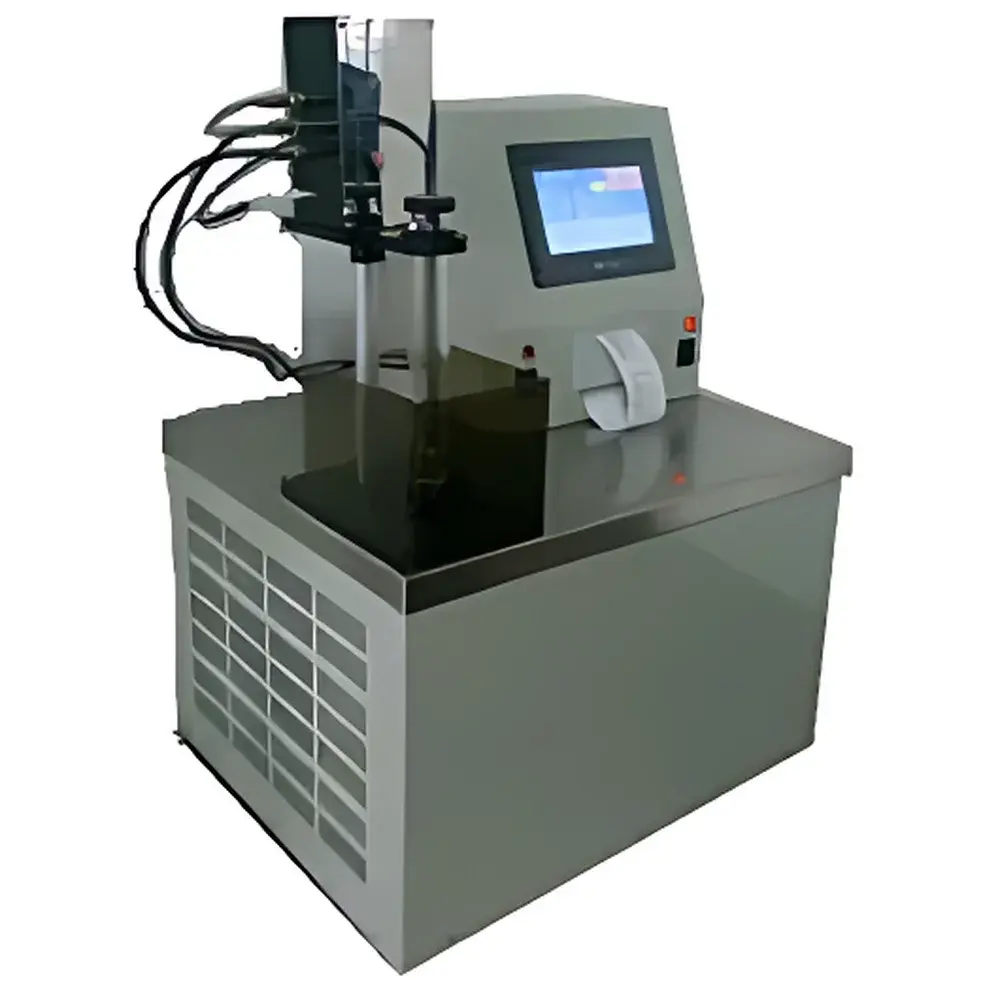
Xufeng XF-0090 ASTM D1177 Automated Freezing Point Tester for Engine Coolants
| Brand | Xufeng |
|---|---|
| Origin | Shanghai, China |
| Model | XF-0090 |
| Temperature Range | 40 °C to –80 °C |
| Temperature Resolution | 0.1 °C |
| Cooling Method | Cascade Compressor Refrigeration System |
| Sensor Type | PT100 (Cold Bath), Custom Platinum Resistance Thermometer (Sample) |
| Compliance | ASTM D1177, SH/T 0090 |
| Power Supply | AC 220 V, 50/60 Hz, 1500 W |
| Dimensions | 550 × 450 × 600 mm (W×D×H) |
| Weight | ~40 kg |
| Interface | RS-232C Serial Output |
Overview
The Xufeng XF-0090 Automated Freezing Point Tester is a precision benchtop instrument engineered for the accurate and repeatable determination of the freezing point of aqueous engine coolants in accordance with ASTM D1177 and SH/T 0090 standards. It employs a thermodynamic phase-transition detection principle: as the coolant sample cools under controlled conditions, the onset of ice crystal formation induces a detectable thermal arrest—identified via high-stability platinum resistance thermometry. The system continuously monitors temperature vs. time profiles, automatically identifies the freezing plateau using algorithmic slope analysis, and calculates the final freezing point to ±0.1 °C resolution. Designed for QC laboratories in OEM engine manufacturing, coolant formulation facilities, and third-party testing service providers, the XF-0090 eliminates operator subjectivity and manual observation errors inherent in traditional manual cryoscopic methods.
Key Features
- Microprocessor-controlled cascade compressor refrigeration system ensures stable, rapid cooling from +40 °C to –80 °C at programmable ramp rates, with thermal uniformity maintained within ±0.2 °C across the cold bath.
- Dual-sensor architecture: Pt100 sensor for cold bath temperature monitoring and a custom-calibrated platinum resistance thermometer immersed directly in the test sample for real-time, high-fidelity freezing point detection.
- Large backlit LCD display with intuitive Chinese–English bilingual interface provides real-time visualization of cooling curves, elapsed time, current temperature, freeze detection status, and pass/fail indicators against method-defined criteria.
- Fully automated workflow—from sample loading and thermal equilibration to plateau detection, result calculation, and report generation—requires no manual intervention beyond initial setup.
- Integrated thermal printer outputs full test reports including instrument ID, date/time stamp, sample ID, cooling curve plot (time vs. temperature), detected freezing point, number of replicate cycles, and system diagnostic flags.
- RS-232C serial interface enables seamless integration into LIMS or laboratory informatics platforms; supports ASCII-based data export for traceability and audit compliance.
- Self-diagnostic firmware continuously monitors refrigeration performance, sensor integrity, power stability, and thermal response anomalies—triggering audible alarms and on-screen fault codes per IEC 61000-4 electromagnetic compatibility guidelines.
- Compact desktop footprint (550 × 450 × 600 mm) and 40 kg mass allow deployment in space-constrained QC labs without dedicated utility infrastructure.
Sample Compatibility & Compliance
The XF-0090 is validated exclusively for aqueous ethylene glycol– or propylene glycol–based engine coolants, including concentrated formulations and pre-diluted ready-to-use solutions. It is not intended for non-aqueous fluids, hydrocarbon fuels, or refrigerants. All operational parameters—including cooling rate profiles, hold times, and detection thresholds—are aligned with the procedural requirements of ASTM D1177 “Standard Test Method for Freezing Point of Aqueous Engine Coolants” and its Chinese national counterpart SH/T 0090. The instrument’s measurement uncertainty budget has been verified against NIST-traceable reference standards (e.g., certified water–glycol mixtures) and satisfies GLP documentation requirements for method validation records. Data integrity features—including immutable timestamped logs, electronic signatures (via optional software module), and audit-trail-enabled operation history—support alignment with FDA 21 CFR Part 11 when deployed in regulated automotive supply chain environments.
Software & Data Management
While the XF-0090 operates autonomously via embedded firmware, its RS-232C port supports bidirectional communication with external PC-based control software (optional). This software layer enables remote instrument configuration, batch test scheduling, trend analysis across historical runs, and export of raw temperature–time datasets in CSV format. All printed reports include machine-readable barcodes linking to internal test IDs, facilitating cross-referencing with ERP or QMS systems. Firmware updates are delivered via USB flash drive and retain full backward compatibility with prior calibration certificates and method configurations.
Applications
- Quality conformance testing of OEM-specified coolant batches prior to shipment.
- In-process verification during coolant blending and dilution operations.
- Stability assessment of long-life coolants after thermal aging or oxidation exposure.
- Technical support for field failure investigations involving coolant freezing-related engine damage.
- Method transfer and interlaboratory comparison studies under ISO/IEC 17025 accreditation frameworks.
FAQ
What standards does the XF-0090 fully comply with?
ASTM D1177 and SH/T 0090 are natively implemented in the instrument’s firmware logic and cooling protocol sequencing.
Can the XF-0090 be used for aviation fuel ice point testing?
No—this instrument is specifically designed for aqueous coolant matrices per ASTM D1177; aviation fuel testing requires ASTM D5972, D7153, or D5901–compliant systems with laser scattering or phase transition optics.
Is calibration traceable to national standards?
Yes—factory calibration uses NIST-traceable Pt100 reference probes and certified glycol–water standards; users receive a calibration certificate with each unit.
Does the instrument support multi-sample unattended operation?
No—it processes one sample per cycle; sequential testing requires manual reloading, though total cycle time (including cooldown reset) is ≤25 minutes.
What maintenance is required for the cascade refrigeration system?
Annual inspection of refrigerant charge and condenser coil cleaning is recommended; no user-serviceable parts exist within the sealed compressor assembly.






