
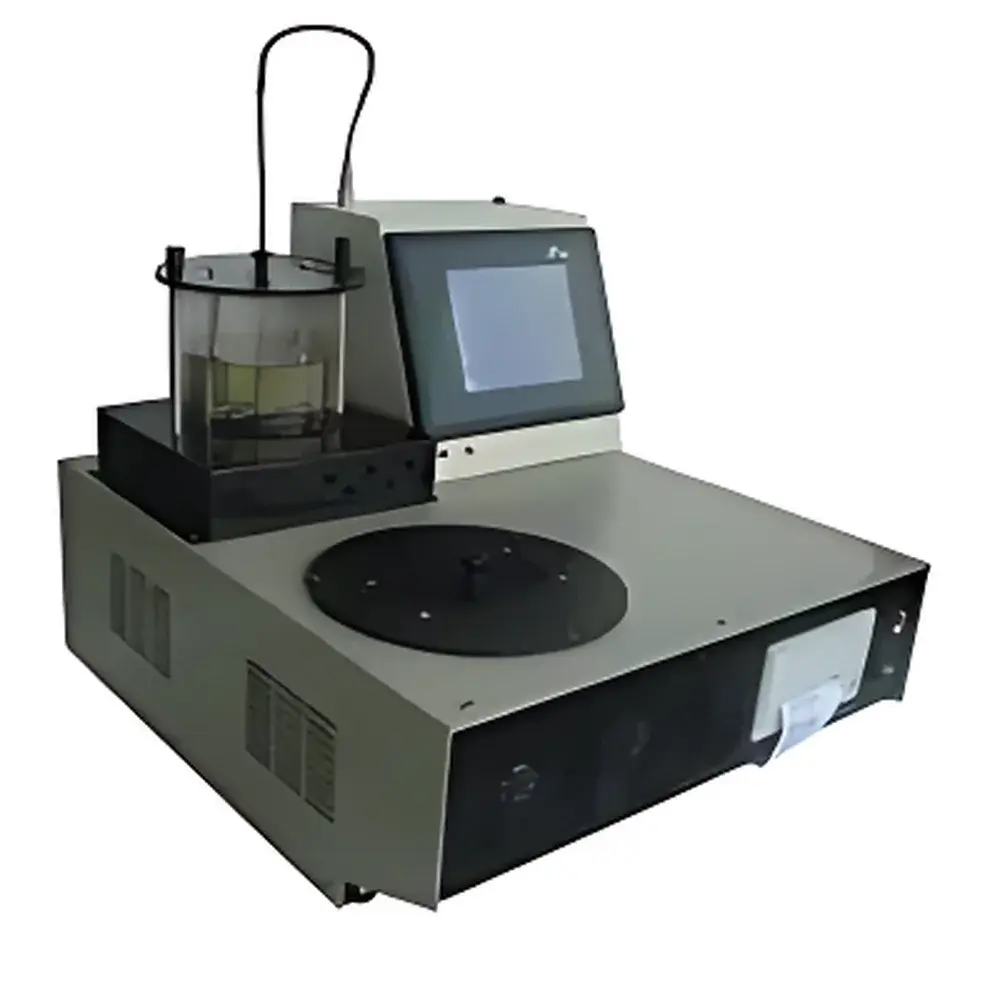
Xufeng XF-36 Automatic Ring-and-Ball Softening Point Tester
| Brand | Xufeng |
|---|---|
| Origin | Shanghai, China |
| Model | XF-36 |
| Standard Compliance | GB/T 4507, ASTM D36/D36M-09 |
| Temperature Range (XF-36A) | Ambient to 200 °C |
| Temperature Range (XF-36B) | Ambient to 200 °C (test bath) + 0–10 °C (air-cooled sample prep bath) |
| Temperature Control Accuracy | ±0.1 °C (both baths) |
| Detection Method | Fiber-optic photoelectric detection |
| Display | Large-format Windows-based LCD interface |
| Data Storage | 100 test records per method profile |
| Power Consumption | 800 W |
| Dimensions (W×D×H) | 380 × 240 × 350 mm |
| Weight | ~10 kg |
| Interface | RS-232C |
Overview
The Xufeng XF-36 Automatic Ring-and-Ball Softening Point Tester is a precision-engineered instrument designed for the standardized determination of the softening point of bituminous materials—including paving-grade asphalts, roofing asphalts, and modified bitumen binders—according to the internationally recognized ring-and-ball principle. Based on the thermo-mechanical deformation behavior of asphalt under controlled heating, the instrument measures the temperature at which a standardized steel ball, resting on a specimen held in a brass ring, descends a defined distance (25.4 mm) through a heated medium (typically glycerin or water). This method provides a reproducible, comparative index of thermoplastic transition behavior critical for quality control, formulation validation, and compliance verification in petroleum refining, road construction materials testing, and polymer-modified asphalt R&D laboratories.
Key Features
- Full automation of the ASTM D36 / GB/T 4507 ring-and-ball softening point test sequence—including ramped heating, real-time optical displacement detection, endpoint recognition, and result calculation—eliminating manual observation bias and operator variability.
- Dual-bath configuration (XF-36B model) integrates a high-stability main heating bath (ambient to 200 °C) with an independently controlled air-cooled sample preparation chamber (0–10 °C), enabling precise thermal conditioning of specimens prior to loading—critical for low-softening-point asphalts and elastomeric modifiers.
- Fiber-optic photoelectric sensors provide non-contact, high-resolution detection of ball descent with sub-millimeter positional accuracy, ensuring consistent endpoint identification across repeated tests.
- Windows-based graphical LCD interface supports intuitive method setup, real-time monitoring of both bath temperatures and displacement status, dynamic display of temperature ramp profiles, and immediate visualization of calculated softening points and statistical averages.
- Onboard diagnostics continuously monitor heater performance, sensor integrity, and thermal stability; system faults trigger context-specific alert screens and audible notifications to prevent invalid test execution.
- RS-232C serial interface enables bidirectional communication with LIMS or centralized QA/QC data management platforms, supporting audit-ready data export and remote parameter synchronization.
- Stainless-steel chassis and modular internal architecture ensure long-term mechanical stability, corrosion resistance in glycerin-rich environments, and ease of maintenance in high-throughput laboratory settings.
Sample Compatibility & Compliance
The XF-36 is validated for use with standard ASTM D36-compliant brass rings (15.9 mm inner diameter, 6.4 mm height), 9.53 mm steel balls (3.5 g mass), and common test media including distilled water (for softening points ≤ 80 °C) and USP-grade glycerin (for points up to 200 °C). It meets the dimensional, thermal, and procedural requirements of GB/T 4507–1999, ASTM D36/D36M–09, ISO 4625:1980, and JIS K 6220–2014. Instrument design incorporates traceable PT-100 platinum resistance thermometers calibrated to NIST-traceable standards. Data logging and user-access controls support alignment with GLP and GMP documentation practices, including operator ID tagging and timestamped record retention.
Software & Data Management
The embedded firmware implements a deterministic real-time control loop for temperature ramping (0.5 °C/min default, adjustable per method), synchronized with continuous optical sampling at 10 Hz. Each test record stores raw temperature vs. time data, detected descent onset/endpoint timestamps, calculated softening point (°C), and arithmetic mean for dual-sample runs. Up to 100 test results per method profile are retained in non-volatile memory with automatic overwrite protection. Exported CSV files include full metadata (operator ID, date/time, bath ID, calibration status flags) suitable for FDA 21 CFR Part 11–compliant review workflows when integrated with validated third-party LIMS software.
Applications
- Quality assurance of virgin and recycled asphalt binders in refinery QC labs and asphalt plant laboratories.
- Evaluation of polymer-modified asphalt (PMA) thermal stability during hot-mix asphalt (HMA) production process development.
- Comparative analysis of aging effects (RTFOT, PAV) on binder rheology via softening point shift assessment.
- Specification conformance testing for national infrastructure projects requiring ASTM D36 or GB/T 4507 certification.
- Research into bio-based asphalt alternatives and crumb rubber–modified binders where thermoplastic transition behavior informs processing temperature windows.
FAQ
What standards does the XF-36 comply with?
The instrument fully satisfies the apparatus, procedure, and reporting requirements of ASTM D36/D36M–09 and GB/T 4507–1999, with additional compatibility for ISO 4625 and JIS K 6220.
Can the XF-36 perform simultaneous dual-sample tests?
Yes—the XF-36B model supports concurrent testing of two independent samples in separate rings within the same heating bath, enabling direct comparison or statistical averaging per ASTM D36 Annex A1.
Is external calibration required?
The built-in PT-100 sensors are factory-calibrated to ±0.05 °C against NIST-traceable references; users may perform periodic verification using certified thermometer standards per ASTM E77 or ISO 17025 protocols.
How is data integrity ensured during network transmission?
RS-232C output delivers ASCII-formatted, delimiter-separated records with embedded checksums; when interfaced with validated LIMS, full electronic audit trails—including user actions, parameter changes, and result approvals—are maintained per 21 CFR Part 11 guidelines.
What maintenance intervals are recommended?
Routine cleaning of brass rings and ball surfaces after each test batch is mandatory; annual verification of thermal uniformity across the bath and optical alignment of fiber sensors is advised for laboratories operating under ISO/IEC 17025 accreditation.






