
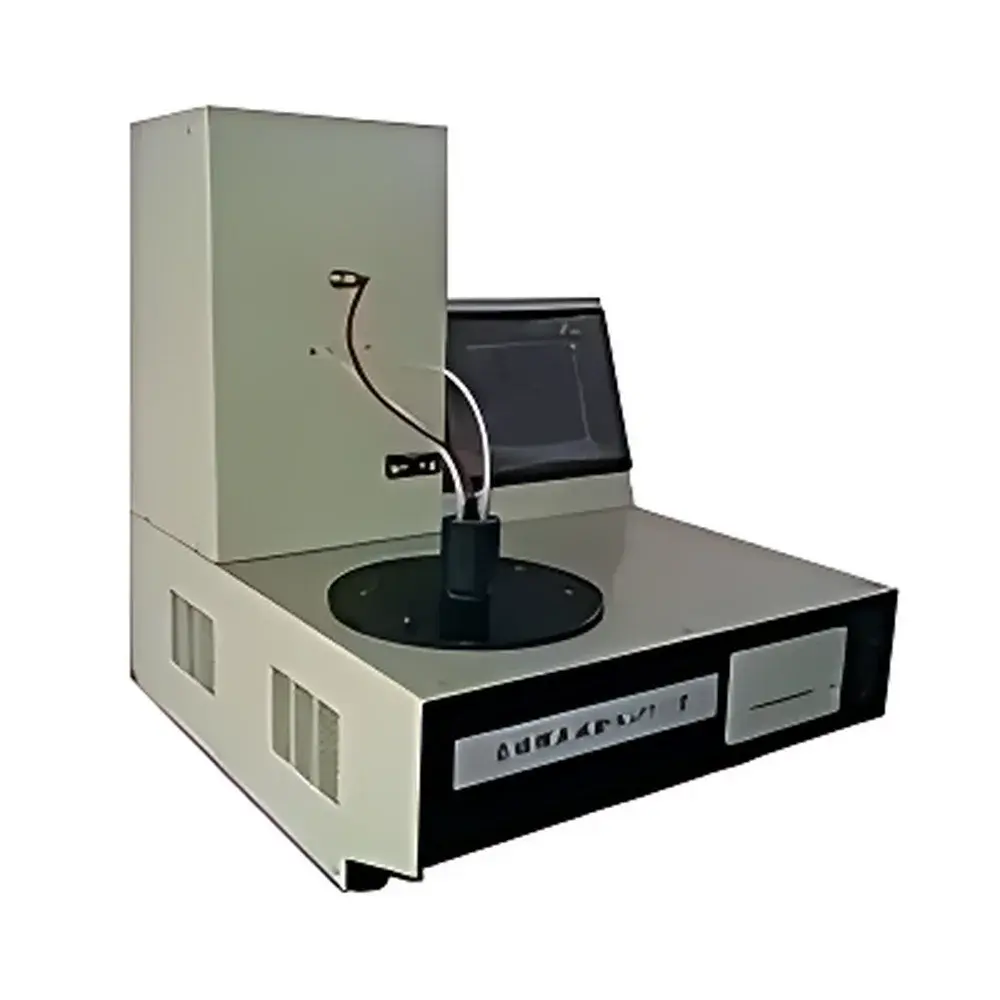
XF-97A Automatic Pour Point Tester (Single-Cup, Air-Pressure Detection Method) – Xufeng
| Brand | Xufeng |
|---|---|
| Model | XF-97A |
| Temperature Range | −20 °C to 50 °C |
| Detection Method | Automatic Air-Pressure Detection |
| Compliance | ASTM D6749, ASTM D97, GB/T 3535 |
| Cooling System | Integrated Semiconductor Cascade Cooler |
| Temperature Resolution | 0.1 °C |
| Sensor Type | PT100 Platinum Resistance Thermometer & High-Sensitivity Optical Fiber Detector |
| Display | 7-inch TFT Touchscreen with Embedded Windows-Based UI |
| Data Output | RS-232C Serial Interface, Built-in Dot-Matrix Printer |
| Power Supply | AC 220 V, 50/60 Hz, 1500 W |
| Dimensions (W×D×H) | 250 × 280 × 290 mm |
| Weight | ~25 kg |
Overview
The XF-97A Automatic Pour Point Tester (Single-Cup, Air-Pressure Detection Method) is a precision-engineered benchtop instrument designed for the standardized determination of the pour point of petroleum products—including lubricating oils, diesel fuels, crude oils, and distillates—according to internationally recognized test methods. It operates on the principle of automatic air-pressure detection, as specified in ASTM D6749, which supersedes and improves upon the classical manual tilt-and-observe procedure defined in ASTM D97 and GB/T 3535. In this method, sample viscosity increase during controlled cooling is monitored via real-time pressure transduction across a sealed capillary column; solidification onset is identified by a measurable resistance to air flow, eliminating subjectivity and operator dependency. The instrument integrates a compact semiconductor cascade cooling system capable of stable thermal control from −20 °C to +50 °C with ±0.1 °C resolution, enabling reproducible ramp-down rates (typically 1.5 °C/min per ASTM D6749) and precise endpoint detection. Its all-stainless-steel chassis ensures chemical resistance and long-term mechanical stability in demanding QC/QA laboratory environments.
Key Features
- Integrated semiconductor cascade refrigeration system—no external coolant or cryogenic fluids required; eliminates maintenance overhead and safety hazards associated with liquid nitrogen or dry ice.
- Optical fiber-based pour point detection with sub-second response time—provides high-resolution phase-transition identification without mechanical contact or sample disturbance.
- 7-inch capacitive touchscreen with embedded Windows CE–based interface—supports intuitive parameter setup, real-time cooling curve visualization, and on-screen diagnostics.
- Onboard dot-matrix printer—automatically generates hard-copy reports containing test conditions (cooling rate, hold times), final pour point result, timestamp, and instrument ID—fully compliant with GLP documentation requirements.
- RS-232C serial port for bidirectional communication with LIMS or laboratory PCs—enables automated data logging, remote firmware updates, and centralized instrument management.
- Self-diagnostic architecture with audible alarm and contextual error display—detects sensor drift, refrigeration failure, pressure seal integrity loss, and thermal overshoot in real time.
- Minimal sample consumption: only 5 mL per test—reduces reagent cost, waste generation, and exposure risk during handling of volatile or hazardous hydrocarbons.
- Programmable cooling profiles compliant with ASTM D6749 Annex A1 (standard ramp) and optional user-defined sequences for method development or non-standard materials.
Sample Compatibility & Compliance
The XF-97A is validated for use with transparent and opaque petroleum liquids exhibiting pour points within the instrument’s operational range (−20 °C to +50 °C). It accommodates standard ASTM D6749 sample tubes (16 mm OD × 125 mm length) and supports routine testing of base oils, finished lubricants, jet fuels (Jet A-1, JP-8), biodiesel blends (B5–B20), and heavy fuel oils after appropriate dilution. All measurement protocols conform strictly to the procedural constraints of ASTM D6749–22 (Standard Test Method for Pour Point of Petroleum Products – Automatic Air Pressure Method), including prescribed cooling rates, temperature stabilization intervals, and pass/fail criteria for air-pressure threshold detection. Equivalent conformance is demonstrated against ASTM D97–21 and GB/T 3535–2022. Instrument validation documentation includes as-delivered temperature uniformity mapping, pressure sensor calibration certificates traceable to NIST standards, and interlaboratory reproducibility data per ISO/IEC 17025:2017 clause 7.7.
Software & Data Management
The embedded control software implements deterministic real-time task scheduling to guarantee synchronized thermoregulation, pressure sampling (10 Hz), and logic-driven decision trees per ASTM D6749 section 8. Data files are stored internally in CSV format with ISO 8601 timestamps and include raw sensor traces, derivative curves (dP/dt), and annotated event markers (e.g., “hold initiated”, “pour point confirmed”). Export options include USB flash drive dump and RS-232 streaming to third-party SCADA or ELN platforms. Audit trail functionality records all user actions—including method edits, calibration events, and result overrides—with immutable timestamps and operator IDs, satisfying FDA 21 CFR Part 11 electronic record requirements when deployed with appropriate access controls and electronic signatures. Optional PC-based software (Xufeng LabLink v3.2) provides advanced statistical process control (SPC) charting, multi-instrument fleet monitoring, and automated report generation aligned with ISO/IEC 17025 clause 7.8.2.
Applications
This instrument serves critical quality assurance functions across upstream, midstream, and downstream petroleum operations. Refineries deploy it for incoming crude assay verification and finished product release testing—ensuring cold-flow properties meet regional specifications (e.g., EN 590 for winter diesel in EU markets). Lubricant manufacturers rely on its repeatability (RSD < 1.2 °C per ASTM D6749 repeatability limit) to qualify additive packages affecting wax crystallization kinetics. Independent testing labs use the XF-97A in contract analyses supporting API licensing, customs clearance, and litigation-grade forensic characterization. Research applications include structure–property studies of paraffinic vs. naphthenic base stocks, evaluation of cold-flow improvers (CFIs), and accelerated aging simulations under controlled thermal cycling. Its compact footprint and low power demand make it suitable for mobile field laboratories operating aboard offshore platforms or pipeline inspection units.
FAQ
What standards does the XF-97A fully comply with?
ASTM D6749 (primary), ASTM D97 (equivalent performance), and GB/T 3535—verified through third-party method validation reports.
Is external refrigeration required for operation?
No—the integrated semiconductor cascade cooler delivers full −20 °C capability without auxiliary chillers, LN₂, or compressor-based systems.
Can test data be exported to LIMS without manual transcription?
Yes—via RS-232C serial interface with configurable ASCII protocol; drivers available for Thermo Fisher SampleManager, LabVantage, and STARLIMS.
What is the minimum sample volume required per test?
5 mL—compatible with standard ASTM D6749 sample tubes and sufficient for duplicate analysis if needed.
Does the instrument support audit-trail generation for regulated environments?
Yes—full electronic audit trail with user authentication, timestamped action logs, and tamper-evident data storage meets FDA 21 CFR Part 11 and ISO/IEC 17025 requirements.
How is calibration maintained over time?
The system includes automated self-calibration routines for temperature (PT100) and pressure sensors; NIST-traceable calibration kits and annual service contracts are available.




