
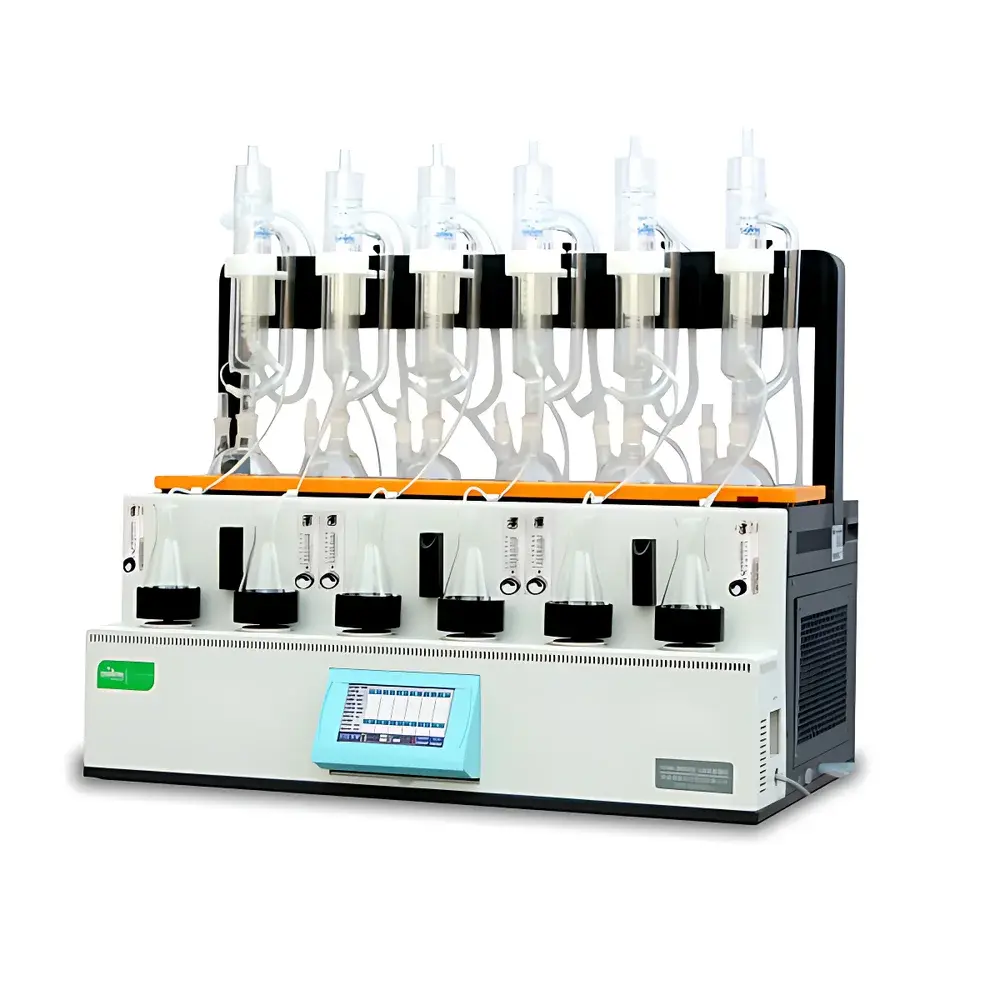
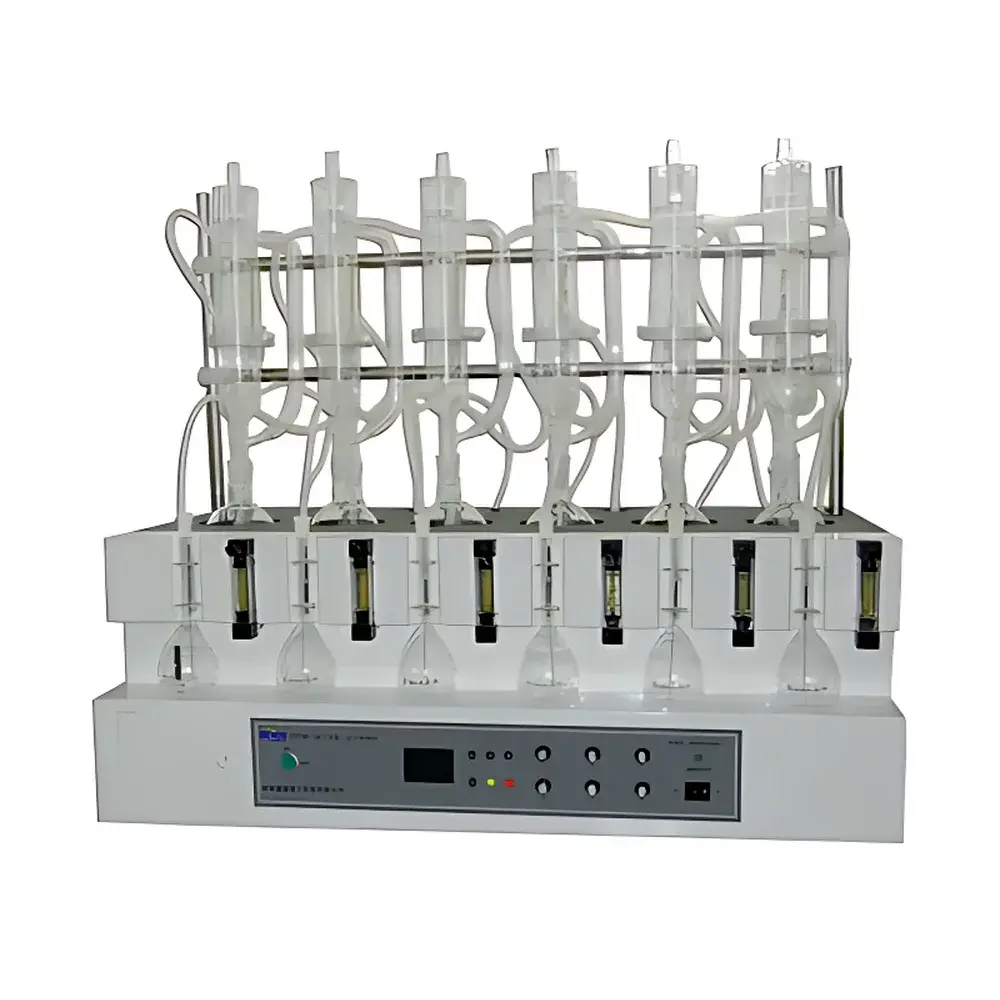
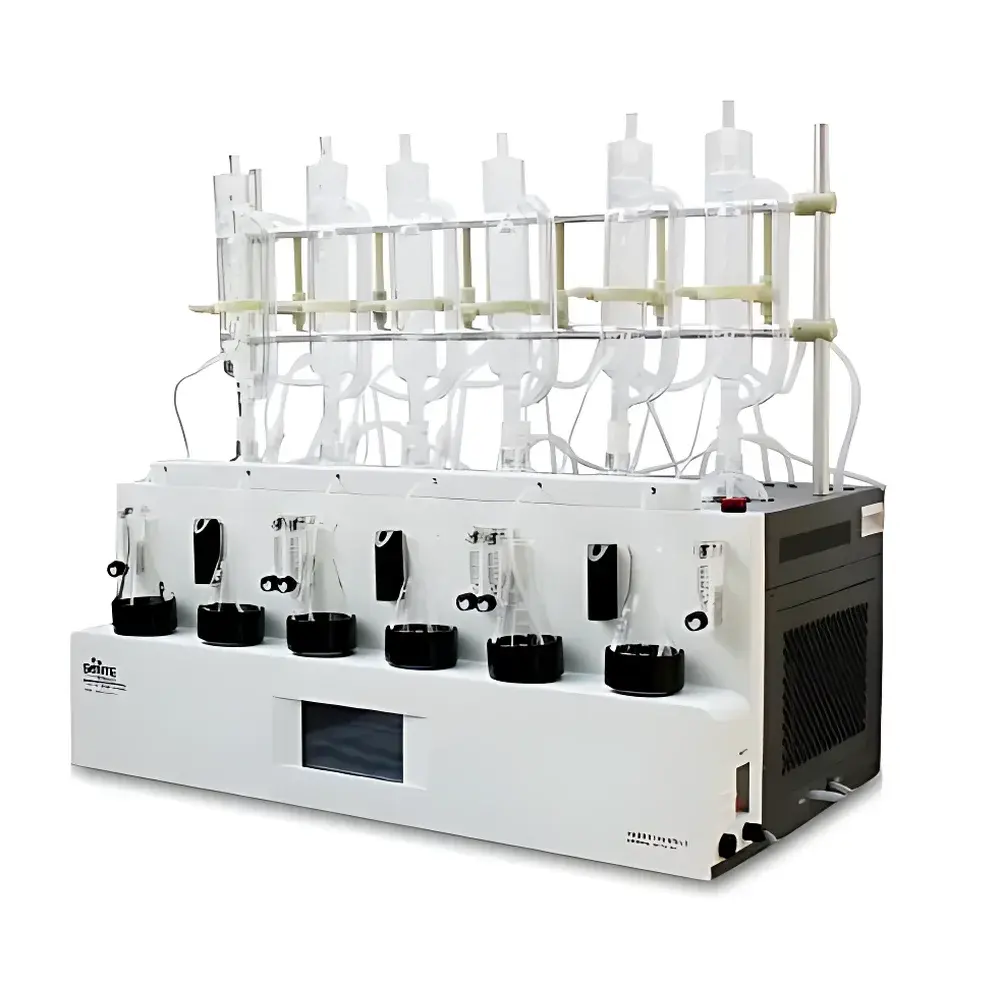
SENTE ST106-1RW Intelligent Integrated Distillation Apparatus
| Brand | SENTE |
|---|---|
| Origin | Shandong, China |
| Manufacturer Type | Direct Manufacturer |
| Country of Origin | China |
| Model | ST106-1RW |
| Heating Method | Far-Infrared Ceramic Heater |
| Cooling Method | Built-in Compressor-Based Closed-Circuit Cooling System |
| Distillation Rate | 2–12 mL/min |
| Heating Ramp Time | ≤8 min (to target temperature) |
| Distillation Endpoint Control Range | 0–1000 mL |
| Number of Independent Heating Channels | 6 |
| Single-Channel Quantitative Distillation Accuracy | ±2 mL (1–500 mL range) |
| Nitrogen Purge Flow Control per Channel | 60–600 mL/min |
| Condenser Type | Spherical Reflux Condenser with Standard Taper (GT14/23) Interface |
| Anti-Suck-Back Protection | Integrated |
| Cooling Water Circulation | Self-contained, No External Tap Water Required |
Overview
The SENTE ST106-1RW Intelligent Integrated Distillation Apparatus is an engineered solution for automated, reproducible, and compliant distillation in analytical laboratories—particularly those engaged in food safety testing, regulatory compliance, and quality control workflows. Unlike conventional modular distillation systems requiring discrete heating mantles, condensers, cooling water sources, and manual endpoint monitoring, the ST106-1RW integrates all critical functions—including far-infrared ceramic heating, compressor-driven closed-loop refrigeration, real-time volume-based endpoint detection, and nitrogen-assisted inert atmosphere control—into a single compact chassis. Its operational principle relies on precise volumetric collection coupled with thermal regulation to achieve stoichiometric recovery of volatile analytes such as sulfur dioxide (SO₂), formaldehyde, ethanol, and other low-boiling-point compounds under standardized test conditions (e.g., GB 5009.34, GB 5009.48, AOAC 971.23). The system operates without open flame or external water supply, eliminating vapor explosion hazards and reducing infrastructure dependencies.
Key Features
- 6 independent distillation channels with individual far-infrared ceramic heating elements—each equipped with rotary power adjustment for fine-tuned thermal input across diverse sample matrices.
- Integrated compressor-based cooling system maintains consistent condenser surface temperature (typically 0–5 °C), enabling high-efficiency reflux and minimizing analyte loss due to incomplete condensation.
- Volumetric endpoint detection with ±2 mL accuracy over 1–500 mL range; automatic termination and channel isolation prevent over-distillation and cross-contamination.
- Spherical reflux condenser with standard taper (GT14/23) joints facilitates rapid disassembly, cleaning, and residue removal—critical for high-throughput labs handling viscous or particulate-laden samples.
- Dedicated nitrogen purge capability per channel (60–600 mL/min), adjustable via precision flow valves, supports oxygen-sensitive distillations and improves recovery of volatile organics.
- Patented anti-suck-back mechanism prevents backflow during pressure fluctuations or abrupt system shutdown—enhancing operator safety and sample integrity.
- Self-contained cooling circuit eliminates reliance on municipal tap water, reducing lab utility load and enabling operation in water-restricted environments.
Sample Compatibility & Compliance
The ST106-1RW accommodates standard 500 mL round-bottom flasks and 250 mL receiving flasks compatible with common digestion and distillation protocols. It supports aqueous, acidic (e.g., HCl, H₃PO₄), and mildly organic solvent-based matrices typical in food and environmental testing. The system’s design aligns with core principles of Good Laboratory Practice (GLP) and ISO/IEC 17025:2017 requirements for method validation and equipment traceability. While not certified to IEC 61000-6-3 or UL 61010-1 out-of-the-box, its electrical architecture complies with CE-marking essential requirements for laboratory apparatus. Documentation packages include calibration records, maintenance logs, and IQ/OQ templates suitable for FDA-regulated environments operating under 21 CFR Part 11-compliant data management frameworks.
Software & Data Management
The ST106-1RW operates via embedded microcontroller firmware with local LCD interface—no PC dependency required for routine operation. All distillation parameters (start time, target volume, heating power per channel, nitrogen flow rate, actual collected volume, endpoint confirmation timestamp) are logged internally with non-volatile memory retention (>10,000 cycles). Optional RS-485 or USB-to-serial interface enables integration into LIMS or ELN platforms for automated data export. Audit trail functionality captures user ID (via optional RFID badge reader), parameter changes, and system alerts—supporting GLP/GMP audit readiness and electronic record integrity per ALCOA+ principles.
Applications
- Determination of SO₂ residues in dried fruits, wine, and preserved vegetables per GB 5009.34–2022 and AOAC Official Method 971.23.
- Quantification of free formaldehyde in starch-based food additives and packaging materials (GB 5009.48–2016).
- Alcohol content analysis in fermented beverages using total distillate collection prior to density or GC-FID measurement.
- Distillation of volatile phenols, cyanide, and ammonia from wastewater and soil extracts (EPA Method 350.1, ISO 5667-16).
- Preparative isolation of heat-labile volatiles in natural product extraction workflows where steam distillation must avoid thermal degradation.
FAQ
Is the ST106-1RW compatible with USP or ASTM distillation methods?
Yes—the system’s volumetric endpoint control, temperature stability, and condenser geometry support adaptation to ASTM D1122 (determination of water in petroleum products) and USP <731> (alcohol determination), provided method-specific validation is performed.
Can the instrument be validated for GMP use?
It supports IQ/OQ documentation and provides electronic audit trails; however, PQ must be conducted per site-specific SOPs and analyte recovery studies.
What maintenance is required for the compressor cooling system?
Annual inspection of refrigerant charge and condenser coil cleanliness is recommended; no routine oil changes are needed as it employs a sealed hermetic compressor.
Does the system meet electrical safety standards for international deployment?
It meets CE Low Voltage Directive (2014/35/EU) and EMC Directive (2014/30/EU); users outside China should verify local import certification requirements (e.g., UKCA, KC Mark, RCM).
How is calibration verified for volumetric endpoint accuracy?
Calibration is performed using Class A volumetric flasks traceable to NIM (China National Institute of Metrology); certificate includes uncertainty budget per ISO/IEC 17025.



