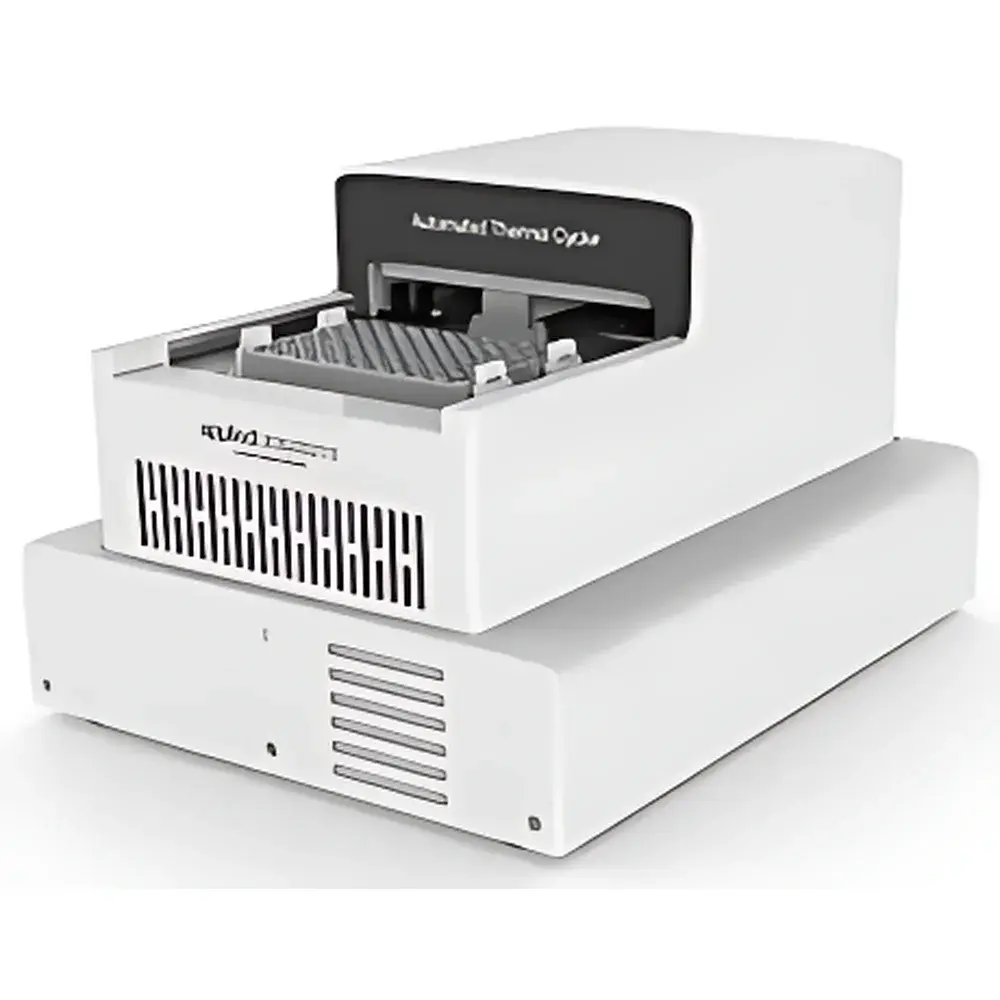
Applied Biosystems ATC Automated Thermal Cycler
| Brand | Applied Biosystems |
|---|---|
| Origin | Singapore |
| Model | ATC |
| Sample Capacity | 96-well and 384-well plates |
| Ramp Rate | 3.5°C/s |
| Temperature Accuracy | ±0.25°C (35–99.9°C) |
| Well-to-Well Uniformity | ≤0.5°C (20 seconds after reaching 95°C) |
| Compliance | SiLA Rapid Integration™ certified |
| Software Interface | RESTful APIs, preconfigured for Beckman Coulter, Hamilton, and other major automation platforms |
Overview
The Applied Biosystems ATC Automated Thermal Cycler is an engineered solution for integration into modern laboratory automation ecosystems. Built upon the foundational thermal performance of the legacy Applied Biosystems 9700 platform—but reimagined for robotic compatibility—the ATC implements precise Peltier-based thermal cycling with real-time closed-loop feedback control. Its core architecture supports two primary operational modes: standalone thermal cycling and fully integrated operation within liquid handling workflows governed by standardized automation protocols. Unlike conventional benchtop cyclers, the ATC decouples thermal control from user interface: the control module is physically separable from the heating block via configurable cabling (10 cm, 1 m, or 3 m), enabling placement beneath workbenches or inside automated enclosures. This modularity ensures compliance with spatial constraints in high-density robotic workcells while maintaining traceable temperature calibration across the full operating range (35–99.9°C).
Key Features
- Modular hardware design with detachable control unit—enables flexible installation in automated enclosures, under benches, or at remote locations up to 3 meters from the thermal block
- Automated sliding heat lid with motorized actuation—ensures consistent thermal contact across full-skirted 96-well and 384-well plates; compatible with half-skirted 96-well formats
- High-fidelity thermal performance: ±0.25°C accuracy and ≤0.5°C well-to-well uniformity (measured 20 s post-95°C ramp), validated per ISO/IEC 17025-accredited internal protocols
- SiLA Rapid Integration™ certification—guarantees interoperability with standardized laboratory automation frameworks without custom driver development
- Built-in RESTful APIs and preconfigured protocol adapters for Beckman Coulter Biomek, Hamilton STAR, Tecan Fluent, and other major liquid handling platforms
- Dual-mode software support: standalone operation via free ATC Demo Software (including Applied Biosystems 9700 emulation mode) and seamless API-driven orchestration within enterprise LIMS or ELN environments
Sample Compatibility & Compliance
The ATC accepts industry-standard microplates conforming to ANSI/SBS dimensions, including full-skirted 96-well and 384-well PCR plates. Half-skirted 96-well plates are supported in the 96-well configuration only. All thermal profiles—including fast-ramp protocols requiring 3.5°C/s transitions—are validated using NIST-traceable reference standards. The instrument meets IEC 61010-1 safety requirements for laboratory equipment and complies with electromagnetic compatibility (EMC) directives (EN 61326-1). For regulated environments, audit trails, electronic signatures, and protocol versioning are supported through integration with 21 CFR Part 11-compliant middleware; native logging does not satisfy FDA requirements without external validation.
Software & Data Management
ATC software operates on a dual-layer architecture: a low-level firmware layer managing thermal execution and hardware abstraction, and a high-level application layer delivering protocol definition, scheduling, and diagnostics. The included ATC Demo Software provides full local control—including method import/export, real-time temperature monitoring, and cycle-by-cycle log export in CSV format. When deployed in automated workflows, the device exposes a documented REST API supporting HTTP POST/GET commands for run initiation, status polling, error reporting, and parameter retrieval. All API interactions generate timestamped, immutable logs suitable for GLP/GMP audit review. Protocol libraries are stored externally, ensuring version consistency across instrument fleets and eliminating firmware-level method lock-in.
Applications
- High-throughput genotyping pipelines where thermal cycling must synchronize precisely with robotic plate staging and liquid transfer
- qPCR assay development requiring identical thermal profiles across legacy (e.g., ABI 9700) and next-generation automated platforms
- Biobanking and clinical sample processing workflows subject to CAP/CLIA accreditation—leveraging consistent thermal uniformity and traceable calibration
- CRISPR library amplification and NGS library prep where evaporation minimization and inter-well reproducibility directly impact sequencing depth uniformity
- Automated diagnostic assay validation under ISO 15189 or ISO 13485 quality management systems
FAQ
Does the ATC require proprietary consumables or licensed reagents?
No. The ATC is consumable-agnostic and compatible with all standard PCR tubes and plates meeting ANSI/SBS dimensional specifications.
Can the ATC be operated without connection to an automation system?
Yes. The included ATC Demo Software enables full standalone operation, including protocol editing, real-time monitoring, and data export—no automation infrastructure required.
Is temperature calibration performed at the factory, and can it be verified onsite?
Each unit ships with a NIST-traceable calibration certificate. End users may perform verification using external thermocouple probes compliant with ASTM E2251, with results logged in the system’s diagnostic report.
What level of cybersecurity hardening is implemented in the control module?
The control module runs a minimal Linux OS with disabled network services by default. Only HTTPS-enabled API endpoints are exposed; SSH access requires explicit user activation and is disabled out-of-the-box.
How is firmware updated, and is rollback supported?
Firmware updates are delivered as signed binary packages via USB drive. The bootloader retains the previous firmware image, enabling immediate rollback if validation fails during boot sequence.