
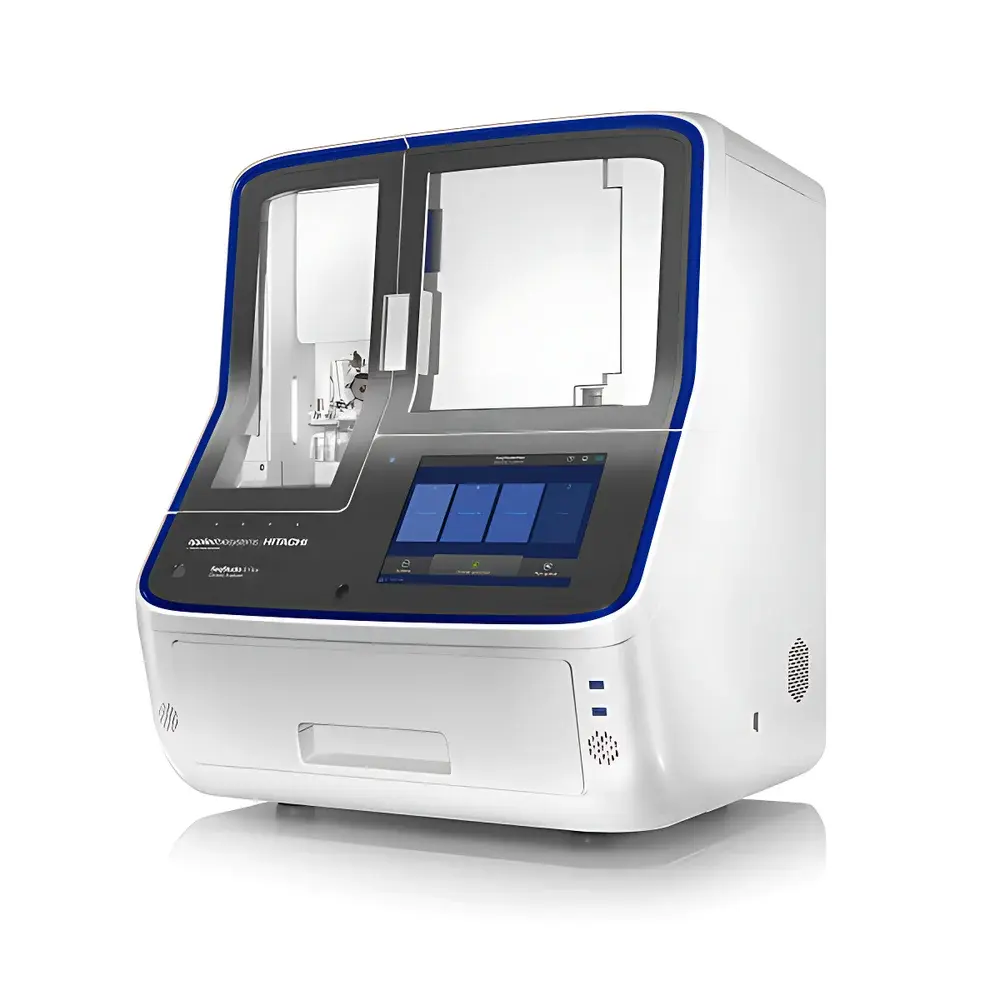
Thermo Fisher SeqStudio Flex Capillary Electrophoresis Gene Analyzer
| Brand | Thermo Fisher |
|---|---|
| Origin | Japan |
| Manufacturer | Thermo Fisher Scientific |
| Product Type | Imported Instrument |
| Model | SeqStudio Flex |
| Instrument Category | First-Generation (Sanger) Sequencer |
| Throughput | Supports up to 4 sample plates (96-well, 384-well, or 8-tube strips) |
| Data Output Format | Capillary Electrophoresis (CE) Trace Files (.fsa) |
| Detection Accuracy | 99.99% |
| Detection Reproducibility | 90% |
| Capillary Configuration | 8-capillary or 24-capillary array |
| Connectivity | LAN, Wi-Fi, USB, LIMS integration |
| Software Options | Secure Audit & Electronic Signature (SAE) module compliant with 21 CFR Part 11 |
| Remote Service Capability | Yes |
Overview
The Thermo Fisher SeqStudio Flex Capillary Electrophoresis Gene Analyzer is a next-generation first-generation sequencing platform engineered for precision, flexibility, and seamless digital integration in modern molecular biology laboratories. Built upon the validated Applied Biosystems capillary electrophoresis architecture, it delivers high-fidelity Sanger sequencing and multiplex fluorescent fragment analysis using standardized dye-terminator chemistry. Unlike high-throughput NGS platforms, the SeqStudio Flex operates on the fundamental principle of size-based separation of DNA fragments under an electric field within polymer-filled fused-silica capillaries, followed by laser-induced fluorescence detection. This CE-based methodology remains the gold-standard reference method for validation, confirmation, and targeted interrogation—particularly where base-call accuracy, long-read continuity (>1,000 bp), and low error rates are non-negotiable. Designed for mid-throughput environments, it bridges the gap between benchtop simplicity and enterprise-grade traceability, supporting both routine QC workflows and exploratory research applications requiring unambiguous sequence resolution.
Key Features
- Modular capillary configuration: Selectable 8-capillary or 24-capillary arrays to balance speed, cost-per-run, and lab space constraints.
- High-density plate handling: Accommodates up to four standard-format plates per run—including 96-well, 384-well microplates, or 8-tube strip formats—enabling batched processing without manual intervention between plates.
- Automated operational workflow: One-touch instrument startup, real-time auto-calibration of optical alignment and voltage parameters, and pre-run integrity checks reduce operator dependency and minimize setup variability.
- Robust capillary array design: Optimized thermal and mechanical stability ensures consistent migration times across runs; simplified insertion mechanism reduces risk of capillary breakage during maintenance.
- Intelligent scheduling and reordering: Dynamic sample re-queueing allows mid-run priority adjustments and reprocessing of failed samples without interrupting ongoing electrophoresis.
- Dual-mode connectivity: Native support for LAN, Wi-Fi, and USB host interfaces enables flexible deployment in isolated labs or fully networked environments.
Sample Compatibility & Compliance
The SeqStudio Flex accepts standard ABI-compatible reaction products generated from BigDye® Terminator v3.1 or similar chemistries. It supports dsDNA quality control, PCR product verification, plasmid sequencing, and amplicon-based variant screening—including SARS-CoV-2 spike gene subtyping and MSI marker profiling—without requiring library prep or cluster generation. All data files conform to the industry-standard .fsa format, ensuring compatibility with Sequencing Analysis Software (SAS), FinchTV, Geneious, and other third-party base-calling and alignment tools. The system meets ISO/IEC 17025 requirements for testing laboratories when operated under documented SOPs. Optional Secure Audit & Electronic Signature (SAE) software provides full 21 CFR Part 11 compliance—including user authentication, electronic signatures, audit trails, and immutable record retention—for regulated environments governed by GLP, GMP, or clinical diagnostics standards.
Software & Data Management
Control and analysis are unified through the Thermo Fisher Connect platform—a secure, cloud-enabled interface accessible via web browser or dedicated desktop client. Users can remotely configure run parameters, monitor real-time electropherogram progression, receive automated alerts for completion or anomalies, and initiate post-run data export directly to designated network drives or LIMS endpoints. The platform logs all user actions, instrument events, and environmental metadata (e.g., ambient temperature, voltage drift) with timestamped, tamper-evident records. Integrated intelligent assistant functionality permits one-click transmission of diagnostic logs, run reports, and raw trace files to Thermo Fisher technical support—accelerating root-cause analysis during troubleshooting. Video-assisted remote collaboration tools allow live screen sharing and synchronized annotation during instrument training or method optimization sessions.
Applications
- Cell line authentication via STR profiling and species-specific marker analysis
- Microsatellite instability (MSI) assessment in oncology research and companion diagnostics development
- dsDNA purity and integrity verification for cloning, transfection, and CRISPR editing workflows
- Multiplex PCR fragment sizing for genotyping, methylation analysis, and allelic ladder calibration
- CRISPR/Cas9 and base-editing outcome validation—including indel quantification and on-target/off-target confirmation
- SARS-CoV-2 lineage tracking and spike protein mutation mapping using consensus Sanger sequencing
- Secondary allele detection at ≤5% variant frequency in heterogeneous samples
- NGS result orthogonal validation—particularly for low-frequency variants, homopolymer regions, or GC-rich templates
- Plasmid backbone and insert verification prior to functional assays or bioproduction
- Challenging template sequencing—including high-GC, repetitive, or secondary-structure-prone amplicons—leveraging optimized polymer and voltage ramping protocols
FAQ
What sequencing chemistry is compatible with the SeqStudio Flex?
The instrument is validated for use with Applied Biosystems BigDye Terminator v3.1 and v1.1 kits, as well as other dye-labeled terminator chemistries that produce fragments compatible with standard CE separation matrices.
Can the SeqStudio Flex integrate with our existing LIMS?
Yes—it supports HL7, ASTM E1384, and custom API-based integration via its Connect platform, enabling bidirectional sample tracking, result import, and audit log synchronization.
Is the 99.99% detection accuracy applicable to all read lengths?
Accuracy reflects base-calling confidence over the first 700–900 bases under optimal conditions (e.g., high-quality templates, balanced dye signals); performance beyond 950 bp may vary depending on template quality and electrophoretic mobility shifts.
Does the system require dedicated IT infrastructure for remote monitoring?
No—Connect operates over standard HTTPS and requires only outbound internet access; local network deployment without cloud connectivity is also supported via on-premise Connect server installation.
How does the SeqStudio Flex handle capillary maintenance and polymer replenishment?
Polymer replacement and capillary washing are automated through predefined maintenance protocols; consumables are tracked via onboard RFID tags, and alerts notify users prior to depletion or expiration.
Related Products




