
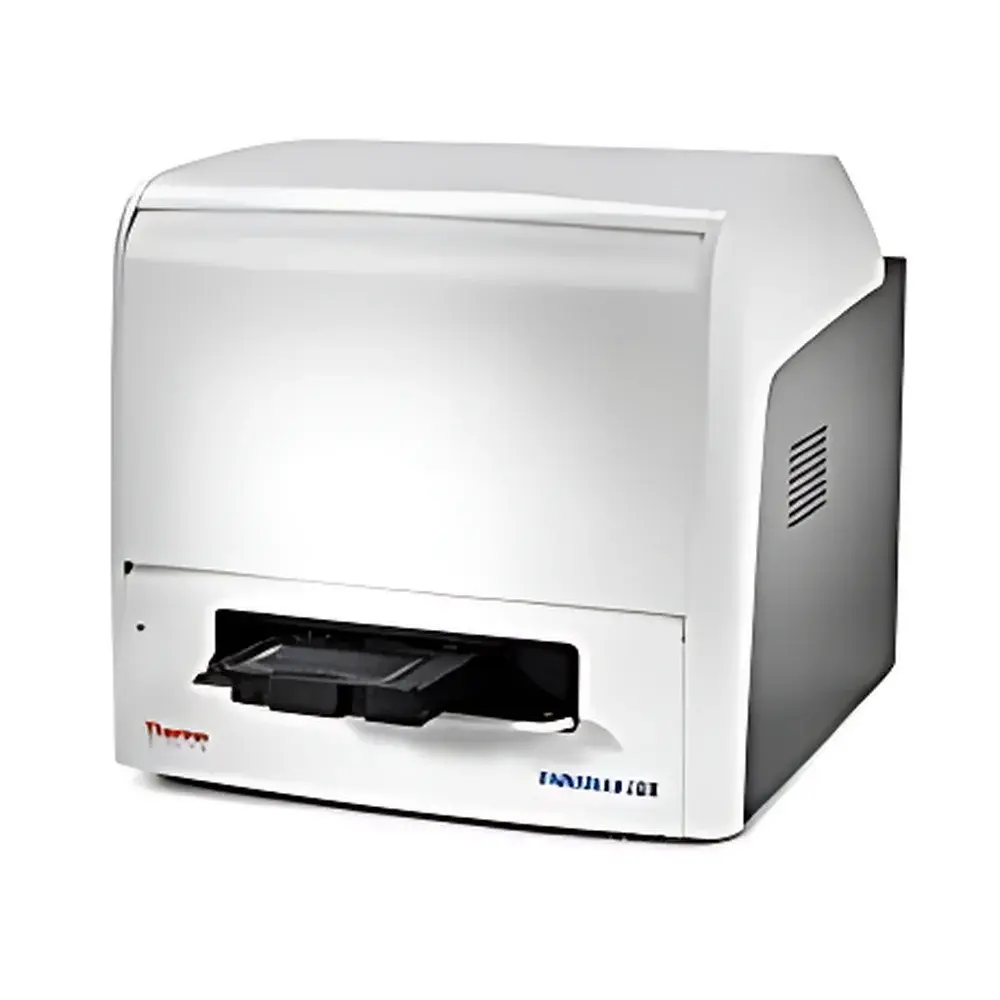
Thermo Scientific Varioskan LUX Multimode Microplate Reader
| Brand | Thermo Fisher |
|---|---|
| Origin | Singapore |
| Manufacturer | Thermo Fisher Scientific |
| Product Category | Imported Instrument |
| Model | Varioskan LUX |
| Functionality | Multimode |
| Automation Level | Fully Automated |
| Assay Modes | Endpoint, Kinetic, Spectral Scan, Multi-Point Scan, Kinetic Spectral Scan |
| Curve Fitting Options | Linear, Quadratic, Cubic, Log-Log, Four-Parameter Logistic (4PL), Five-Parameter Logistic (5PL), Sigmoidal, Exponential Decay/Growth |
| Detector Types | Photodiode (PD), Extended Red PMT, Low-Noise Photon-Counting PMT |
| Wavelength Range | 200–1000 nm |
| Absorbance Range | 0–6 OD |
| Absorbance Linearity | ±2% at 0–4 Abs (96-well plate, 450 nm) |
| Read Speed | 15 seconds per 96-well plate |
| Precision | SD < 0.001 Abs |
Overview
The Thermo Scientific Varioskan LUX Multimode Microplate Reader is a high-performance, modular microplate detection platform engineered for precision, flexibility, and reproducibility in life science research laboratories. Based on dual optical path architecture—employing both monochromator-based and filter-based excitation/emission selection—the instrument supports five core detection technologies: absorbance (Abs), fluorescence intensity (FI), luminescence (Lum), AlphaScreen/AlphaLISA, and time-resolved fluorescence (TRF). Its measurement principle integrates optimized photonic signal acquisition with intelligent dynamic range adjustment, enabling accurate quantification across broad signal intensities without manual gain intervention. Designed for compliance with GLP and GMP environments, the Varioskan LUX delivers traceable, audit-ready data generation suitable for regulated applications including assay development, compound screening, and biomarker validation.
Key Features
- Modular & Future-Proof Architecture: Factory-configured for core multimode functionality with optional field-upgradable modules—including TRF, AlphaScreen, and enhanced luminescence sensitivity—ensuring long-term adaptability to evolving assay requirements.
- Intelligent Dynamic Range Selection: Automatically selects optimal detector gain and integration time based on real-time signal amplitude, eliminating saturation and underexposure while preserving full dynamic range across all detection modes.
- Dual Optical Path Design: Monochromator (200–1000 nm, 1 nm resolution) for flexible spectral scanning and broad-spectrum absorbance/fluorescence; high-transmission interference filters for high-sensitivity TRF and AlphaScreen assays requiring precise wavelength definition.
- Advanced Detector Suite: Includes a silicon photodiode for high-stability absorbance measurements, an extended-red photomultiplier tube (PMT) for near-infrared fluorescence (e.g., Cy5.5, IRDye800), and a low-dark-current photon-counting PMT optimized for ultra-low-light luminescence and TRF applications.
- Integrated Safety & Workflow Integrity: Built-in error-prevention logic monitors plate presence, lid position, reagent dispensing status (when integrated with compatible injectors), and optical path integrity—issuing real-time alerts prior to measurement initiation.
Sample Compatibility & Compliance
The Varioskan LUX supports standard microplate formats (6–384-well), including clear, white, black, and specialized assay plates (e.g., AlphaPlate, TRF-compatible low-background plates). It accommodates opaque and transparent bottom configurations and is compatible with common biological sample matrices—cell lysates, serum, plasma, culture supernatants, and purified proteins—without cross-contamination risk due to non-contact optical readout. The system complies with ISO/IEC 17025 calibration traceability standards and supports 21 CFR Part 11-compliant software configurations (via optional Thermo Scientific SkanIt Software version 5.2 or later), including electronic signatures, audit trails, and user access control. All firmware and hardware design align with IEC 61010-1 safety standards for laboratory equipment.
Software & Data Management
Controlled via Thermo Scientific SkanIt Software, the Varioskan LUX enables protocol-driven assay execution, real-time kinetic monitoring, and automated spectral optimization. The software provides built-in curve-fitting algorithms—including four-parameter logistic (4PL), five-parameter logistic (5PL), and sigmoidal models—essential for ELISA, receptor binding, and dose-response analysis. Raw data export is supported in CSV, XML, and Excel-compatible formats; metadata tagging (user, timestamp, instrument ID, plate map) ensures FAIR (Findable, Accessible, Interoperable, Reusable) data principles. Optional SkanIt Cloud Connect enables secure remote instrument monitoring, method sharing across distributed labs, and centralized backup of calibration logs and maintenance records.
Applications
- Quantitative ELISA, cell viability (MTT, XTT, Resazurin), and protein concentration (Bradford, BCA) via absorbance
- Calcium flux, cAMP, kinase activity, and protein-protein interaction (FRET) using fluorescence intensity
- Reporter gene assays (luciferase), ATP quantification, and caspase activity via luminescence
- High-sensitivity immunoassays (AlphaLISA, AlphaScreen) for cytokine or phosphoprotein detection
- Time-resolved assays (TR-FRET, hTRF) for GPCR ligand screening and nucleic acid hybridization studies
- Spectral characterization of dyes, nanoparticles, and enzyme kinetics across UV-Vis-NIR range
FAQ
Does the Varioskan LUX support kinetic measurements with temperature control?
Yes—integrated Peltier-based temperature control maintains plate temperature from ambient +4 °C to 45 °C with ±0.5 °C accuracy, enabling reliable enzyme kinetics and cell-based assays.
Can it perform simultaneous dual-emission detection for FRET or ratiometric assays?
Yes—dual-monochromator configuration allows sequential or rapid alternating excitation/emission scans with sub-second switching, supporting ratiometric calcium imaging and FRET efficiency calculations.
Is optical path length correction available for absorbance measurements?
Yes—integrated linear variable filter (LVF) technology enables automatic pathlength correction for 96- and 384-well plates, converting raw OD values to standardized 1-cm equivalent absorbance.
What level of validation documentation is provided for regulated environments?
Factory-installed IQ/OQ documentation packages are available; users may perform PQ using built-in verification protocols (e.g., absorbance linearity check at 450 nm, fluorescence sensitivity verification with quinine sulfate standard).
How is firmware updated, and is version history retained?
Firmware updates are performed via SkanIt Software with digital signature verification; update timestamps and version IDs are logged in the system audit trail and exported with instrument reports.
Related Products




