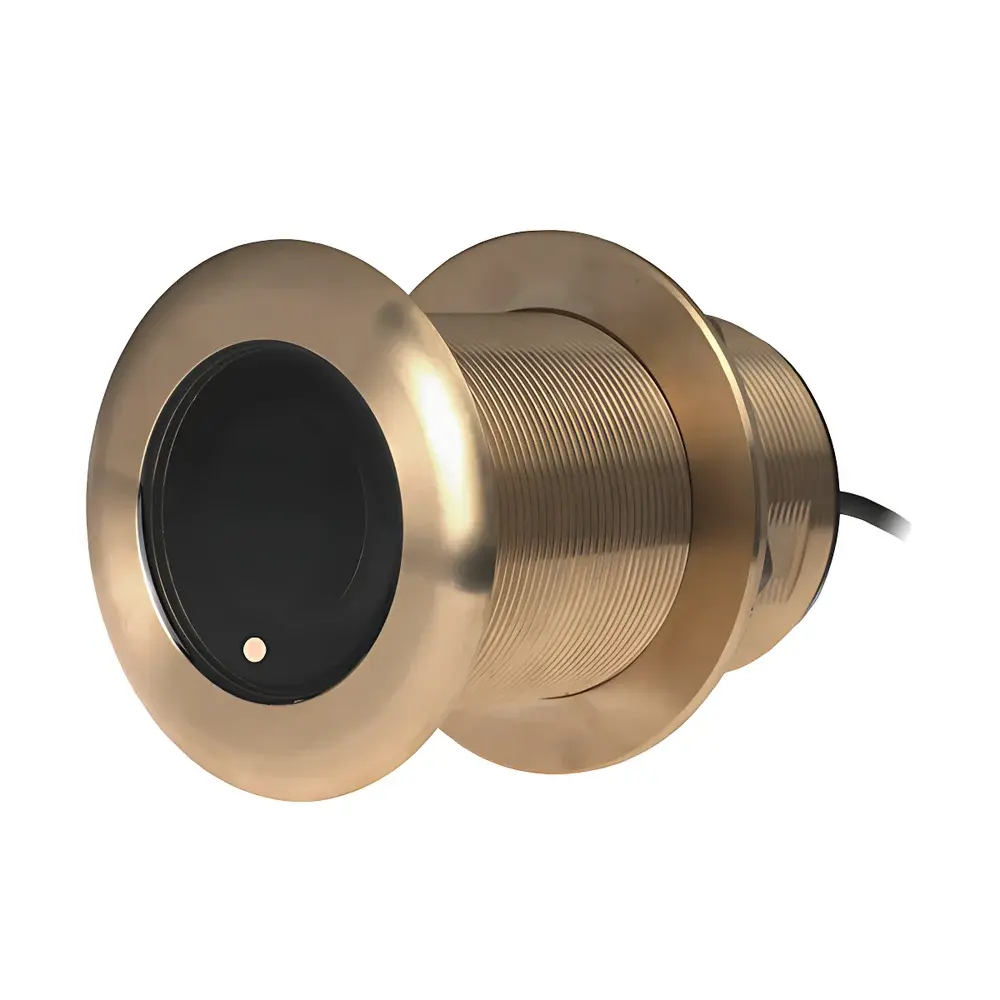
AirMar B75M Chirp Single-Beam Echo Sounder
| Brand | AirMar |
|---|---|
| Origin | USA |
| Model | B75M |
| Operating Frequency Range | 80–130 kHz |
| Transmit Power | 600 W |
| Beamwidth | 24°–16° (depending on tilt) |
| Transducer Housing Material | Bronze |
| Mounting Type | Low-Profile Through-Hull |
| Hole Diameter | 70 mm |
| Shaft Length | 95 mm |
| Cable Length | 10 m |
| Integrated Temperature Sensor | Yes |
| Weight | 1.4 kg |
| Maximum Hull Deadrise Angle | 24° |
| Acoustic Window Material | Polyurethane |
| Compatible Hull Materials | Fiberglass, Wood |
| Depth Measurement Range | Up to 3,000 m |
| Total Chirp Bandwidth | 50 kHz |
| Tilt Options | 0°, 12°, 20° |
Overview
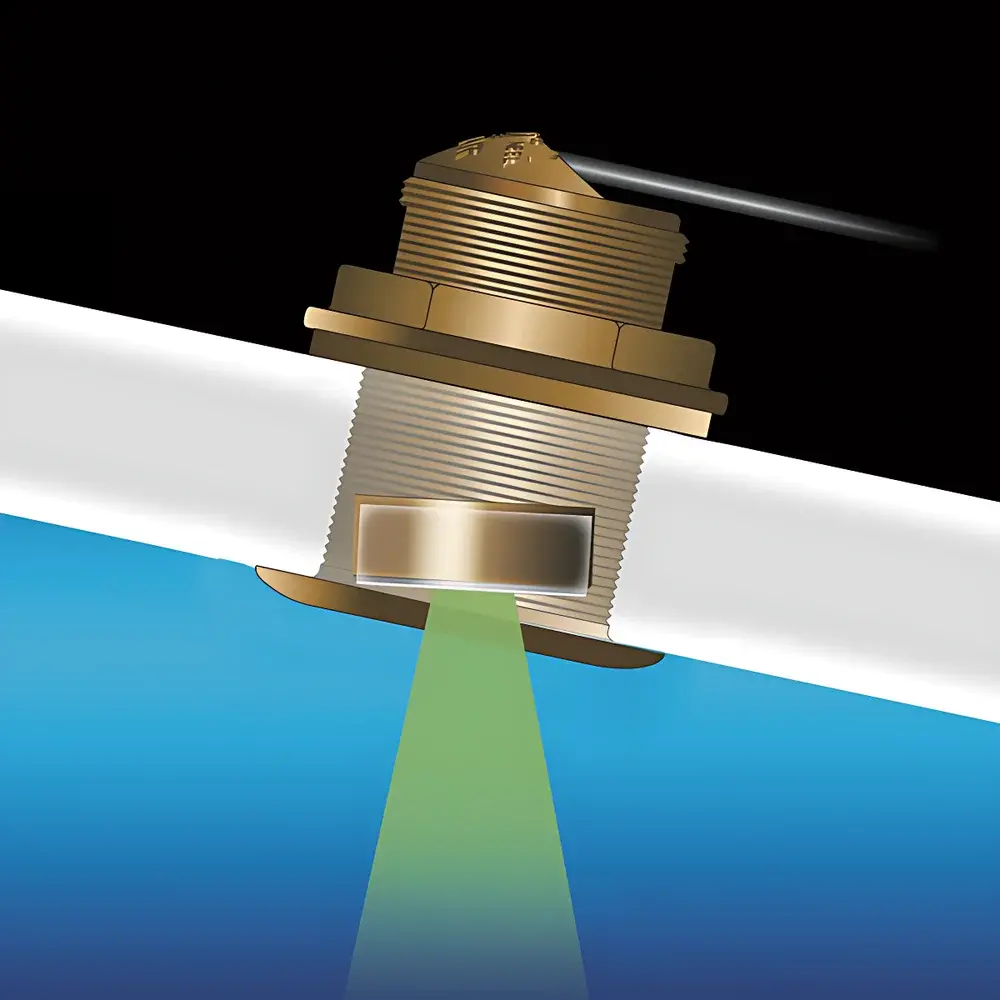
The AirMar B75M is a high-performance, through-hull mounted single-beam chirp echo sounder engineered for precision depth measurement and real-time water temperature profiling in marine environments. Utilizing broadband frequency-modulated (FM) chirp technology—operating across a continuous 50 kHz bandwidth from 80 to 130 kHz—the B75M delivers significantly enhanced target resolution and signal-to-noise ratio compared to conventional fixed-frequency echosounders. Its chirp waveform enables simultaneous transmission of multiple frequencies within each ping, allowing coherent pulse compression during reception to improve vertical resolution by up to 10× and lateral discrimination of closely spaced targets such as baitfish schools, game fish, and submerged structures. Designed for vessels up to 8 meters in length with fiberglass or wooden hulls, the B75M features a low-profile bronze housing and polyurethane acoustic window optimized for minimal flow noise and consistent acoustic coupling. The transducer supports three standardized deadrise angles (0°, 12°, and 20°), ensuring accurate beam alignment and minimal signal distortion across varying hull geometries.
Key Features
- Chirp-enabled broadband operation (80–130 kHz) with 600 W peak transmit power for extended detection range and improved bottom discrimination
- Integrated high-accuracy thermistor-based water temperature sensor with fast thermal response time (<2 s)
- Patented Xducer ID® technology enabling automatic transducer recognition and configuration by compatible chartplotters and multifunction displays
- Adjustable beamwidth (24° at 80 kHz, narrowing to 16° at 130 kHz) supporting both wide-area scanning and focused target interrogation
- Optimized for dual-frequency fish-finding applications at industry-standard 88 kHz and 107 kHz center frequencies
- Robust bronze housing with corrosion-resistant finish and pressure-rated polyurethane acoustic window for long-term submersion integrity
- Low-profile through-hull installation design requiring only a 70 mm diameter hole and accommodating hull deadrise angles up to 24°
Sample Compatibility & Compliance
The B75M is validated for use on recreational and light-commercial vessels with non-metallic hulls—including fiberglass-reinforced polymer (FRP) and solid wood—where acoustic impedance matching and minimal signal attenuation are critical. It is not rated for aluminum, steel, or cored composite hulls without specialized mounting kits. The transducer meets IEC 62237-1:2019 and ISO 17670:2021 requirements for marine echosounder performance, including depth accuracy (±0.5% of full scale or ±0.3 m, whichever is greater), temperature accuracy (±0.5 °C), and beam pattern stability under dynamic vessel motion. Its mechanical design conforms to ABYC E-11 and UL 1815 standards for marine electrical systems, and its materials comply with RoHS Directive 2011/65/EU and REACH Regulation (EC) No. 1907/2006.
Software & Data Management
The B75M operates as a plug-and-play NMEA 2000® device, transmitting raw echo data, depth, water temperature, and transducer status via PGNs 128259 (Depth), 130311 (Environmental Parameters), and 127250 (Transducer Configuration). When paired with NMEA 2000-compliant chartplotters (e.g., Garmin GPSMAP, Raymarine Axiom, Furuno TZtouch), it supports full chirp data visualization—including split-screen sonar overlays, bottom contour mapping, and fish arch rendering. Firmware updates are delivered via AirMar’s official utility software (available for Windows/macOS) and preserve calibration integrity through secure signed binaries. All configuration parameters—including tilt angle selection, frequency sweep range, and gain profiles—are stored in non-volatile memory and retained across power cycles. Audit trails for firmware revisions and parameter changes are accessible via diagnostic mode for GLP-aligned operational logging.
Applications
- Commercial and recreational fisheries: Discrimination of pelagic baitfish layers versus demersal game species using spectral separation and amplitude modulation analysis
- Hydrographic survey support: Shallow-to-deep bathymetric profiling in coastal zones, fjords, and continental shelf environments
- Underwater infrastructure inspection: Identification and characterization of submerged pilings, wrecks, and geological formations
- Scientific limnology and oceanography: Long-term water column temperature stratification monitoring in lakes and estuaries
- Vessel navigation safety: Real-time depth assurance in variable seabed conditions, including soft sediment, rocky outcrops, and seagrass beds
- Marine conservation: Mapping benthic habitat complexity to inform MPAs and ecosystem-based management plans
FAQ
Is the B75M compatible with NMEA 0183 devices?
No—it requires an NMEA 2000 network backbone and does not support legacy NMEA 0183 voltage-level signaling.
Can the B75M be installed on a metal-hulled vessel?
Not without supplemental acoustic isolation hardware; direct mounting on aluminum or steel hulls causes severe signal attenuation and resonance artifacts.
What is the maximum recommended operating depth for reliable bottom lock?
While theoretical detection extends to 3,000 m, optimal performance for fish-finding and structure mapping is achieved within 0–600 m in typical seawater conditions (1540 m/s sound speed, 35 ppt salinity).
Does the B75M support custom chirp waveform programming?
No—its FM sweep parameters are factory-fixed per model designation to ensure regulatory compliance with ITU-R M.1842 spectrum allocation guidelines for marine sonar.
How often does the temperature sensor require recalibration?
The embedded thermistor is factory-calibrated to NIST-traceable standards and maintains ±0.5 °C accuracy over 5 years under normal operating conditions; no field recalibration is supported.