
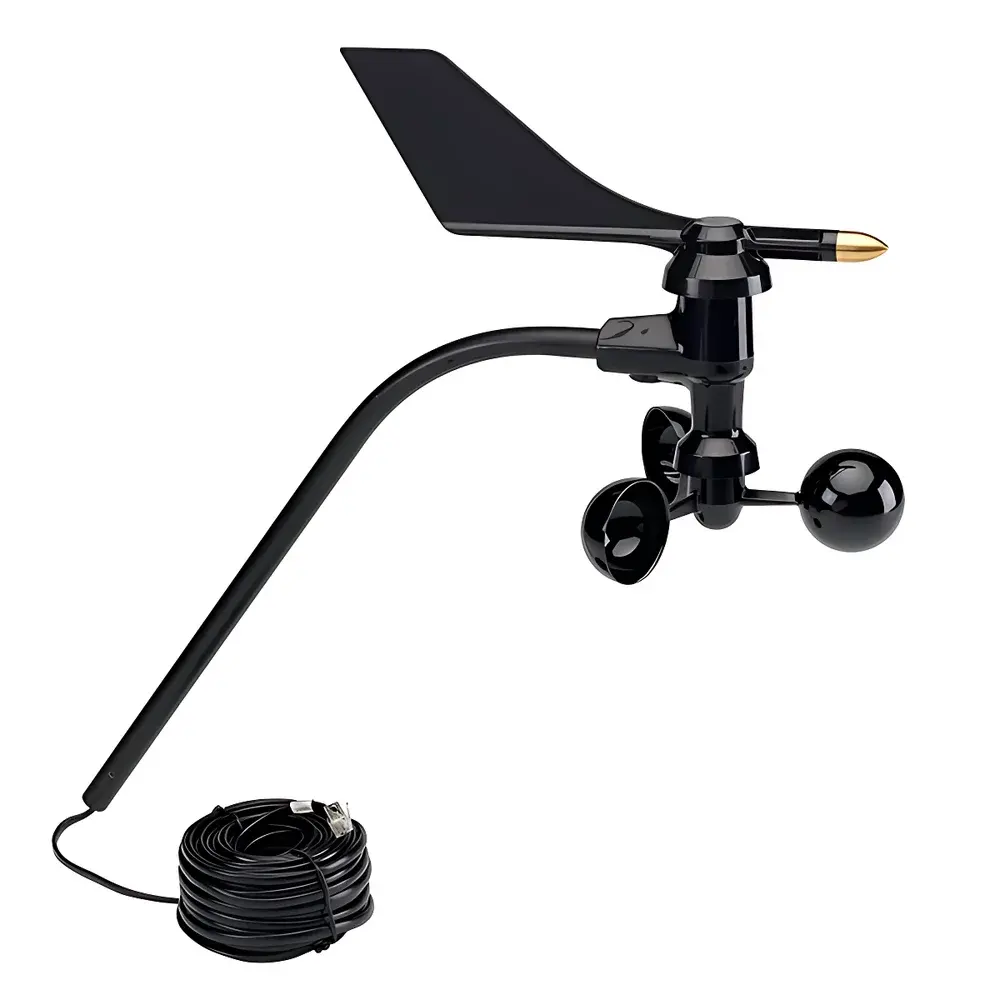
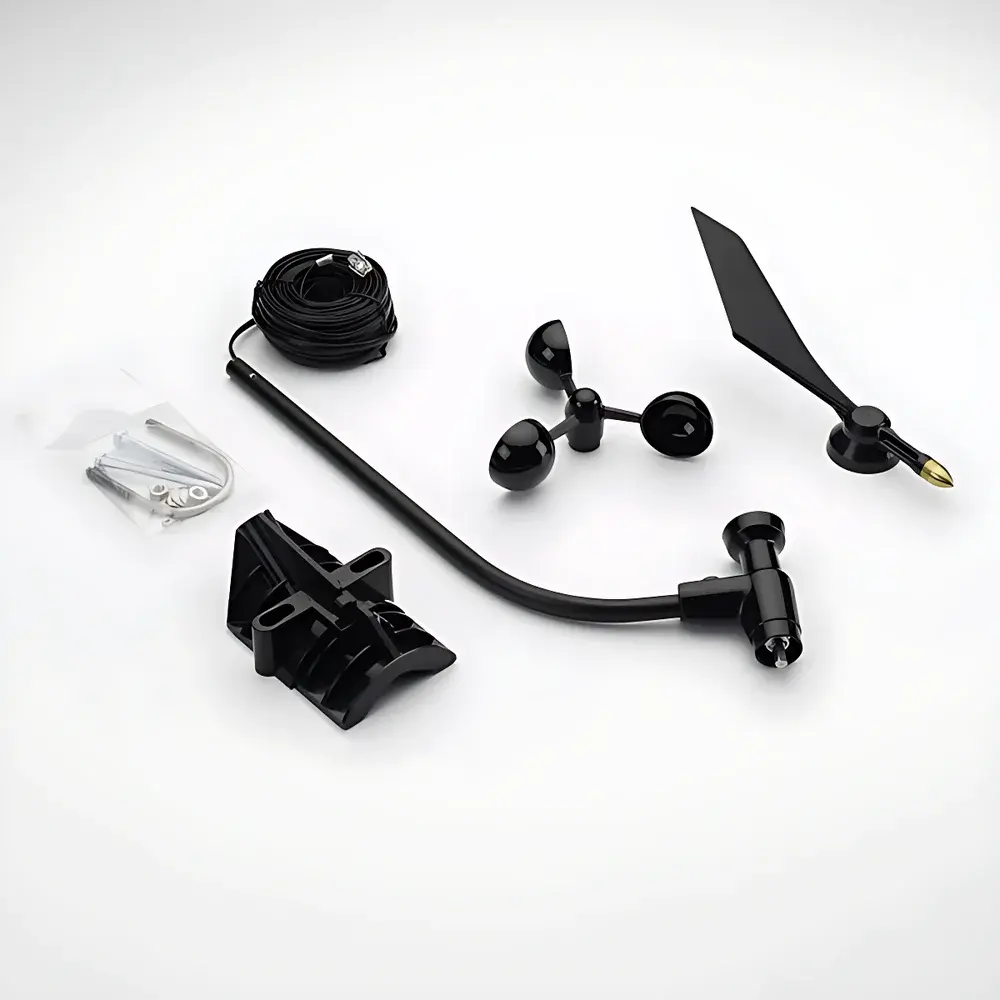
Davis 6410 Wind Speed and Wind Direction Sensor
| Brand | Davis Instruments |
|---|---|
| Origin | USA |
| Model | 6410 |
| Instrument Type | Cup Anemometer with Vane-Based Wind Direction Sensor |
| Wind Speed Range | 0.5–89 m/s |
| Wind Speed Accuracy | ±1 m/s or ±5%, whichever is greater |
| Wind Speed Resolution | 0.1 m/s |
| Wind Speed Sampling Interval | 2.25 s |
| Wind Direction Range | 0°–360° |
| Wind Direction Accuracy | ±7° |
| Wind Direction Resolution | 1° |
| Wind Direction Sampling Interval | 1 s |
| Operating Temperature | −40°C to +65°C |
| Operating Humidity | 0–100% RH |
| Housing Material (Vane) | UV-Stabilized ABS |
| Cup Material | Polycarbonate |
| Arm Material | Anodized Aluminum with Black Coating |
| Cable | 4-Conductor, 26 AWG, Standard RJ11 Connector |
| Standard Cable Length | 12 m |
| Maximum Extended Cable Length | 73 m |
| Dimensions (L×W×H) | 381 mm × 38 mm × 457 mm |
| Weight | 1.332 kg |
Overview
The Davis 6410 Wind Speed and Wind Direction Sensor is a field-proven, industrial-grade environmental transducer engineered for long-term deployment in unattended meteorological monitoring systems. Designed and manufactured in the United States by Davis Instruments, this dual-parameter sensor integrates a three-cup anemometer with magnetic reed switch output for wind speed measurement and a precision potentiometric vane assembly for azimuthal wind direction determination. Its operational principle relies on calibrated mechanical rotation (for wind speed) and resistive angular position sensing (for wind direction), both validated under controlled wind tunnel conditions per ASTM D5096 and ISO 12213-2 reference methodologies. The sensor is optimized for integration into automated weather stations—most notably as the OEM-specified wind module for the Vantage Pro2 platform—where reliability, thermal stability, and signal integrity across extreme ambient gradients are critical. Its robust mechanical architecture ensures minimal hysteresis and low maintenance over extended service life, even under cyclic loading from turbulent or gusty flow regimes.
Key Features
- True dual-axis measurement: Simultaneous acquisition of wind speed (pulse-frequency output) and wind direction (analog voltage proportional to bearing angle)
- Wide dynamic range: Certified wind speed response from 0.5 m/s (detecting light breezes) up to 89 m/s (surviving hurricane-force winds)
- Thermally stable design: Operational capability across −40°C to +65°C, with UV-resistant ABS vane and polycarbonate cups minimizing solar heating-induced drift
- Modular cabling system: Standard 12 m shielded 4-conductor cable (26 AWG) with RJ11 termination; supports extension to 73 m without signal degradation when used with recommended twisted-pair topology
- Low-power excitation requirement: Wind direction circuit operates with ≤15 V DC excitation, compatible with most data loggers and telemetry controllers
- High mechanical repeatability: Anodized aluminum cross-arm provides torsional rigidity and corrosion resistance in coastal or industrial atmospheres
Sample Compatibility & Compliance
The Davis 6410 is designed for outdoor atmospheric sampling in open-exposure configurations, conforming to WMO No. 8 guidelines for siting and exposure of wind sensors. It meets IEC 61326-1:2013 for electromagnetic compatibility (EMC) in industrial environments and complies with RoHS 2011/65/EU material restrictions. While not certified for SIL or ATEX hazardous locations, its non-sparking mechanical construction and absence of internal electronics make it suitable for Class I, Division 2 installations when deployed with appropriate barrier-rated data acquisition hardware. Calibration traceability follows NIST-traceable wind tunnel protocols, and documentation supports GLP-compliant environmental data logging per EPA 40 CFR Part 58 requirements.
Software & Data Management
The sensor outputs raw analog (wind direction) and digital pulse (wind speed) signals requiring external conditioning. Compatible with Campbell Scientific CR series, Onset HOBO UX120, and Davis-compatible loggers (e.g., Vantage Connect), it supports standard data parsing via user-defined scaling functions. Wind speed pulses are counted over configurable intervals (default 2.25 s); wind direction voltage is digitized at 1 s intervals with 10-bit or higher resolution ADCs. Firmware-level timestamping and linearization coefficients can be embedded in logger scripts to correct for known nonlinearity in the potentiometric element. Output data formats include CSV, JSON, and Modbus RTU when interfaced via protocol converters—enabling seamless ingestion into SCADA, IoT cloud platforms (AWS IoT Core, Azure IoT Hub), or regulatory reporting systems compliant with FDA 21 CFR Part 11 audit trail requirements.
Applications
- Automated weather station networks for aviation safety, wildfire risk modeling, and agricultural microclimate monitoring
- Renewable energy site assessment—particularly pre-construction wind resource evaluation for small-scale turbine feasibility studies
- Environmental impact assessments (EIA) requiring continuous boundary-layer wind profiling under ISO 14001 frameworks
- Urban air quality monitoring systems where wind vector data informs dispersion modeling (e.g., CALPUFF, AERMOD inputs)
- Educational meteorology labs requiring durable, repairable instrumentation with transparent signal physics for student experimentation
- Industrial stack emission monitoring where cross-wind correction is required for plume trajectory estimation
FAQ
What power supply is required for the Davis 6410?
The wind direction circuit requires a stable DC excitation voltage ≤15 V; no power is needed for the wind speed cup assembly, which generates self-powered pulses.
Can the 6410 be mounted vertically or only horizontally?
It must be installed horizontally with the vane aligned to true north using a calibrated compass or GNSS-derived azimuth reference—vertical mounting invalidates directional accuracy.
Is the 12 m cable shielded against EMI in high-noise industrial settings?
Yes—the standard cable includes foil + braid shielding and is rated for 30 V AC/DC working voltage; additional conduit routing is recommended near VFDs or radio transmitters.
Does Davis provide NIST-traceable calibration certificates?
Calibration reports are available upon request for individual units, referencing wind tunnel test data traceable to NIST Standard Reference Material (SRM) 2800.
How does ice accumulation affect performance in sub-zero conditions?
The polycarbonate cups and ABS vane exhibit low ice adhesion; however, active de-icing is not integrated—users in freezing rain zones should consider supplemental heating or ultrasonic anti-icing add-ons.
Related Products







