
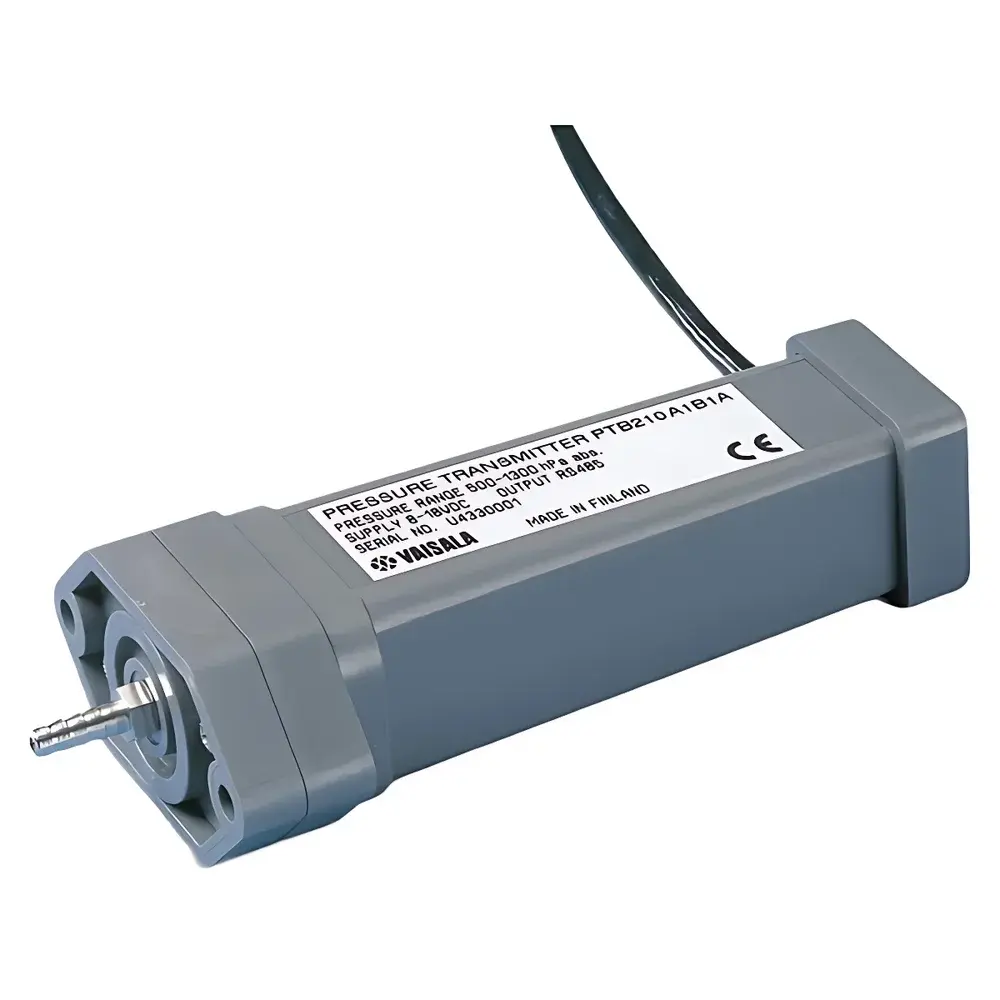
Vaisala PTB210 Barometric Pressure Transmitter
| Brand | Vaisala |
|---|---|
| Origin | Finland |
| Model | PTB210 |
| Output Interface | RS232/RS485/TTL (optional), 0–5 VDC / 0–2.5 VDC analog |
| Pressure Range (Digital) | 50–1100 hPa or 500–1100 hPa |
| Pressure Range (Analog) | 500–1100 hPa, 600–1060 hPa, 800–1060 hPa, 900–1100 hPa |
| Accuracy (Digital, -40–+60 °C) | ±0.25 hPa (Class A), ±0.30 hPa (Class B), ±0.50 hPa (Class C) |
| Long-term Stability | ±0.10 hPa/year (A/B), ±0.20 hPa/year (C) |
| Resolution | 0.01 hPa (1 Hz), 0.03 hPa (10 Hz) |
| Operating Temperature | -40 to +60 °C |
| Enclosure Rating | IP65 (electronics), IP53 (sensor) |
| Power Supply | 5–28 VDC (RS232/TTL), 8–18 VDC (RS485/analog) |
| Current Consumption | <15 mA (active), 0.2 mA (sleep) |
| EMC Compliance | EN 61326-1 (Industrial Environment) |
| Calibration | NIST-traceable factory calibration certificate included |
Overview
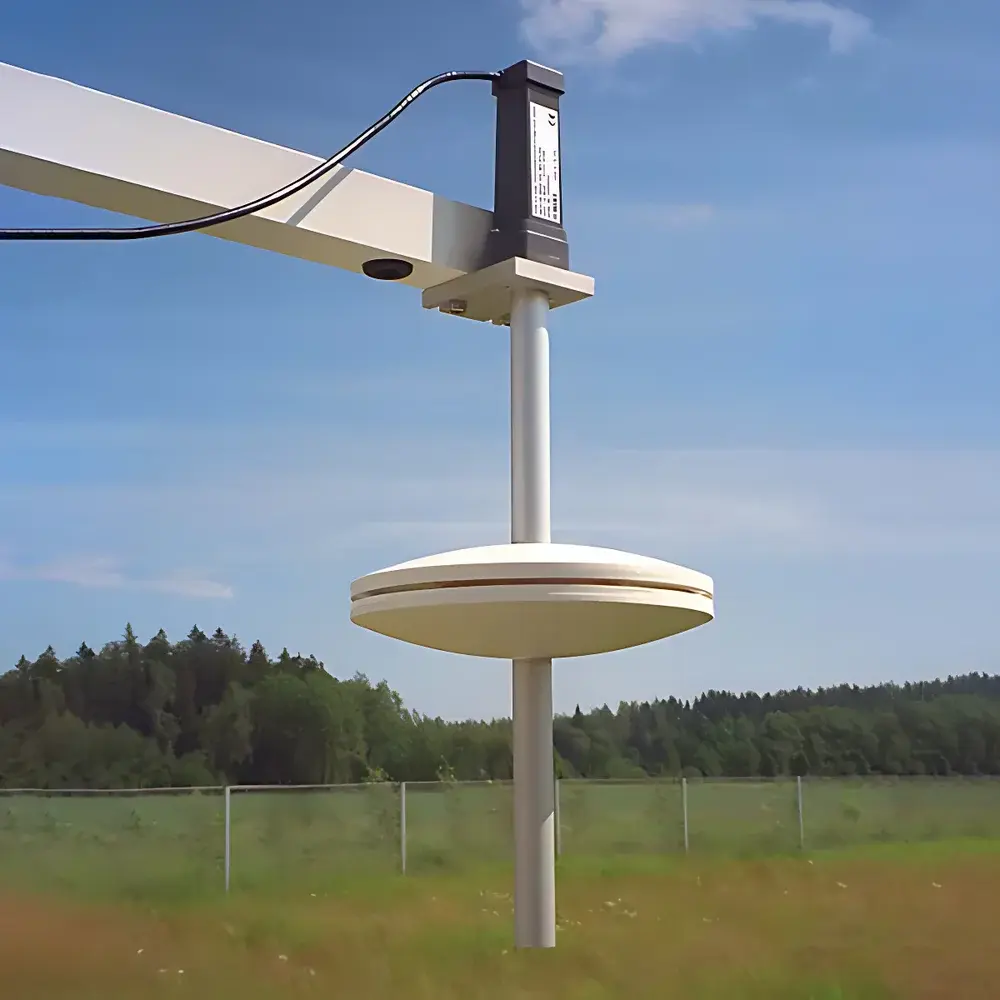
The Vaisala PTB210 is a high-stability, digitally compensated barometric pressure transmitter engineered for continuous, unattended operation in demanding environmental and industrial applications. At its core lies the proprietary Vaisala BAROCAP® silicon capacitive absolute pressure sensor—a monolithic MEMS device designed specifically for atmospheric pressure measurement. Unlike piezoresistive or strain-gauge-based alternatives, the BAROCAP® principle relies on electrostatic capacitance variation across a vacuum-referenced, temperature-compensated silicon diaphragm. This architecture delivers exceptional long-term stability, minimal hysteresis (<±0.05 hPa), and low thermal drift (<±0.20 hPa over -40 to +60 °C), making the PTB210 suitable for reference-grade meteorological networks, aviation altimetry support systems, and critical process monitoring where pressure drift must remain below 0.1 hPa per year. The unit integrates seamlessly with Vaisala SPH10/SPH20 static pressure heads—enabling accurate wind-robust measurements in open-air installations without dynamic pressure error.
Key Features
- Vaisala BAROCAP® absolute pressure sensor with monolithic silicon construction and on-chip digital temperature compensation
- Multiple configurable pressure ranges: digital output options include 50–1100 hPa and 500–1100 hPa; analog outputs support four fixed spans (500–1100, 600–1060, 800–1060, 900–1100 hPa)
- IP65-rated electronics enclosure (NEMA 4 equivalent) for outdoor deployment—resistant to water splashes, dust ingress, and mechanical impact
- NIST-traceable factory calibration with documented uncertainty (±0.07 hPa for Class A units at 20 °C); full calibration certificate supplied
- Low-power operation: <15 mA typical current draw, 0.2 mA sleep mode—enabling solar- or battery-powered remote stations
- Flexible communication interfaces: standard RS232/RS485 (non-isolated, optional) and TTL-level serial; analog voltage outputs (0–5 VDC or 0–2.5 VDC) with 300 µV resolution
- Rapid response time: 1 s for digital output, 500 ms for analog; configurable measurement rate up to 10 samples/s (digital) or 3 samples/s (analog)
Sample Compatibility & Compliance
The PTB210 is designed for direct measurement of ambient atmospheric pressure in non-corrosive, non-condensing gaseous environments. It is not intended for use with aggressive chemicals, saturated vapors, or particulate-laden air without appropriate inlet filtration. Its IP53-rated sensor module permits mounting in ventilated enclosures or behind static pressure heads (e.g., SPH10/SPH20), ensuring immunity to wind-induced turbulence and rain splash. The device complies with EN 61326-1 for electromagnetic compatibility in industrial environments and meets IEC 61000-4 immunity requirements for electrostatic discharge, radiated RF fields, and fast transients. All units ship with a factory calibration certificate traceable to NIST standards, supporting ISO/IEC 17025-compliant laboratories and GLP/GMP-aligned environmental monitoring programs requiring documented metrological traceability.
Software & Data Management
The PTB210 operates as a self-contained smart sensor with no embedded firmware update requirement under normal conditions. Configuration—including range selection, output protocol, baud rate (1200–19200 bps), parity, and stop bits—is performed via ASCII command set over serial interface. Raw pressure data is delivered in ASCII or binary format with 0.01 hPa resolution at 1 Hz sampling. For integration into SCADA or IoT platforms, the analog variants provide direct compatibility with PLC analog input modules (e.g., 16-bit ADCs), while digital variants support Modbus RTU over RS485 when used with third-party protocol converters. Data logging systems may leverage the unit’s deterministic response time and stable zero point to implement time-synchronized multi-sensor fusion algorithms—particularly valuable in barometric altimeter validation and differential pressure correction workflows. Audit trails and calibration history are maintained externally per user-defined QA procedures, consistent with FDA 21 CFR Part 11 requirements for electronic records when paired with validated acquisition software.
Applications
- Meteorological observatories and automated weather stations (AWS) requiring long-term stability and low maintenance
- Aviation ground support systems—including altimeter setting (QNH/QFE) derivation and runway pressure monitoring
- Oceanographic data buoys and coastal monitoring platforms exposed to salt spray and wide thermal cycling
- Environmental soil gas flux studies where barometric compensation is essential for accurate CH₄/CO₂ emission quantification
- Industrial test benches (e.g., engine dynamometers, wind tunnels) needing reference-grade static pressure references
- Calibration laboratories performing intercomparisons or serving as secondary standards for portable barometers
- High-precision laser interferometry setups requiring real-time air refractivity correction via measured pressure, temperature, and humidity (when paired with Vaisala HUMICAP® hygrometers)
FAQ
Is the PTB210 suitable for underwater or submerged installation?
No. The PTB210 measures atmospheric (ambient) pressure only and is not rated for submersion. Its IP65 rating applies solely to the electronics housing; the sensor port must remain exposed to ambient air.
Can the PTB210 be recalibrated in-field using portable standards?
Yes. The unit supports digital adjustment via serial commands and is compatible with high-accuracy portable pressure calibrators (e.g., Fluke 729, Druck DPI620). Full two-point calibration requires traceable reference standards meeting ISO 5725 accuracy criteria.
What is the maximum allowable overpressure before damage occurs?
The sensor is rated for a maximum absolute pressure of 5000 hPa (≈5 bar). Exceeding this limit may cause permanent diaphragm deformation or seal failure.
Does the PTB210 meet aviation regulatory requirements for certified altimeter systems?
While widely used in aviation-supporting infrastructure, the PTB210 itself is not TSO-certified. It serves as a high-fidelity reference sensor in ground-based pressure reporting systems compliant with ICAO Annex 3 and WMO Guide to Meteorological Instruments and Methods of Observation.
How does BAROCAP® technology differ from traditional aneroid barometers?
BAROCAP® employs a solid-state silicon capacitor with vacuum reference cavity and integrated temperature compensation—eliminating mechanical linkages, lubricants, and hysteresis-prone metal bellows found in aneroid designs. This yields superior repeatability, lower long-term drift, and immunity to orientation effects.
Related Products







