
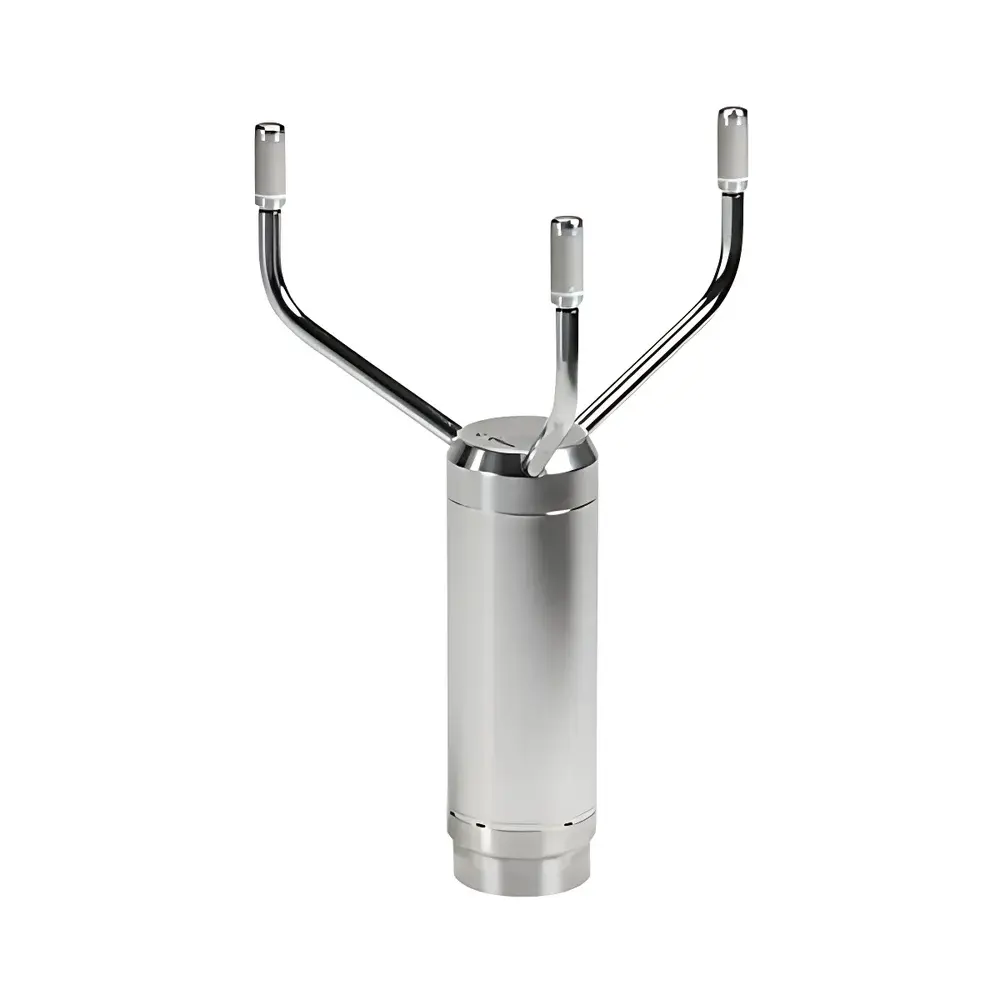
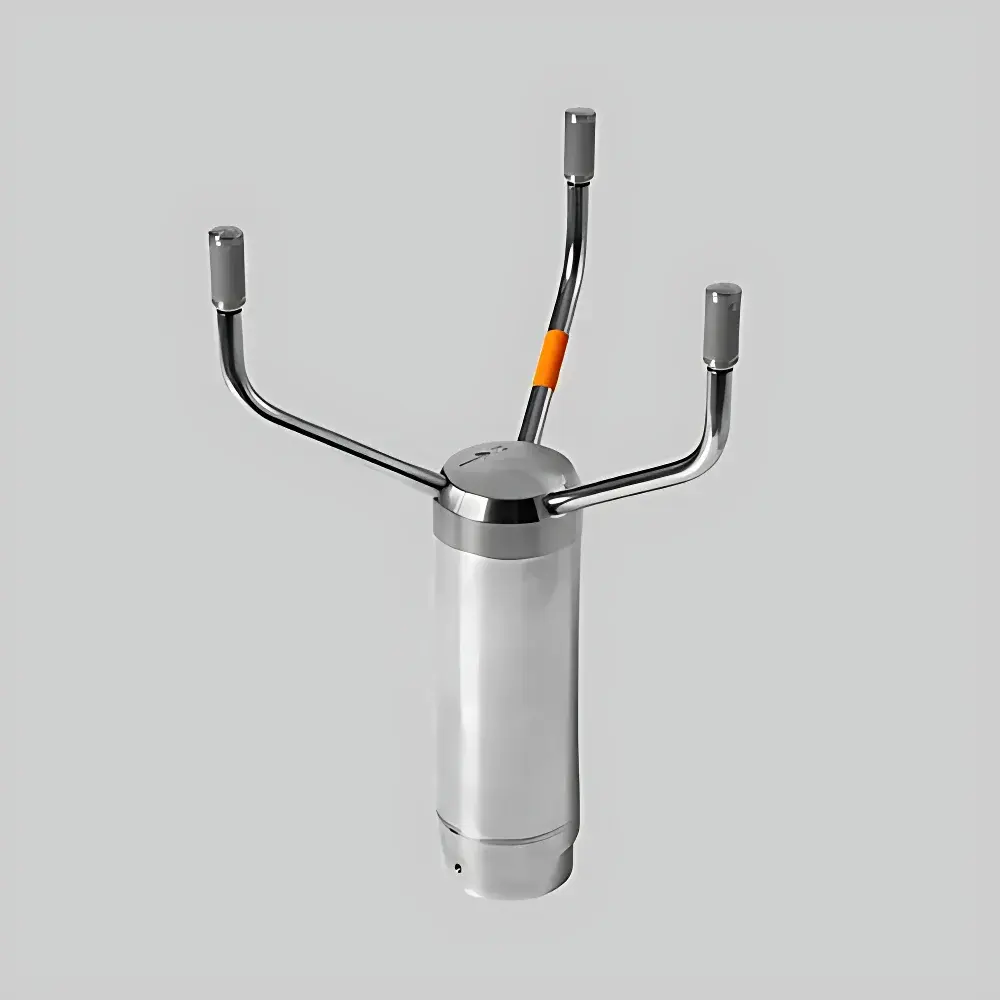
Vaisala WMT700 WINDCAP® Ultrasonic Anemometer
| Brand | Vaisala |
|---|---|
| Origin | Finland |
| Model | WMT700 |
| Instrument Type | Ultrasonic Anemometer |
| Resolution | 0.01 m/s |
| Measurement Range | 0–90 m/s |
| Accuracy | ±2% (0–75 m/s) |
| Operating Temperature | −55°C to +70°C |
| Relative Humidity Range | 0–100% RH |
| IP Rating | IP66 / IP67 |
| Output Rate | Up to 8 Hz |
| Power Supply | 9–36 VDC (sensor), 24–36 VDC (heating variants) |
| Heating Power | Up to 250 W (full-heating model) |
| Communication Interfaces | RS-485, RS-422, RS-232, SDI-12 |
| Compliance | WMO Guide No. 8 (7th ed.), ICAO Annex 3, ISO 16622, IEC 61000-4-2, IEC 60068-2, DNVGL-CG-0339, LR Type Approval, IEC 60945 |
Overview
The Vaisala WMT700 WINDCAP® Ultrasonic Anemometer is an industrial-grade, maintenance-free wind measurement system engineered for continuous, high-reliability operation in demanding meteorological, aviation, and environmental monitoring applications. It employs time-of-flight ultrasonic anemometry — a principle based on precise measurement of acoustic transit times between three transducer pairs arranged at 60° angles — to compute horizontal wind speed and direction with inherent immunity to ambient temperature, pressure, and relative humidity variations. Unlike mechanical cup-and-vane or hot-wire sensors, the WMT700 contains no moving parts or exposed heating elements susceptible to icing or wear, delivering long-term stability and metrological traceability under extreme climatic conditions. Designed and manufactured in Finland to stringent aerospace and civil aviation standards, the WMT700 meets the technical specifications outlined in WMO Guide to Instruments and Methods of Observation (CIMO Guide, No. 8, 7th edition) and ICAO Annex 3 — making it suitable for use in certified airport weather stations, automated surface observing systems (ASOS), and national meteorological networks.
Key Features
- Fully solid-state ultrasonic sensing architecture with zero mechanical wear and no routine calibration requirements
- Triple-transducer geometry enabling vector-based wind computation with 0.01 m/s speed resolution and 0.01° directional resolution
- Stainless steel (AISI 316) housing, mounting arm, and bracket; nickel-plated brass transducer housing for corrosion resistance
- Integrated self-diagnostics including real-time signal quality assessment, transducer health monitoring, and internal validation of measurement integrity
- Configurable output modes: polar (speed/direction) or Cartesian (u/v components); averaging intervals up to 3600 seconds (60 minutes)
- Heating variants available: sensor-only, sensor + mounting arm, or full-unit heating (up to 250 W peak) compliant with IEC 60068-2-31 ice accretion testing
- Dual serial interfaces (COM1: RS-485; COM2: RS-485/RS-422/RS-232/SDI-12) supporting multiple protocols including WMT700 ASCII, NMEA 0183 (v4.10), SDI-12 (v1.3), WS425 ASOS, and ROSA MES12
- IP66/IP67 ingress protection; qualified per ISO 16622 (wind turbine site assessment), DNVGL-CG-0339 (maritime), and IEC 60945 (marine electronics)
Sample Compatibility & Compliance
The WMT700 is validated for unattended, year-round deployment across terrestrial, marine, and high-altitude environments — including polar research stations, offshore platforms, and mountain-top observatories. Its operational envelope spans −55°C to +70°C ambient temperature and 0–100% RH, with storage capability from −60°C to +80°C. The instrument complies with electromagnetic compatibility (EMC) requirements per IEC 61000-4-2 (ESD), -4-3 (radiated RF), -4-4 (electrical fast transients), and -4-5 (surge), ensuring stable performance in electrically noisy infrastructure such as wind farms or radar installations. Environmental stress qualification includes IEC 60068-2-1 (cold), -2 (dry heat), -6 (vibration), -30 (solderability), -31 (salt mist), -34 (accelerated aging), and -78 (thermal shock). For aviation-critical sites, the WMT700 satisfies FAA Advisory Circular 150/5220-16C and EASA AMC 20-193 requirements for wind sensor redundancy, data continuity, and failure reporting.
Software & Data Management
The WMT700 operates autonomously without embedded firmware updates or host-dependent software. Configuration is performed via ASCII command set over serial interface using standard terminal emulation (e.g., PuTTY, Tera Term) or integrated into SCADA/HMI platforms via Modbus RTU (optional). All digital outputs include timestamped metadata (UTC time, sensor status flags, diagnostic codes) enabling audit-ready data provenance. When deployed in GLP/GMP-regulated environments (e.g., environmental impact assessments, air quality compliance monitoring), the device supports deterministic data logging with configurable averaging windows and output rates (1–8 Hz). While the WMT700 itself does not implement FDA 21 CFR Part 11 electronic signature controls, its deterministic serial protocol and hardware-level error checking (CRC-16, parity, framing) facilitate integration into validated data acquisition systems that enforce ALCOA+ principles (Attributable, Legible, Contemporaneous, Original, Accurate, Complete, Consistent, Enduring, Available).
Applications
- Automated airport weather observation systems (AWOS/ASOS) for real-time wind shear, crosswind, and tailwind alerts
- Renewable energy: wind resource assessment, turbine control input, wake modeling, and power curve validation per IEC 61400-12-1
- Environmental monitoring networks: EPA PM2.5/PM10 dispersion modeling, fugitive dust tracking, and boundary layer turbulence studies
- Marine and offshore operations: vessel navigation support, platform safety interlocks, and metocean data collection per DNVGL-ST-0126
- Research infrastructure: flux tower measurements (eddy covariance), urban climate studies, and cryospheric monitoring in Antarctica and Greenland
- Civil defense and emergency management: wildfire spread prediction, hazardous material dispersion modeling, and storm surge forecasting
FAQ
What wind speed and direction accuracy can be expected across the full range?
At wind speeds from 0 to 75 m/s, accuracy is specified as ±0.1 m/s or ±2% of reading (whichever is greater); from 75 to 90 m/s, accuracy degrades to ±5% of reading due to nonlinear acoustic propagation effects at high Reynolds numbers.
Does the WMT700 require periodic recalibration?
No. The sensor uses geometrically fixed transducer spacing and temperature-compensated time-of-flight measurement, eliminating drift mechanisms found in mechanical or thermal anemometers. Field verification may be performed using NIST-traceable reference standards per ISO/IEC 17025 procedures.
Can the WMT700 be used in salt-laden coastal or offshore environments?
Yes. The AISI 316 stainless steel construction and nickel-plated brass transducer housing meet IEC 60068-2-52 salt mist test requirements (severity level 6, 21 days), and the unit holds DNVGL-CG-0339 maritime certification.
How is ice formation mitigated during sub-zero operation?
Heated variants incorporate thermostatically controlled resistive heaters in the transducer heads, mounting arm, and optionally the main housing. Full-heating models sustain transducer surface temperatures above freezing even at −40°C ambient and 95% RH, preventing rime ice accumulation per IEC 60068-2-31 test Db.
Is analog output supported, and what are its limitations?
Yes — optional voltage (0–10 V), current (4–20 mA), frequency (0–10 kHz), or potentiometric outputs are available. However, analog channels lack timestamping, diagnostics, and protocol-level error detection; digital interfaces are recommended for mission-critical or regulatory applications.
Related Products







