
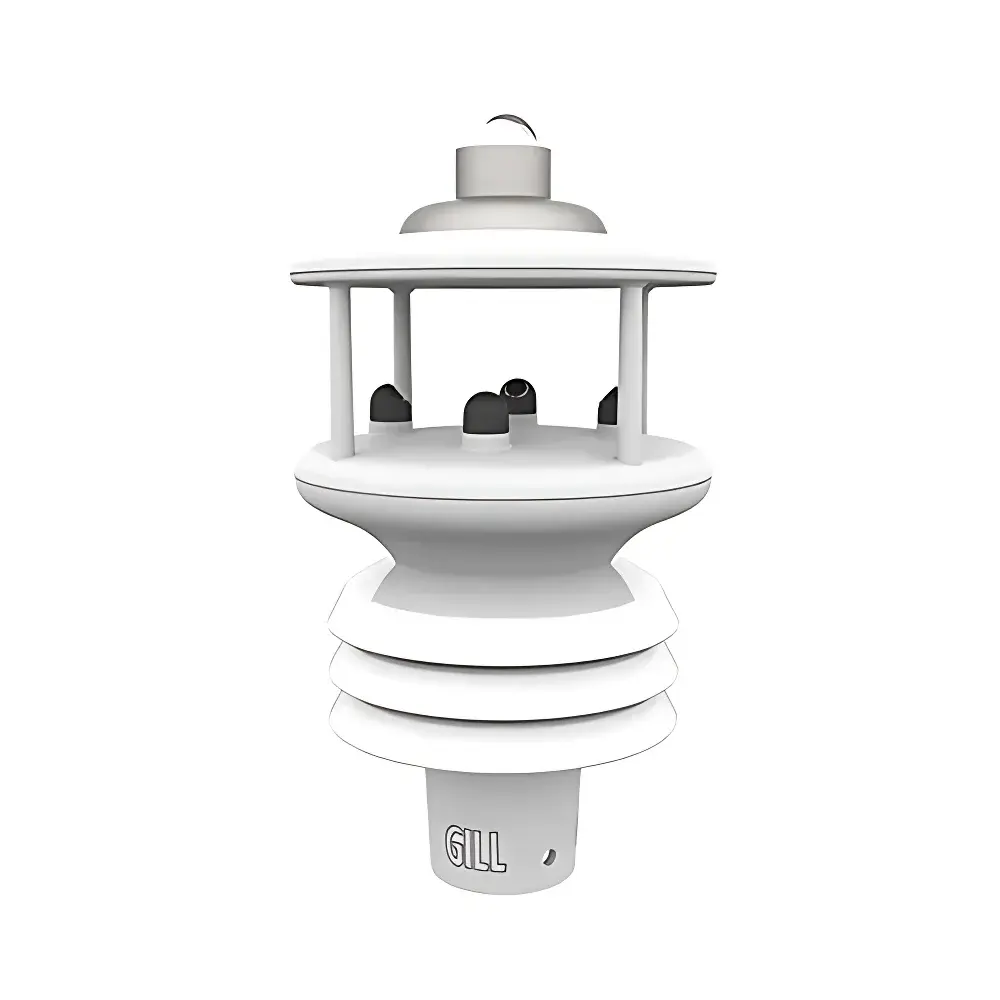
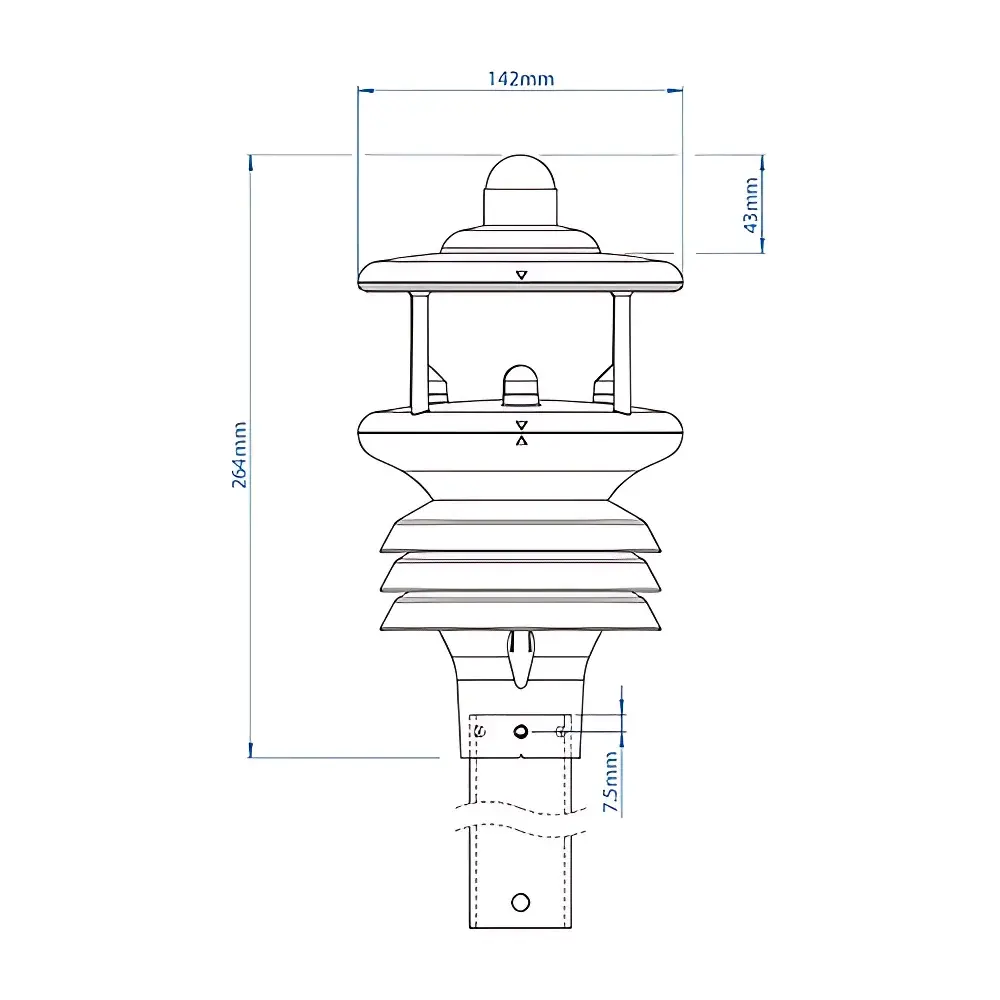
Gill GMX501 Compact Weather Station
| Brand | Gill |
|---|---|
| Origin | United Kingdom |
| Model | GMX501 |
| Instrument Type | Portable Weather Station |
| Compliance | ISO 9060:2018 (Class C), WMO Guide to Meteorological Instruments and Methods of Observation (WMO-No. 8) |
| Output Interfaces | RS-232 / RS-422 / RS-485 (ASCII), SDI-12, NMEA 0183, MODBUS RTU, Analog (optional) |
| Radiation Sensor | Hukseflux LP02 pyranometer (ISO 9060:2018 Class C) |
| Wind Measurement | Ultrasonic anemometer with integrated electronic compass |
| Environmental Housing | Triple-layer, UV-stabilized, naturally ventilated radiation shield (no moving parts) |
| Optional GPS Module | Provides true wind calculation, georeferenced coordinates (lat/lon), altitude (m ASL), solar position (sunrise/sunset, solar noon, twilight), and MSL pressure correction |
Overview
The Gill GMX501 Compact Weather Station is a fully integrated, maintenance-free environmental monitoring system engineered for long-term, high-reliability deployment in diverse operational environments. Designed and manufactured in the United Kingdom by Gill Instruments—a globally recognized leader in precision meteorological instrumentation—the GMX501 implements a modular, sensor-fused architecture grounded in internationally validated measurement principles. Its core sensing methodology combines passive thermodynamic equilibrium (for temperature/humidity/pressure), thermopile-based broadband solar irradiance detection (per ISO 9060:2018 Class C), and time-of-flight ultrasonic wind profiling—eliminating mechanical wear and ensuring metrological stability over extended field service intervals. Unlike traditional rotating-cup or vane-based systems, the GMX501’s solid-state wind measurement delivers continuous, gap-free sampling at 1 Hz resolution, enabling robust statistical derivation of WMO-standard 2-minute mean wind vectors, gust parameters (3-second maximum), and apparent wind components. The unit operates autonomously within its triple-layer, naturally ventilated radiation shield—designed to minimize solar loading errors while maintaining thermal equilibration across diurnal cycles—making it suitable for unattended operation in climatically heterogeneous zones from coastal exposure to arid inland sites.
Key Features
- Fully integrated tri-sensor module: air temperature, relative humidity, and barometric pressure housed within a UV-resistant, naturally ventilated triple-louvered radiation shield—compliant with WMO No. 8 requirements for passive aspiration.
- ISO 9060:2018 Class C-certified pyranometer (Hukseflux LP02) with fused silica dome, 180° field-of-view, and calibrated output in W/m²; supports direct irradiance, diffuse irradiance (with shading disk), and sunshine duration logging.
- Ultrasonic wind sensor with built-in 3-axis electronic compass; outputs instantaneous wind speed (m/s, km/h, mph, knots, ft/min), wind direction (0–359°), apparent wind vector, and—when paired with optional GPS—true wind speed/direction referenced to ground motion.
- Optional embedded GPS receiver provides georeferenced metadata: latitude/longitude (WGS84), elevation above sea level (m ASL), solar geometry calculations (sunrise, sunset, solar noon, civil/nautical/astronomical twilight), and mean sea level (MSL) pressure derivation.
- Multi-protocol digital interface suite: native support for ASCII serial (RS-232/422/485), SDI-12, NMEA 0183 (for GPS and sensor fusion), MODBUS RTU, and configurable analog outputs (0–5 V, 4–20 mA) for SCADA integration.
- Comprehensive derived parameter set: wet-bulb temperature, absolute humidity (g/m³), air density (kg/m³), wind chill index (°C/°F), dew point, and heat index—all calculated in real time using IEC 60751, ISO 7730, and ASHRAE Fundamentals algorithms.
Sample Compatibility & Compliance
The GMX501 is designed for ambient atmospheric sampling only and does not require consumables, calibration gases, or optical reagents. All primary sensors meet traceable international standards: temperature and humidity elements are factory-calibrated against NPL-traceable reference standards; the LP02 pyranometer carries individual calibration certificates compliant with ISO/IEC 17025; and the ultrasonic wind sensor undergoes aerodynamic validation per IEC 61000-6-2/6-4 EMC directives. System-level compliance includes adherence to WMO observational guidelines (Chapter 6, WMO-No. 8, 2022 edition), ISO 9060:2018 (spectral response, directional response, temperature dependence), and CE marking under the EU Electromagnetic Compatibility and RoHS directives. Data integrity protocols support audit-ready logging for GLP-aligned environmental monitoring programs.
Software & Data Management
The GMX501 operates as a self-contained data acquisition node. Raw sensor values are timestamped with internal RTC (±2 s/month drift) and formatted into user-selectable output protocols. Gill’s proprietary MetLink software (Windows/macOS) enables configuration, firmware updates, real-time telemetry visualization, and export to CSV, NetCDF, or CF-compliant formats. For enterprise deployment, the station integrates natively with industry-standard platforms—including Campbell Scientific LoggerNet, DTN Weather Central, and NOAA’s MADIS—via SDI-12 or MODBUS. All digital interfaces support configurable polling intervals (1 s to 60 min), data buffering (up to 32 MB internal memory), and failover transmission via cellular or LoRaWAN gateways (external). Audit trails, checksummed packet validation, and CRC-16 error detection ensure data provenance in regulated applications.
Applications
- Agricultural meteorology: microclimate monitoring for irrigation scheduling, frost risk assessment, evapotranspiration modeling (FAO-56 Penman-Monteith), and precision viticulture.
- Renewable energy: photovoltaic performance ratio analysis, solar resource assessment (SRP), and wind farm site pre-feasibility screening.
- Transport infrastructure: road surface condition forecasting (via dew point and wet-bulb temperature), aviation weather observation (AWOS-lite), and rail corridor wind hazard alerts.
- Coastal and marine operations: wave height proxy estimation (via wind stress), fog onset prediction, and port environmental compliance reporting.
- Educational and research networks: low-cost, high-fidelity nodes for citizen science initiatives, university mesonet deployments, and climate change impact studies.
- Industrial process control: HVAC optimization, cleanroom environmental verification, and emissions monitoring support (e.g., dispersion modeling input).
FAQ
Does the GMX501 require routine recalibration?
No—its solid-state sensors are factory-calibrated with NPL-traceable references and exhibit minimal drift (<0.1 %/year for LP02, <0.2 °C/year for temperature element). Annual verification against a reference standard is recommended for ISO/IEC 17025-compliant operations.
Can the GMX501 operate independently without external power?
Yes—it supports 6–30 V DC input and consumes ≤1.2 W in continuous mode. With optional solar charging and deep-cycle battery integration, it achieves >12 months of autonomous operation in mid-latitude temperate climates.
Is the radiation shield compatible with extreme temperatures?
The triple-louvered shield is rated for –40 °C to +70 °C ambient operation and features UV-stabilized polycarbonate construction resistant to thermal shock and long-term solar degradation.
What GPS accuracy can be expected with the optional module?
Typical horizontal accuracy is 2.5 m CEP (95 % confidence) with SBAS augmentation; vertical accuracy is ±5 m. Positional data is updated at 1 Hz and logged synchronously with meteorological measurements.
How is data security handled during wireless transmission?
When interfaced with third-party gateways (e.g., LTE or LoRaWAN), encryption (TLS 1.2+, AES-128) and device authentication are enforced at the network layer—not within the GMX501 itself, which remains a deterministic sensor node per IEC 62443-3-3 Level 1 principles.







