
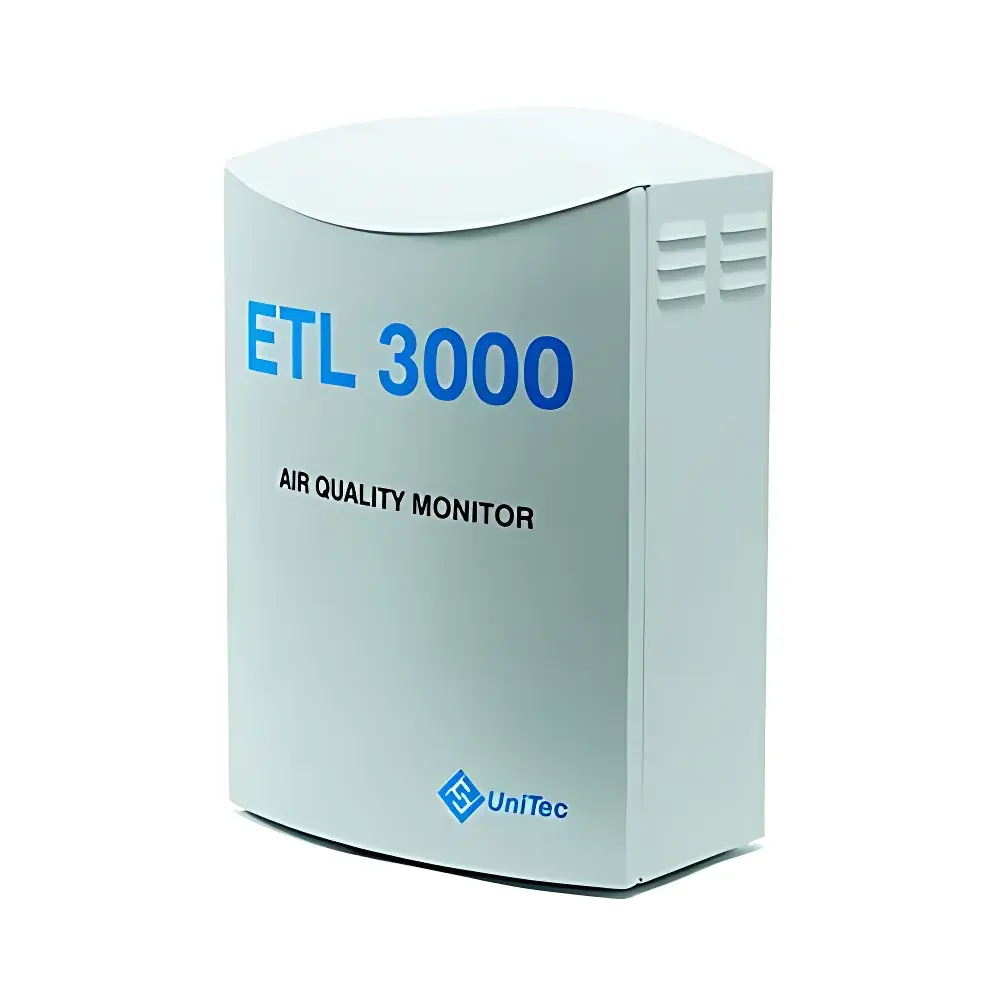
Unitec ETL3000 Automatic Air Quality Monitoring System
| Brand | UNITEC |
|---|---|
| Origin | Italy |
| Model | ETL3000 |
| Measured Pollutants | SO₂, H₂S, CO, NH₃, VOC, C₆H₆, NO₂, O₃, CH₄, CO₂ |
| Sensor Technologies | TF-MOS (Thick-Film Metal Oxide Semiconductor), Electrochemical (EC), Non-Dispersive Infrared (NDIR) |
| Operating Temperature | −20 to +50 °C |
| Humidity Range | 10–95 % RH (non-condensing) |
| Enclosure Rating | IP55 |
| Dimensions | 370 × 522 × 210 mm |
| Weight | 10 kg |
| Power Options | 220 VAC / 110 VAC / 12 VDC |
| Max Power Consumption | 30 W |
| Data Logging | 1 Hz sampling, 15- or 60-min averaging, internal flash storage |
| Communication | RS232 ASCII output, optional GSM/UMTS modem (VPN-capable) |
| Optional Add-ons | Integrated meteorological station, Class 1 noise monitor, solar power kit (panel + battery + charge controller), heating module for particulate sampling line |
Overview
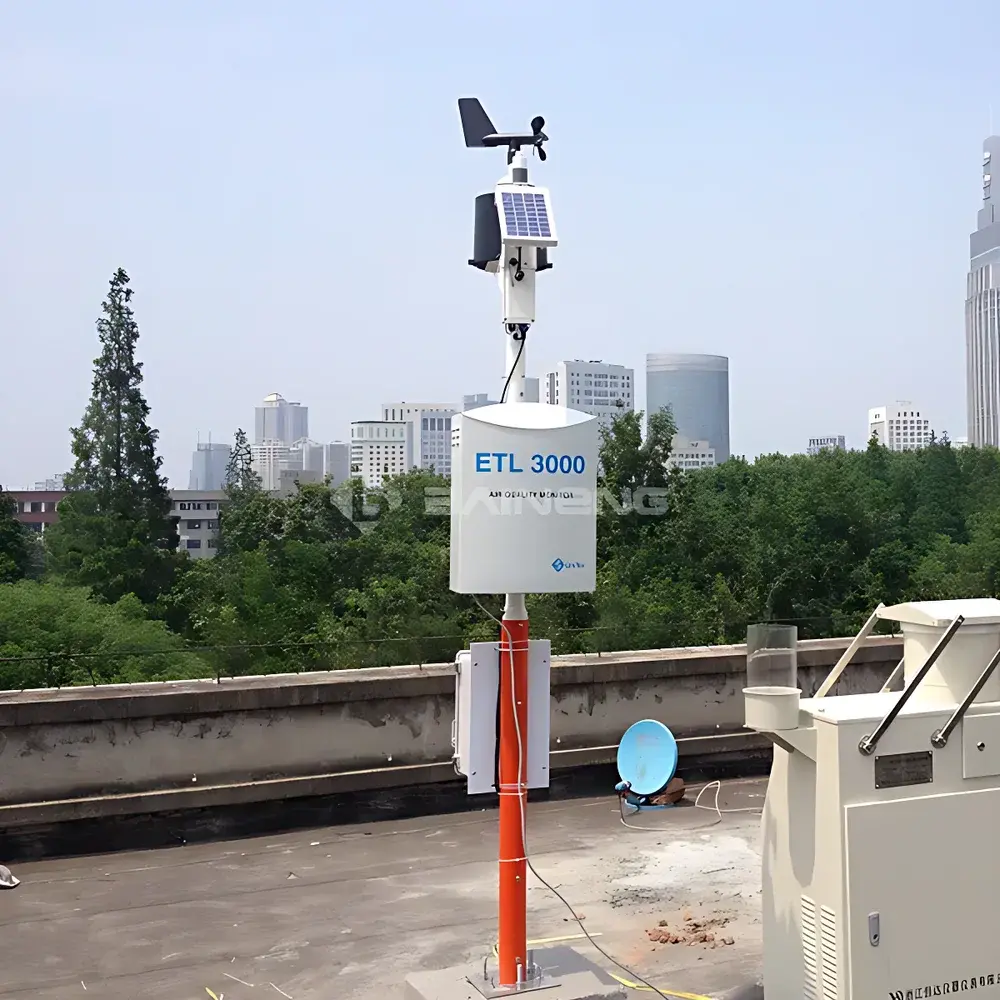
The Unitec ETL3000 is a fully integrated, field-deployable automatic air quality monitoring system engineered for continuous, real-time measurement of gaseous pollutants and environmental parameters in ambient outdoor environments. Designed and manufactured in Italy, the ETL3000 complies with EU Directive 2008/50/EC on ambient air quality and cleaner air for Europe, supporting regulatory-grade data acquisition for statutory reporting and long-term trend analysis. Its architecture is built around Unitec’s proprietary SENS-IT sensor platform — a modular, multi-technology sensing framework combining thick-film metal oxide semiconductor (TF-MOS), electrochemical (EC), and non-dispersive infrared (NDIR) detection principles. Each sensor is gas-specific, factory-calibrated, and electrically isolated — enabling selective, stable, and drift-resistant measurements without frequent recalibration. The system operates autonomously in harsh outdoor conditions (−20 to +50 °C, up to 95 % RH), requiring no active air conditioning, sample conditioning, or external cooling units. Its IP55-rated enclosure ensures protection against dust ingress and low-pressure water jets, permitting direct pole-mount installation with minimal civil works.
Key Features
- Modular SENS-IT sensor architecture: Individual TF-MOS, EC, and NDIR sensors dedicated to specific target analytes — CO, NO₂, O₃, C₆H₆, CH₄, SO₂, H₂S, NH₃, VOC, and CO₂ — with ppb-level resolution for key trace gases.
- Integrated data acquisition unit: Onboard microcontroller with LCD interface, flash memory, and configurable logging intervals (1-second raw data capture; 15- or 60-minute averaged values stored internally).
- Low-power design: Maximum 30 W consumption under full configuration — compatible with AC mains or DC sources including solar-powered operation via optional photovoltaic kit (panel, deep-cycle battery, and smart charge controller).
- Field-serviceability: Hot-swappable sensors connect via standardized interfaces; no tools required for replacement — minimizing downtime during maintenance or reconfiguration.
- Expandable peripheral integration: Native support for co-located meteorological stations (wind speed/direction, temperature, relative humidity, barometric pressure, rainfall, solar irradiance, UV index) and Class 1 noise monitors (IEC 61672-1 compliant).
- Secure remote connectivity: Optional GSM or UMTS modems enable encrypted data transmission over cellular networks, including VPN tunneling for IT infrastructure alignment with enterprise security policies.
Sample Compatibility & Compliance
The ETL3000 is validated for unattended, long-term deployment in diverse ambient settings — urban background sites, roadside locations, industrial perimeters, landfill boundaries, and sensitive receptor zones. Its sensor technologies meet performance criteria defined in EN 14625 (O₃), EN 14626 (SO₂), EN 14627 (NO₂), EN 15446 (VOCs), and EN 14628 (CO), ensuring metrological traceability to national reference standards. The system supports GLP-aligned data integrity through time-stamped, tamper-evident logging and audit-ready metadata (sensor ID, calibration date, firmware version, environmental conditions). While not certified to ISO/IEC 17025 as a testing laboratory, its hardware and firmware architecture align with requirements for data used in compliance reporting under EU national implementation plans and local air quality management frameworks.
Software & Data Management
Three complementary software packages are available for system configuration, visualization, and post-processing: @COM3000 (local PC-based tool for instrument setup, firmware updates, and batch download of raw/averaged datasets in CSV or ASCII format); ETL BAR (web-enabled dashboard for real-time graphical display of current concentrations, trends, and alarm thresholds); and ETL TOTEM (localized, multi-language platform supporting GIS mapping, automated report generation, and integration with municipal environmental information systems). All software modules enforce role-based access control and maintain full audit trails per FDA 21 CFR Part 11 principles — including electronic signatures, change history, and user activity logs — where required for regulated operations.
Applications
- Urban air quality monitoring networks — providing high-temporal-resolution data for public health advisories and policy evaluation.
- Roadside pollution assessment — capturing transient peaks from traffic emissions with second-by-second responsiveness.
- Industrial fence-line monitoring — verifying compliance with emission limits and detecting fugitive releases near process boundaries.
- Landfill and waste treatment facility surveillance — tracking H₂S, NH₃, VOCs, and CH₄ for odor control and greenhouse gas inventory reporting.
- Environmental impact assessments (EIA) and baseline studies — delivering calibrated, continuous datasets for pre- and post-construction comparison.
- Academic and research applications — supporting atmospheric chemistry modeling, sensor validation trials, and exposure science investigations.
FAQ
Does the ETL3000 require periodic calibration in the field?
Calibration intervals depend on application criticality and regulatory requirements; however, SENS-IT sensors exhibit low drift characteristics, enabling 6–12 month calibration cycles under typical ambient conditions. Field zero/span checks can be performed using certified gas standards via the onboard test port.
Can the system operate independently during grid power outages?
Yes — when equipped with the optional solar power kit, the ETL3000 sustains full functionality (including all sensors, data logger, and GSM modem) for ≥72 hours without sunlight, based on standard 100 W panel and 100 Ah battery configuration.
Is particulate matter (PM) measurement supported?
The base ETL3000 does not include PM sensors; however, it provides mechanical and electrical interfaces for third-party optical or beta-attenuation PM monitors, and optionally integrates a heated sampling line (220 VAC-powered) to prevent condensation in humid environments.
What communication protocols are supported for SCADA or central data platforms?
The system outputs ASCII-formatted strings via RS232 serial interface, compatible with Modbus RTU gateways. With UMTS/GSM modem, it supports TCP/IP-based MQTT or HTTP(S) POST to cloud platforms or municipal AQMS servers.
How is data security ensured during wireless transmission?
Optional UMTS modems support TLS 1.2 encryption and configurable firewall rules; VPN tunnels (IPsec or OpenVPN) can be established between the ETL3000 and secure corporate networks to isolate telemetry traffic from public internet exposure.
Related Products







