
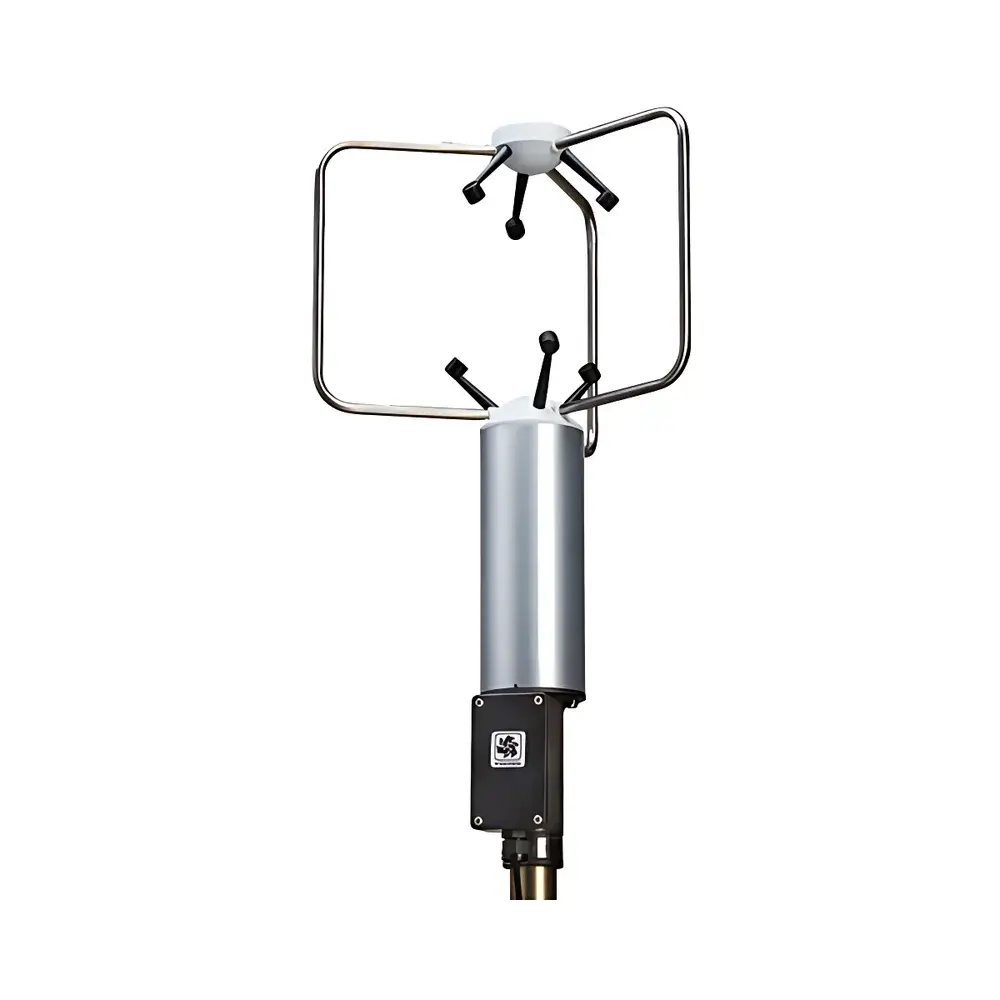
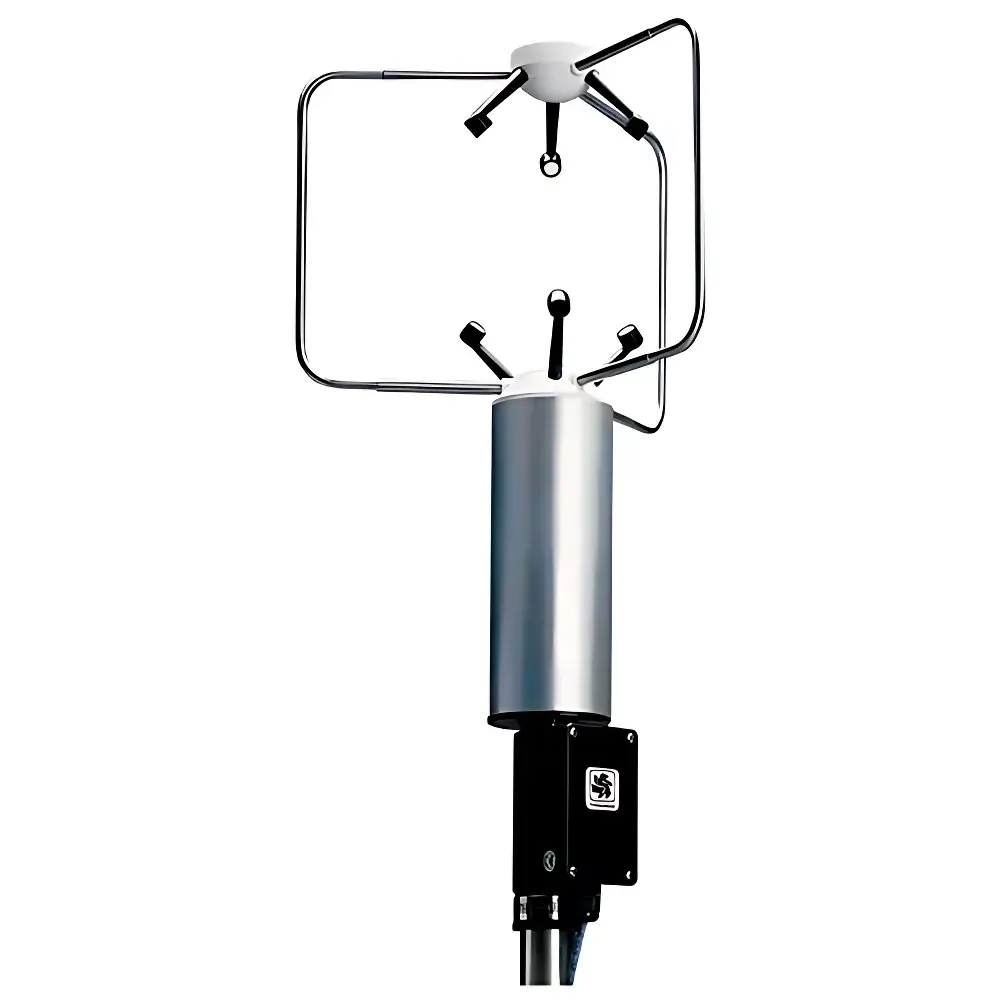
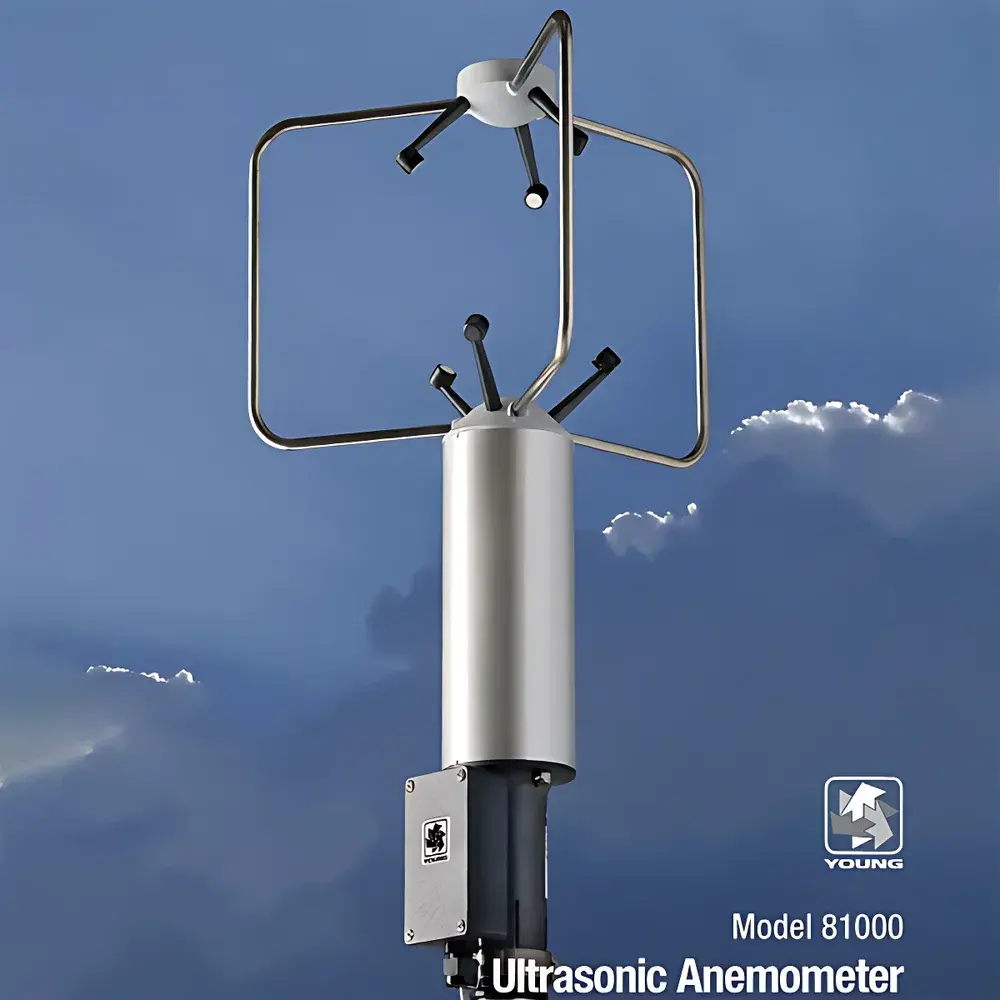
R.M. Young 81000 Three-Dimensional Ultrasonic Anemometer
| Brand | R.M. Young |
|---|---|
| Origin | USA |
| Model | 81000 |
| Instrument Type | Ultrasonic Anemometer |
| Resolution | 0.01 m/s |
| Wind Speed Range | 0–40 m/s |
| Accuracy | ±1% (0–30 m/s), ±3% (30–40 m/s) |
| Operating Temperature | −50 to +50 °C |
| Relative Humidity Range | 0–100% RH |
| Wind Direction Range | 0–360° |
| Elevation Angle Range | ±60° |
| Sonic Temperature Range | −50 to +50 °C |
| Output Options | RS-232 / RS-485 serial, 4-channel analog voltage (81000) |
| Sampling Rate | Up to 160 Hz |
| Output Frequency | User-selectable 4–32 Hz |
| Power Supply | 12–24 VDC, 110 mA |
| Dimensions | 55 cm height × 17 cm diameter |
| Weight | 1.7 kg |
Overview
The R.M. Young 81000 Three-Dimensional Ultrasonic Anemometer is a precision-engineered, solid-state wind sensing instrument designed for high-fidelity atmospheric turbulence measurement and long-term environmental monitoring. Unlike mechanical cup-and-vane anemometers, the 81000 employs time-of-flight ultrasonic transit-time principle across three orthogonal transducer pairs to simultaneously resolve instantaneous u-, v-, and w-axis wind velocity components—enabling true 3D vector wind analysis without moving parts. This architecture eliminates mechanical wear, inertia-induced lag, and directional hysteresis, making it ideal for eddy covariance flux studies, boundary layer research, wind resource assessment, and meteorological network deployments requiring sub-second temporal resolution and structural robustness in harsh field conditions.
Key Features
- Three orthogonal ultrasonic transducer pairs mounted on a rigid stainless-steel support structure, engineered to minimize wake interference and maintain geometric stability under dynamic loading.
- High-speed sampling up to 160 Hz, supporting spectral analysis of turbulent kinetic energy and coherent structures in the inertial subrange.
- User-configurable output frequency (4–32 Hz) and digital baud rates (1200–38400 bps) for seamless integration with data loggers, SCADA systems, and real-time telemetry platforms.
- Dual configuration options: standard 81000 (four analog voltage outputs) and 81000V (four analog voltage inputs + serial data output), accommodating synchronized multi-sensor acquisition (e.g., CO₂, H₂O, temperature).
- Individual wind-tunnel calibration for each unit, correcting for structural shadow effects and cross-axis sensitivity—traceable to NIST-traceable standards.
- Weathertight junction box with IP65-rated cable entry, enabling outdoor installation on standard 1-inch mounting pipes without external enclosures.
Sample Compatibility & Compliance
The 81000 operates reliably across extreme environmental conditions—from Arctic tundra (−50 °C) to desert environments (+50 °C) and saturated tropical atmospheres (0–100% RH). Its non-rotating design ensures consistent performance during freezing precipitation events where icing would disable mechanical sensors. The device complies with IEC 61326-1 (EMC for measurement equipment) and meets the environmental stress testing requirements outlined in MIL-STD-810G Method 502.6 (low temperature) and Method 507.5 (humidity). While not certified for SIL or ATEX zones, its intrinsic safety profile supports deployment in unclassified outdoor meteorological stations aligned with WMO Guide to Meteorological Instruments and Methods of Observation (CIMO Guide, Chapter 8).
Software & Data Management
Data output is fully programmable via ASCII-based serial protocol, supporting user-defined fields including u/v/w components, sonic temperature, virtual temperature, horizontal wind speed/direction, vertical wind velocity, and elevation angle—all selectable in SI or imperial units (m/s, mph, knots, km/h). The instrument supports both fixed-format and delimited streaming modes, facilitating direct ingestion into Python-based processing pipelines (e.g., PyFluxPro, EddyPro), MATLAB, or commercial SCADA historian systems. Audit-ready timestamping is enabled when synchronized with GPS-disciplined PPS signals. Though the 81000 itself does not embed FDA 21 CFR Part 11-compliant electronic signatures, its deterministic ASCII output enables full traceability when paired with compliant data acquisition software meeting GLP/GMP metadata logging requirements.
Applications
- Eddy covariance flux towers for net ecosystem exchange (NEE) of CO₂, CH₄, and H₂O vapor in ecological and agricultural research.
- Boundary layer profiling and turbulence intensity mapping for wind turbine siting and wake modeling (IEC 61400-12-1 compliant measurements).
- Urban meteorology networks assessing ventilation efficiency, pollutant dispersion, and heat island dynamics.
- Air quality monitoring stations requiring co-located wind vector data for source attribution and plume trajectory modeling.
- Aviation weather systems at remote airstrips where rapid response and ice-free operation are critical.
- Calibration reference for lower-cost ultrasonic or thermal anemometers in metrological intercomparison campaigns.
FAQ
What is the difference between the 81000 and 81000V models?
The 81000 provides four user-assignable analog voltage outputs (0–5000 mV) for wind components or derived parameters; the 81000V replaces these with four analog voltage inputs (two at 0–5000 mV, two at 0–1000 mV), allowing simultaneous acquisition of auxiliary sensor signals (e.g., gas analyzers, pyranometers) alongside ultrasonic wind data.
Is the 81000 suitable for icing-prone environments?
Yes—the absence of moving parts and use of heated transducer housings (optional accessory) enable reliable operation in freezing fog and light rime conditions. However, heavy glaze ice accumulation may require periodic manual de-icing or integration with active heating systems.
How is calibration traceability maintained?
Each unit undergoes individual low-turbulence wind tunnel calibration at R.M. Young’s Ann Arbor facility, with correction coefficients applied to compensate for support structure aerodynamics. Calibration reports include uncertainty budgets per ISO/IEC 17025:2017 Annex A.
Can the 81000 interface directly with Campbell Scientific CR-series dataloggers?
Yes—via RS-232 or RS-485 using standard SDI-12 or custom ASCII protocols; example wiring diagrams and CRBasic code libraries are available in the R.M. Young Application Notes repository.
What is the recommended maintenance interval?
No routine maintenance is required beyond biannual visual inspection of transducer faces for debris or corrosion. Annual recalibration is recommended for applications demanding ≤±0.5% wind speed uncertainty over time.







