
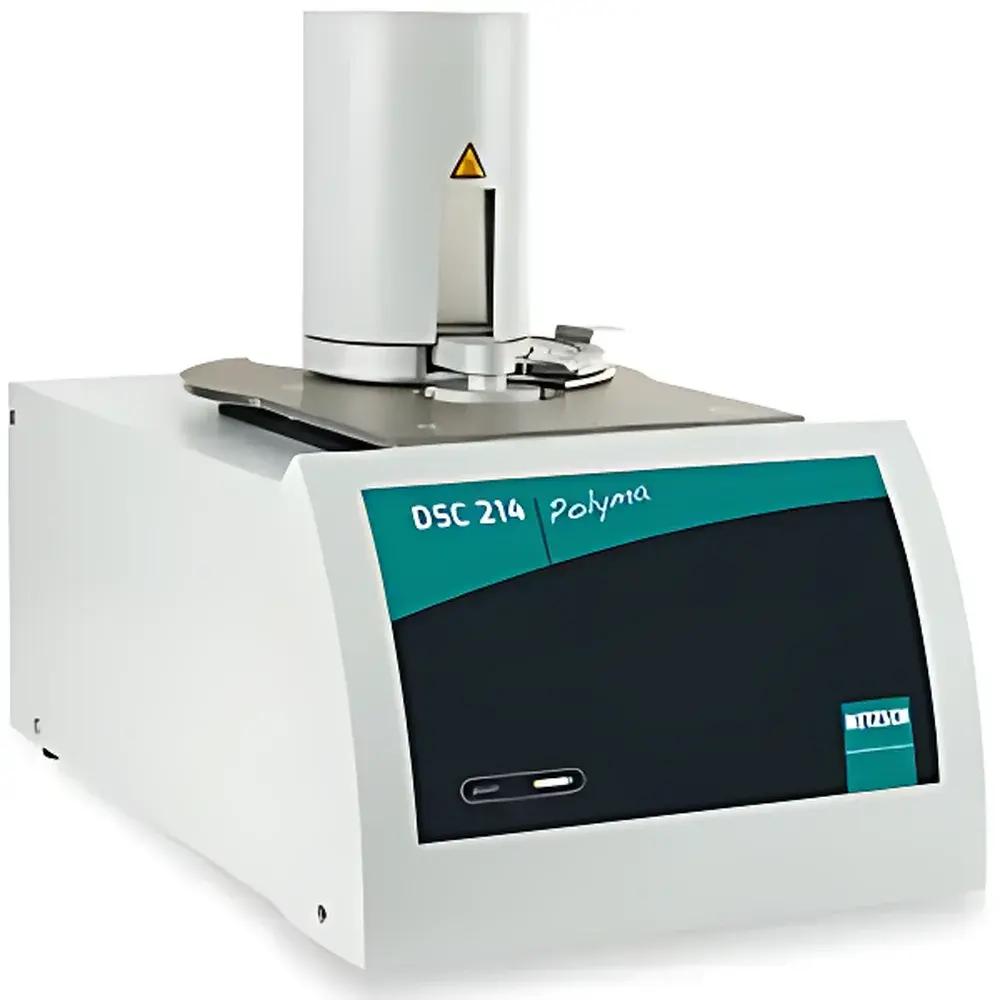
Netzsch DSC 214 Polyma Differential Scanning Calorimeter
| Brand | Netzsch |
|---|---|
| Origin | Germany |
| Instrument Type | DSC |
| Temperature Range | −170 °C to 600 °C |
| Temperature Accuracy | ±0.1 K |
| Heating/Cooling Rate | 0 to 500 °C/min |
| Detection Limit | 0.1 μW |
| Atmosphere Control | Dynamic or static inert, reducing, or oxidizing (automated gas switching) |
| Cooling Options | Compressed air, mechanical refrigeration, liquid nitrogen (dual-cooling system optional, software-switchable) |
| Optional Accessories | Photo-DSC module, ASC automatic sample changer (20 positions), TMDSC upgrade |
| Software Features | Intelligent Mode, Expert Mode, Auto-Calibration, Auto-Analysis, Pattern Recognition, Tau-R® advanced thermal lag correction, DSC spectral database and search engine |
Overview
The Netzsch DSC 214 Polyma is a high-performance heat-flux differential scanning calorimeter engineered for precision thermal characterization of polymeric, pharmaceutical, inorganic, and composite materials. Operating on the fundamental principle of heat-flux DSC—where the temperature difference between a sample and reference pan is measured under controlled heating or cooling—the instrument delivers exceptional sensitivity and reproducibility across an extended thermal range from −170 °C to 600 °C. Its industry-leading heating and cooling rates—up to 500 °C/min—enable rapid thermal profiling, kinetic analysis under non-isothermal conditions, and accurate determination of transient transitions such as cold crystallization, melt reorganization, and fast-cure exotherms. The DSC 214 Polyma’s modular architecture supports seamless integration of advanced functionalities without compromising baseline stability or signal-to-noise ratio.
Key Features
- Ultra-fast thermal control: Programmable heating/cooling rates from 0 to 500 °C/min with sub-millisecond response time and precise ramp fidelity.
- Dual-cooling capability: Simultaneous installation of mechanical refrigeration and liquid nitrogen cooling systems, switchable via software—enabling uninterrupted operation across cryogenic to high-temperature regimes.
- Tau-R® dynamic thermal lag correction: A proprietary real-time algorithm that compensates for sensor and furnace thermal inertia, significantly improving peak shape fidelity, onset accuracy, and enthalpy quantification—particularly critical for sharp transitions and overlapping events.
- Integrated spectral database and pattern recognition: First-of-its-kind DSC spectral search engine allows users to compare unknown thermograms against a curated library of reference curves, supporting material identification, batch consistency checks, and failure root-cause analysis.
- Modular expansion readiness: Native support for Photo-DSC (UV-curing kinetics), TMDSC (temperature-modulated DSC for separation of reversing/non-reversing heat flow), and ASC automatic sample changer (20-position carousel with integrated calibration verification).
- Multi-platform software interface: Compatible with Windows-based PCs and tablet devices; full remote monitoring and method execution via secure local network or VPN-enabled access.
Sample Compatibility & Compliance
The DSC 214 Polyma accommodates standard crucibles (aluminum, gold-plated aluminum, stainless steel, high-purity graphite) and custom pans for reactive or volatile samples. It supports quantitative analysis of solids, powders, films, fibers, gels, and semi-crystalline formulations—including thermoplastics, thermosets, elastomers, APIs, excipients, and battery electrode materials. The instrument meets essential regulatory requirements for GLP and GMP environments: audit-trail enabled data logging, electronic signatures (21 CFR Part 11 compliant when deployed with Netzsch Proteus® Software Suite v12+), and traceable calibration protocols aligned with ISO 11357-1 and ASTM E794. Gas atmosphere control enables oxidative induction time (OIT) testing per ISO 11357-6 and ASTM D3895, while inert-mode measurements comply with USP for thermal stability assessment of pharmaceuticals.
Software & Data Management
Proteus® Software serves as the unified platform for instrument control, data acquisition, and advanced post-processing. It provides three operational modes: Intelligent Mode (guided workflows for routine QA/QC), Expert Mode (full parameter customization), and Auto-Analysis Mode (rule-based event detection and reporting). All raw and processed data are stored in vendor-neutral HDF5 format with embedded metadata (operator ID, timestamp, method version, calibration history). Batch processing, statistical trend analysis, kinetic modeling (e.g., Ozawa-Flynn-Wall, Kissinger), and comparative overlay tools are natively supported. Data export options include CSV, PDF reports, and direct integration with LIMS via OPC UA or RESTful API.
Applications
- Thermal transition analysis: Precise determination of glass transition temperature (Tg), melting point (Tm), crystallization onset (Tc), and associated enthalpies (ΔHf, ΔHc)—critical for polymer processing optimization and formulation development.
- Cure and crosslinking kinetics: Real-time monitoring of epoxy, silicone, and acrylate resin curing under isothermal or dynamic conditions; calculation of degree of cure and activation energy.
- Oxidative stability assessment: OIT and Oxidative Onset Temperature (OOT) measurement in polyolefins, lubricants, and composites per industrial aging standards.
- Polymorph screening and phase behavior: Identification and quantification of solid-state transformations, including enantiotropic/monotropic transitions and hydrate/dehydrate events.
- Specific heat capacity (Cp) determination: Using sapphire calibration and multi-step temperature modulation protocols.
- Reaction calorimetry: Quantitative analysis of decomposition exotherms, catalytic activity, and compatibility screening (e.g., drug-excipient interactions).
FAQ
What cooling configurations are supported, and how does dual-cooling improve experimental flexibility?
The DSC 214 Polyma accepts compressed air, mechanical refrigeration (−60 °C base), and liquid nitrogen (−170 °C base) cooling units. Dual-cooling allows users to switch between systems within a single method sequence—eliminating manual hardware changes and enabling continuous low-to-high temperature sweeps without thermal lag penalties.
Is the Tau-R® correction algorithm validated against international standards?
Yes—Tau-R® has been benchmarked against NIST SRM 3451 (indium) and ISO 11357-1 Annex B procedures, demonstrating improved onset accuracy (99.2%) compared to conventional DSC instruments.
Can the DSC 214 Polyma be integrated into automated lab environments?
Absolutely—the ASC 20-position autosampler supports barcode-driven sample loading, integrated calibration verification, and unattended overnight runs. Full SCADA compatibility is available via optional Ethernet/IP or Modbus TCP modules.
Does the system support compliance with FDA 21 CFR Part 11 for regulated industries?
When configured with Proteus® Software v12.2 or later, user authentication, electronic signatures, immutable audit trails, and role-based access control fully satisfy 21 CFR Part 11 requirements for pharmaceutical and medical device development labs.
How is baseline stability maintained during ultra-fast heating ramps?
The furnace design incorporates symmetric dual-sensor geometry and active thermal shielding, minimizing asymmetry-induced drift. Combined with Tau-R® real-time correction, baseline deviation remains below ±0.02 μW over 500 °C/min ramps—ensuring reliable quantification even for micro-scale transitions.



