
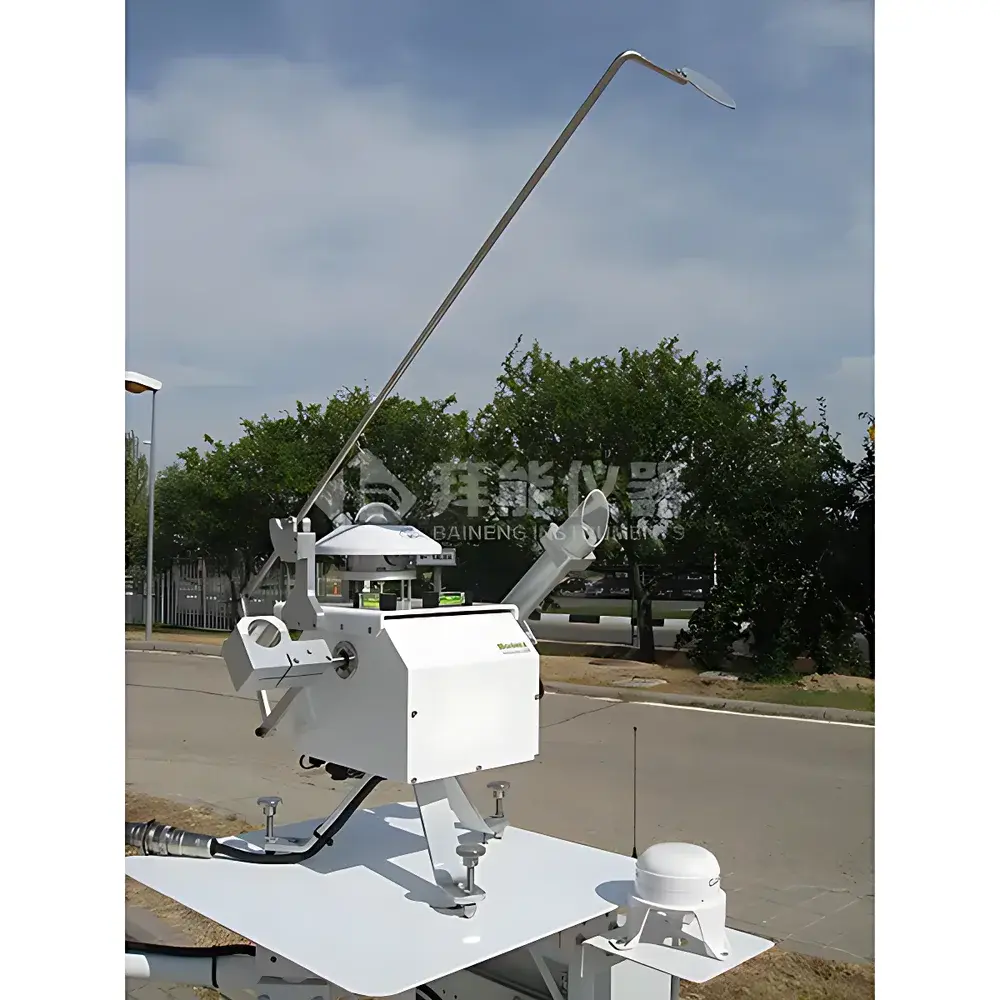
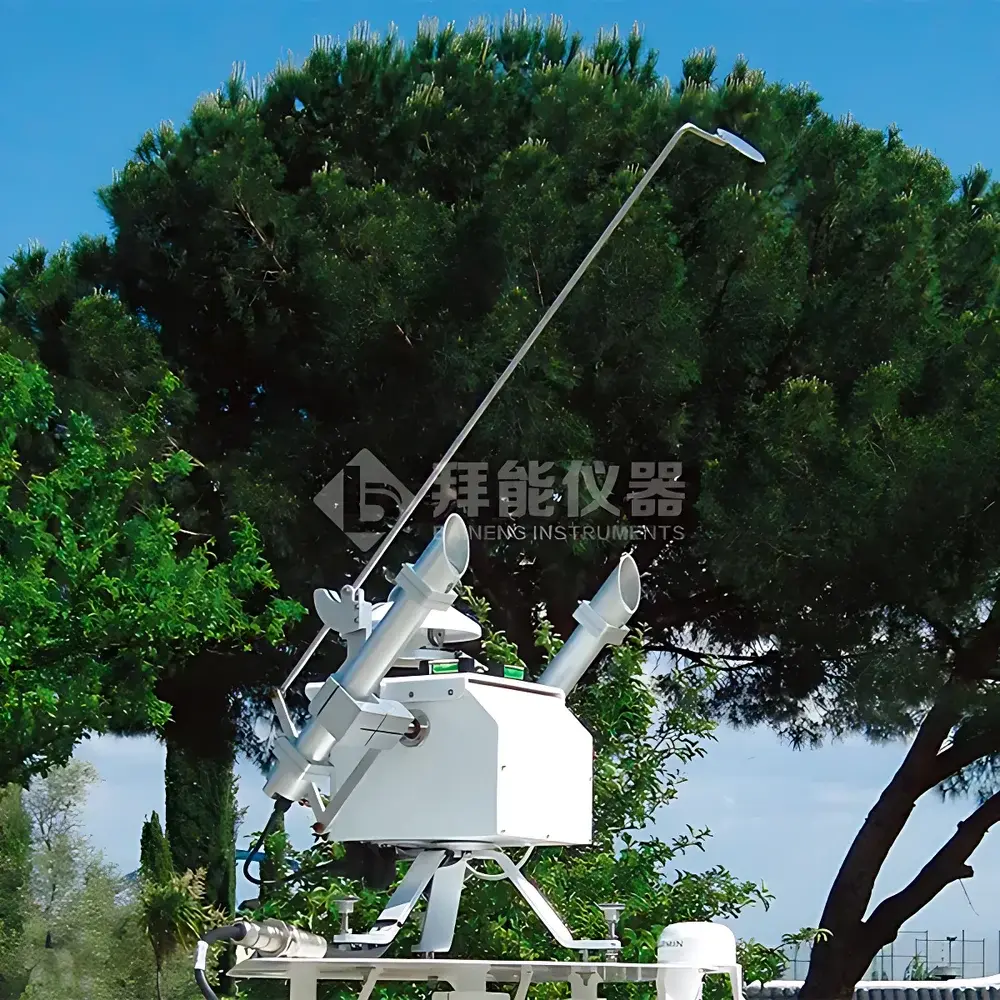
Geonica SunTracker-2000 Solar Tracker
| Brand | Geonica |
|---|---|
| Origin | Spain |
| Model | SunTracker-2000 |
| Power Consumption | <2 W |
| Tracking Accuracy | 0.1° (passive), 0.02° (active with optional radiometer feedback) |
| Payload Capacity | 10 kg |
| Azimuth & Elevation Drive Speed | 9.4°/s |
| Operating Temperature | −20 °C to +60 °C |
| Humidity Range | 0–100% RH |
| Weight | 7 kg |
| Dimensions | 300 × 370 × 290 mm |
| Mounting | Tripod with dual bubble levels |
| Housing Material | Rust-resistant aluminum alloy |
| Worm Gear Material | 304 stainless steel worm and bronze gear |
| Communication Interface | RS-485 (integrated control module), compatible with METEODATA dataloggers via RS-232/422/485 or Ethernet |
| Time Synchronization | Internet NTP or integrated GPS receiver |
| Position Resolution | Real-time solar altitude and azimuth calculated and logged at 1 Hz |
Overview
The Geonica SunTracker-2000 is a high-precision, dual-axis solar tracker engineered for continuous, autonomous alignment of pyrheliometers and pyranometers with the solar disk under variable geographic and meteorological conditions. It operates on a deterministic astronomical algorithm—precomputed using UTC time, latitude, longitude, and elevation—to drive two stepper motors that reposition mounted radiation sensors in real time. Unlike open-loop trackers relying solely on photodiode feedback, the SunTracker-2000 implements hybrid tracking: primary positioning is performed via celestial mechanics, while optional active correction (0.02° accuracy) integrates real-time radiometric feedback from co-mounted DNI sensors. This architecture ensures robust performance across diurnal cycles, seasonal declination shifts, and low-sun-angle conditions—critical for high-fidelity solar resource assessment, PV performance modeling, and atmospheric transmittance studies.
Key Features
- Fully autonomous operation with no manual intervention required; designed for unattended deployment in remote or off-grid sites.
- Ultra-low power consumption (<2 W DC at 12 V), enabling full system operation—including METEODATA datalogger—using a single 50 W solar panel and rechargeable battery bank; AC mains supply is not required.
- Integrated RS-485 control module enables seamless bidirectional communication with METEODATA series dataloggers, supporting remote configuration, diagnostics, and firmware updates over GSM/GPRS, 3G, satellite, Wi-Fi, or WiMa networks.
- Real-time solar position calculation (altitude and azimuth) at 1 Hz resolution, synchronized via NTP over Ethernet or internal GPS receiver—ensuring sub-second temporal alignment between irradiance measurements and geometric solar geometry.
- Continuous motor health monitoring: detects stalling, missed steps, or torque anomalies and triggers SMS alerts (via optional GPRS modem) to up to five predefined users.
- Passive tracking accuracy of ±0.1°; enhanced to ±0.02° when paired with radiometer-based closed-loop correction—a capability validated per ASTM E892 and ISO 9060:2018 Class A specifications for direct normal irradiance instrumentation.
- Mechanically robust drivetrain featuring a 304 stainless steel worm and bronze gear set, delivering 12 Nm holding torque and supporting payloads up to 10 kg—including dual DNI sensors, a global horizontal irradiance (GHI) pyranometer, and optional shading assembly for diffuse irradiance (DIF) measurement.
Sample Compatibility & Compliance
The SunTracker-2000 accommodates standard ISO 9060:2018-compliant radiation sensors, including thermopile-based pyrheliometers (e.g., Kipp & Zonen CHP1, Hukseflux SR30) and secondary-standard pyranometers (e.g., CMP22, SPN1). Its modular mounting platform supports simultaneous installation of one or two DNI sensors, one GHI sensor, and an optional motorized shading band for automated diffuse irradiance derivation. The system meets IEC 61724-1:2021 requirements for photovoltaic system monitoring and is routinely deployed in BSRN (Baseline Surface Radiation Network) and WRMC (World Radiation Monitoring Center) certified stations. All mechanical components comply with EN 60529 (IP65 equivalent) for dust and water ingress protection, and the aluminum housing conforms to EN 50081-2 for electromagnetic compatibility in industrial environments.
Software & Data Management
When integrated with the METEODATA-3000 datalogger, the SunTracker-2000 forms a fully auditable solar monitoring node compliant with GLP and GMP data integrity principles. The ADAS-3000 (Automatic Diagnostics and Alarm Software) runs natively on the datalogger and performs real-time coherence validation across three core irradiance parameters: DNI, GHI, and DIF. Using concurrent inputs—including GPS-derived position, astronomical ephemeris, raw sensor voltages, and digital signal processing outputs—ADAS-3000 applies physically constrained consistency checks grounded in the solar geometry equation and Lambert-Beer attenuation models. Deviations exceeding user-defined thresholds trigger event-based alarms logged with timestamps, sensor IDs, and diagnostic context. Alert delivery options include encrypted TCP/IP transmission to GEO-DRC (Geographic Data Reception Center) or SMS notifications adhering to ITU-T E.164 numbering standards. All alarm states are stored in a dedicated non-volatile channel with write-cycle protection, satisfying FDA 21 CFR Part 11 requirements for electronic record retention and audit trail generation.
Applications
- Solar resource assessment for utility-scale PV and CSP plant feasibility studies.
- Calibration and intercomparison campaigns at national metrology institutes (e.g., PTB, NREL, NPL).
- Atmospheric science research requiring high-temporal-resolution DNI time series for aerosol optical depth (AOD) inversion and water vapor column estimation.
- Performance ratio (PR) monitoring of operational photovoltaic power plants under IEC 61724-1 Tier 2 protocols.
- Long-term climate observation networks operating under GCOS (Global Climate Observing System) guidelines.
- Research-grade solar forecasting model validation using ground-truth irradiance synchronized with sky imaging and lidar data streams.
FAQ
What is the maximum payload weight the SunTracker-2000 can support?
The system supports up to 10 kg distributed across its mounting platform, accommodating combinations such as two pyrheliometers, one pyranometer, and associated shading hardware.
Does the SunTracker-2000 require external GPS for accurate timekeeping?
No—time synchronization is achieved either via NTP over Ethernet or through the optional integrated GPS receiver in the METEODATA datalogger; standalone GPS on the tracker is not required.
Can the tracker operate in sub-zero temperatures?
Yes—the mechanical and electronic subsystems are rated for continuous operation from −20 °C to +60 °C, with lubricants and stepper motor windings qualified for low-temperature torque retention.
How is tracking accuracy verified in field conditions?
Accuracy is validated using shadow-band occlusion tests and cross-referenced against reference-grade sun cameras (e.g., Solys2); passive mode achieves ±0.1° RMS error, while active radiometer-corrected mode achieves ±0.02° per IEC 61852 Annex B test procedures.
Is the ADAS-3000 software included by default?
ADAS-3000 is an optional licensed application pre-installed on METEODATA-3000 dataloggers; licensing is tied to the datalogger’s serial number and requires activation via Geonica’s secure portal.







