
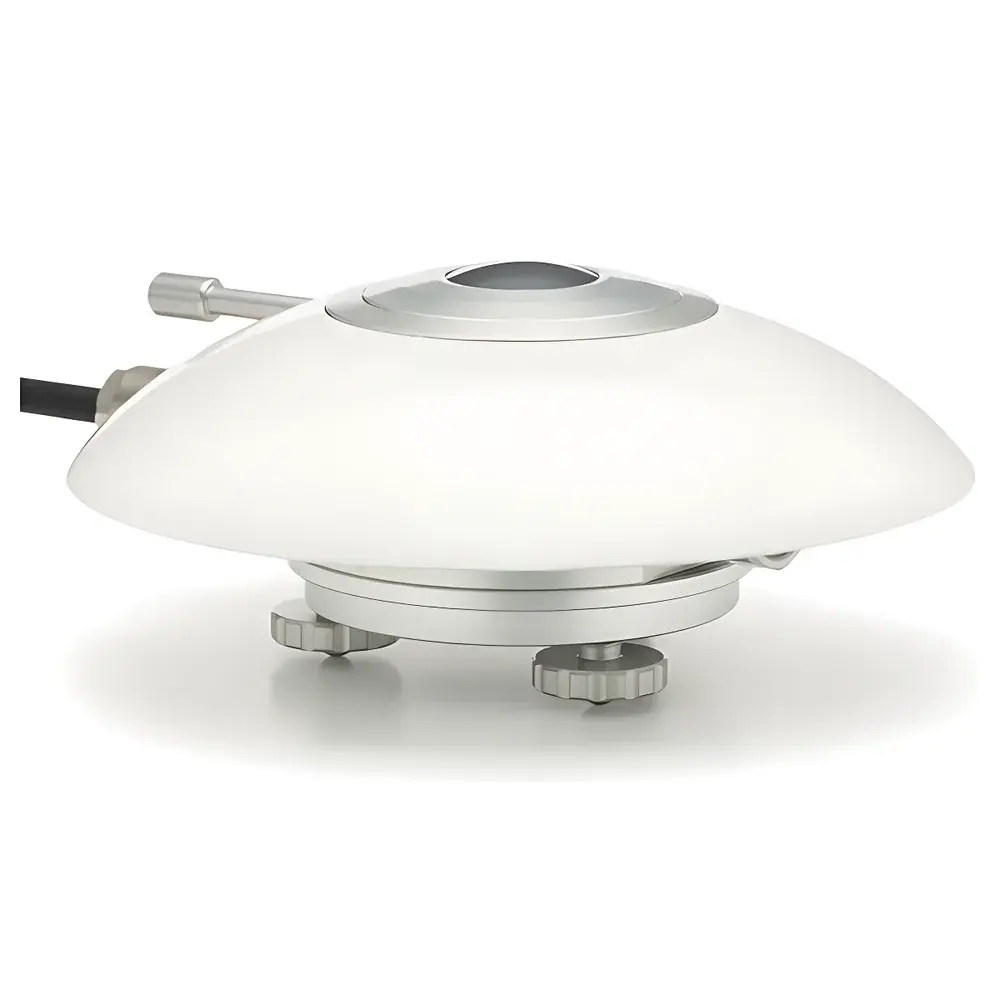
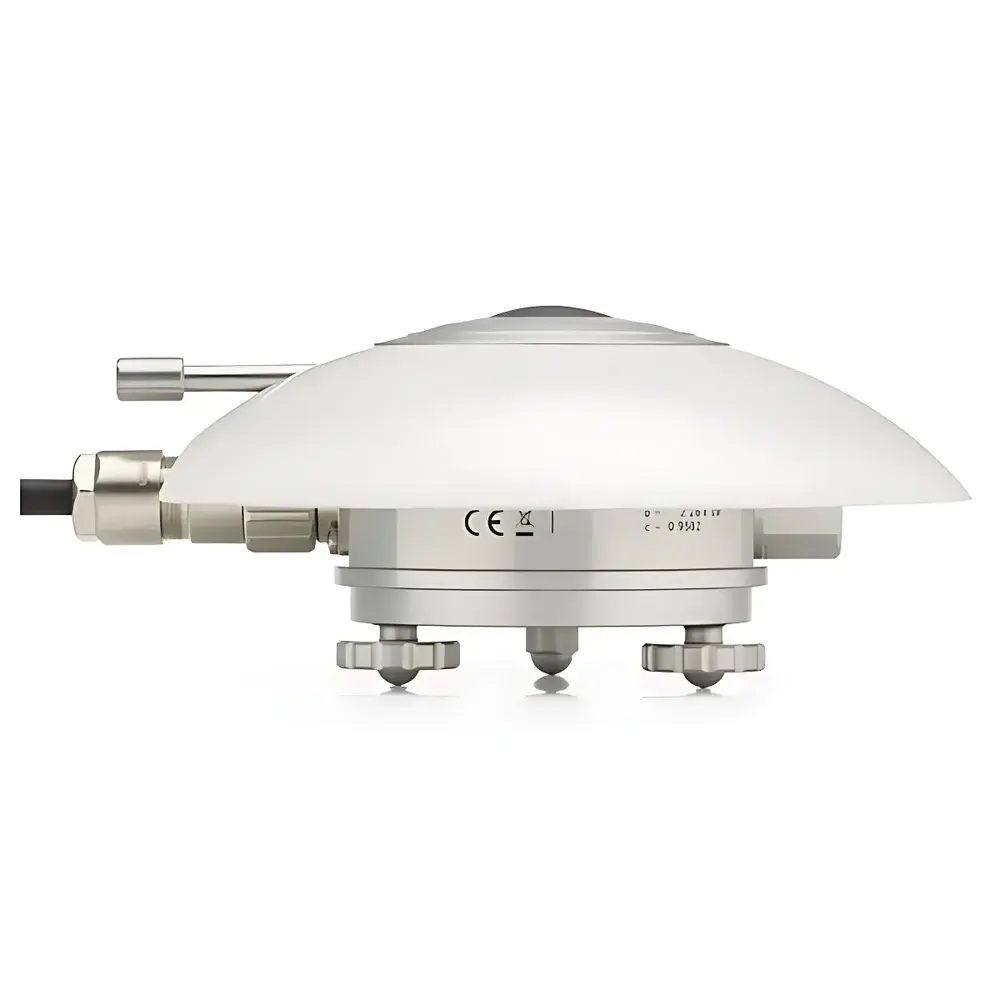
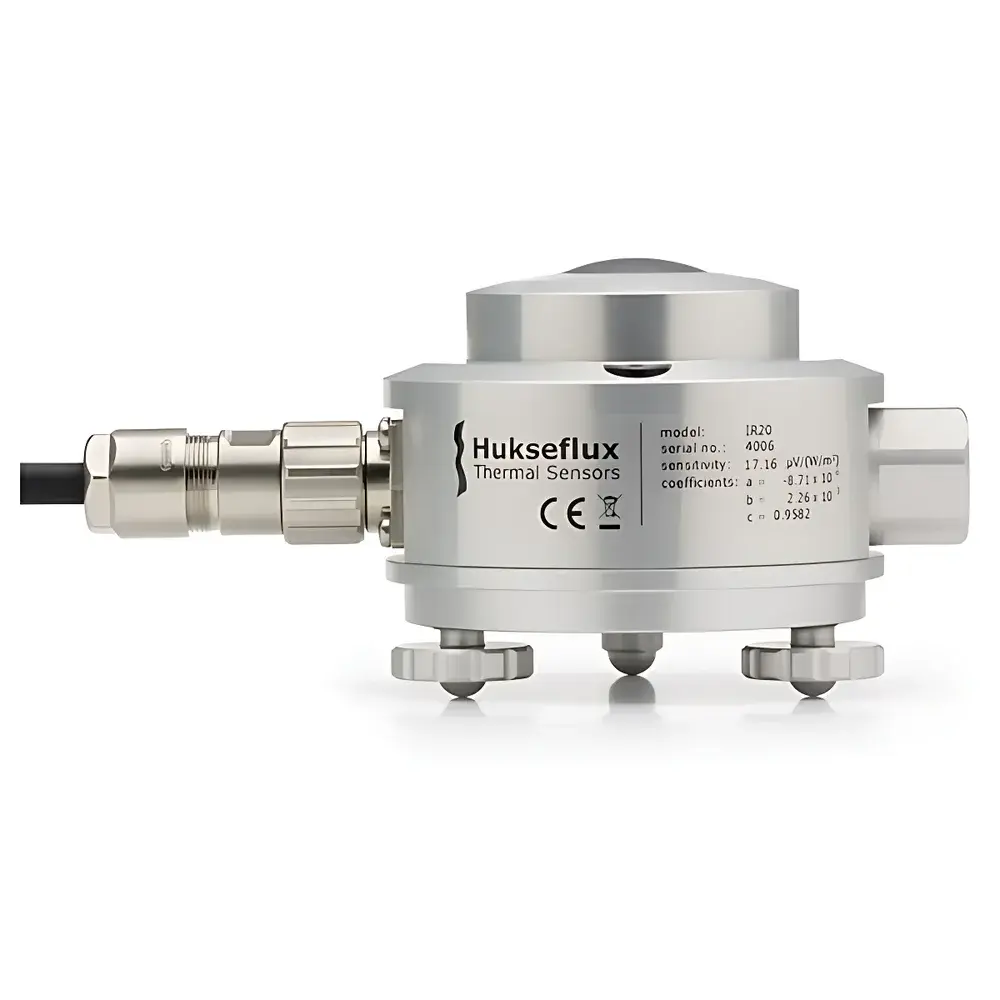
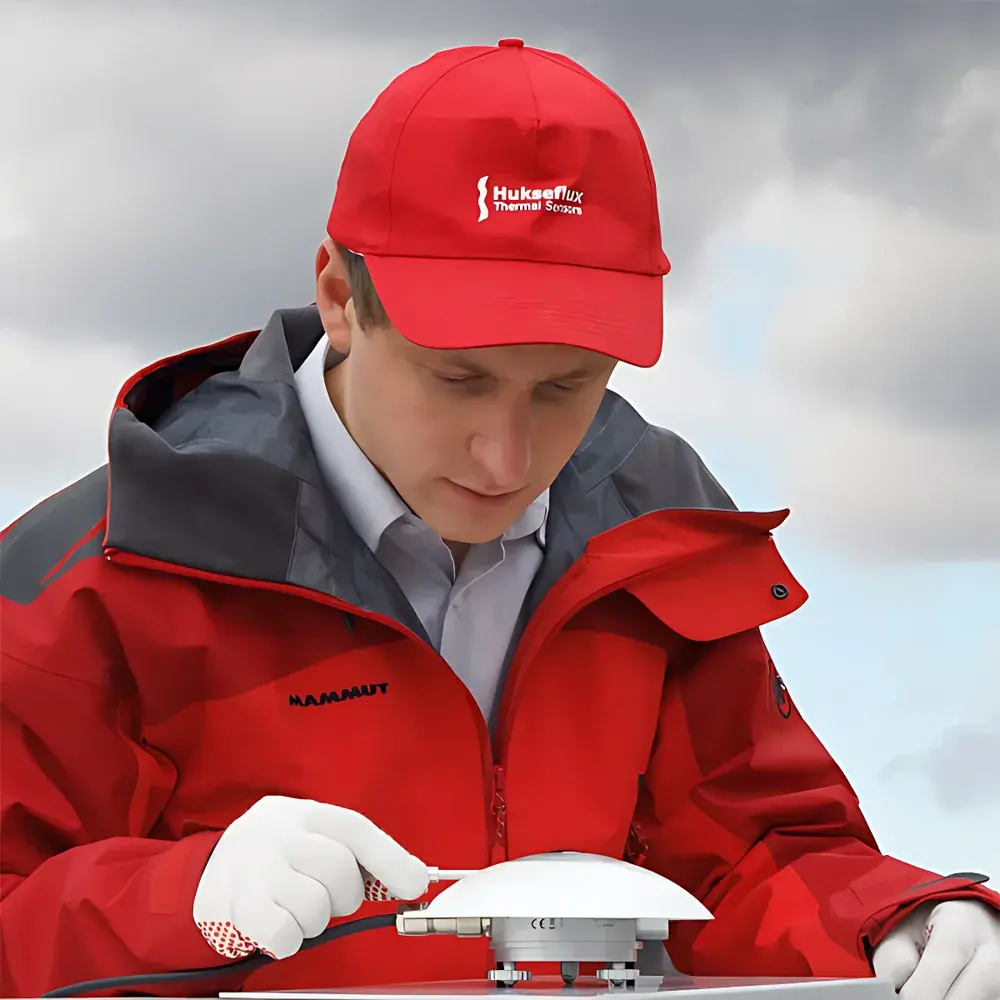
Hukseflux IR20 Long-Wave Pyrgeometer
| Brand | Hukseflux |
|---|---|
| Origin | Netherlands |
| Model | IR20 |
| Spectral Range | 4.5–42 µm |
| Field of View | 180° |
| Response Time | 3 s |
| Sensitivity | 17 µV/(W/m²) |
| Operating Temperature | −40 to +80 °C |
| Temperature Dependence | < ±0.4 % (−30 to +50 °C) |
| Calibration Traceability | WISG or optional ITS-90 blackbody |
| Thermistor | 10 kΩ |
| Heater Power | 1.5 W @ 12 VDC |
| Cable Length | 5 m (standard, extendable in 5-m increments) |
| Weight | 0.5 kg (sensor only) |
| Ingress Protection | IP67 |
Overview
The Hukseflux IR20 is a research-grade long-wave pyrgeometer engineered for high-accuracy measurement of downward and upward terrestrial infrared irradiance (W/m²) in meteorological and climatological applications. It operates on the principle of thermopile-based detection of net long-wave radiation—defined by the World Meteorological Organization (WMO) as electromagnetic radiation emitted by Earth’s surface, atmosphere, and clouds in the far-infrared spectrum, typically spanning wavelengths from ~4.5 µm to beyond 40 µm. Unlike shortwave radiation originating from the sun, long-wave radiation arises exclusively from thermal emission at ambient terrestrial temperatures. The IR20 features a precision-calibrated silicon dome with an integrated spectral filter, cutting off transmission below 4.5 µm to exclude solar contamination—enabling reliable all-sky, day-and-night operation without diurnal bias. Its 180° field of view ensures hemispherical integration of radiation incident on a horizontal plane, conforming to ISO 9060:2018 classification requirements for secondary standard pyrgeometers.
Key Features
- Thermopile sensor with ultra-low thermal resistance: Minimizes temperature gradient error between sensor surface and instrument body—eliminating the need for empirical correction terms required by conventional designs.
- Onboard Peltier heater (1.5 W @ 12 VDC): Prevents dew, frost, or snow accumulation on the dome; critical for maintaining optical integrity and measurement continuity in high-humidity, polar, or maritime environments.
- Temperature-compensated output: Each unit is supplied with individual calibration coefficients enabling real-time correction using integrated 10 kΩ thermistor data—achieving < ±0.4 % uncertainty across −30 to +50 °C, superior to fixed-coefficient compensation.
- Fast thermal response (3 s, 95%): Supports high-temporal-resolution monitoring on dynamic platforms including unmanned aerial systems (UAS), ocean buoys, and tethered balloon payloads.
- Traceable calibration options: Standard WISG (World Irradiance Scale Group) traceability; optional ITS-90 blackbody calibration available for metrological reference applications.
- Ruggedized IP67 enclosure: Sealed against dust and immersion up to 1 m for 30 min—validated for deployment in extreme climates ranging from Arctic tundra to tropical coastal stations.
Sample Compatibility & Compliance
The IR20 is compatible with standard meteorological data loggers supporting low-level DC voltage input (e.g., Campbell Scientific CR series, Delta-T DL6, or custom DAQ systems with ≥16-bit resolution). Its 17 µV/(W/m²) sensitivity ensures signal-to-noise ratios sufficient to avoid quantization-limited uncertainty when paired with typical 24-bit loggers. The instrument complies with WMO Guide to Instruments and Methods of Observation (CIMO Guide, Chapter 8) for long-wave radiation measurement, and meets the physical and performance criteria outlined in ISO 9060:2018 for secondary standard pyrgeometers. Optional ITS-90 blackbody calibration supports GLP-aligned uncertainty budgets required for BSRN (Baseline Surface Radiation Network) and GCOS (Global Climate Observing System) tier-1 stations.
Software & Data Management
No proprietary software is required for basic operation. Raw voltage output is linearly proportional to irradiance and converted using the equation: E = (Vout − Voffset) / S × [1 + α(T − Tref) + β(T − Tref)²], where S is sensitivity (µV/(W/m²)), T is thermistor-measured body temperature, and α, β are unit-specific temperature coefficients provided in the certificate. For automated post-processing, users may integrate IR20 data into Python (via NumPy/Pandas), MATLAB, or R workflows. Calibration certificates include full uncertainty budgets per GUM (JCGM 100:2008) and specify 5% cutoff and 50% transmission points—essential for spectral correction in radiative transfer modeling (e.g., libRadtran, MODTRAN).
Applications
- Continuous long-wave irradiance monitoring in national weather service networks and climate observatories
- Surface energy balance studies in eddy covariance flux towers (paired with shortwave pyranometers and net radiometers)
- Validation of satellite-derived land surface temperature (LST) and outgoing longwave radiation (OLR) products
- Uncertainty propagation analysis using dual-sensor configurations (IR20 + IR20WS for extended spectral characterization)
- Reference-grade calibration transfer in metrology labs supporting ISO/IEC 17025-accredited environmental testing facilities
- Embedded sensing on autonomous marine platforms and stratospheric sondes requiring low-power, high-reliability radiometry
FAQ
What distinguishes the IR20 from the IR20WS model?
The IR20WS extends the lower spectral cutoff to 1.0 µm, enabling higher-precision measurements under low-radiance conditions (e.g., clear-sky nighttime), though it requires shading during daylight to avoid solar contamination. The IR20’s 4.5 µm cutoff allows unshaded 24/7 operation.
Is the IR20 suitable for BSRN-level measurements?
Yes—when calibrated to ITS-90 and operated with documented environmental corrections, the IR20 meets BSRN requirements for long-wave irradiance uncertainty (< 2 W/m², k=2) under standard conditions.
Can the heater be controlled externally?
Yes—the 12 VDC heater circuit is electrically isolated and can be driven via external thermostatic switching or PWM control to optimize power use in battery-constrained deployments.
Does the IR20 require regular recalibration?
Hukseflux recommends recalibration every two years for critical climate applications; annual verification against a stable reference is advised for operational networks.
How is spectral responsivity verified?
Each unit ships with a factory-measured spectral transmittance curve, reporting 5% cutoff and two 50% transmission wavelengths—traceable to NPL or PTB reference spectroradiometers.







