
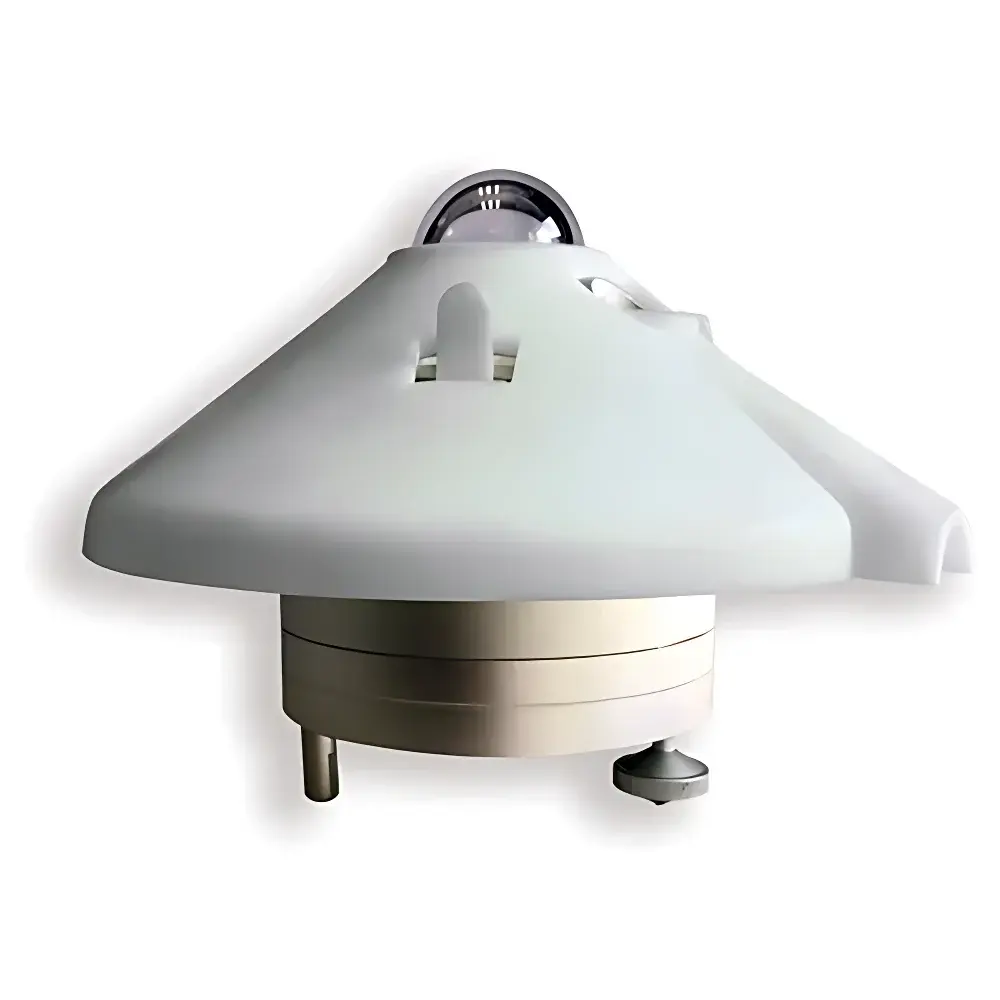
SP10 Solar Total Radiation Sensor
| Origin | Shanghai |
|---|---|
| Manufacturer Type | Distributor |
| Origin Category | Domestic (China) |
| Model | SP10 |
| Price | Upon Request |
| Spectral Range | 280–3000 nm |
| Measurement Range | 0–2000 W/m² |
| Sensitivity | 7–14 µV/(W·m²) |
| Output Signal | Standard 0–20 mV, optional RS232/RS422/RS485 |
| Resolution | 1 W/m² |
| Stability | ≤ ±2% per year |
| Internal Impedance | <100 Ω |
| Response Time (95%) | ≤20 s |
| Temperature Response | ±2% (-20 to +40 °C) |
| Non-linearity | ±2% |
| Operating Temperature | -40 to +85 °C |
| Operating Humidity | 0–100% RH |
| Dimensions | Ø15 cm × 10 cm (H) |
| Weight | 350 g |
Overview
The SP10 Solar Total Radiation Sensor is a precision-grade pyranometer engineered for continuous, high-fidelity measurement of global solar irradiance across the full terrestrial solar spectrum (280–3000 nm). Designed and calibrated in accordance with ISO 9060:2018 Class II specifications and World Meteorological Organization (WMO) Guide to Meteorological Instruments and Methods of Observation (WMO-No. 8), the SP10 employs a thermopile-based detection principle—specifically, a thin-film semiconductor thermopile mounted beneath a precision-ground, hemispherical quartz dome. This architecture ensures uniform spectral response, minimal thermal offset, and robust performance under variable environmental loading. Unlike photodiode-based sensors, the thermopile design provides true broadband radiometric accuracy without reliance on spectral correction factors, making it suitable for applications demanding traceable, standards-compliant irradiance data—including solar resource assessment, agronomic microclimate monitoring, building energy modeling, and atmospheric science field campaigns.
Key Features
- ISO 9060:2018 Class II and WMO-compliant calibration certificate supplied with each unit, traceable to national metrology institutes
- Thermopile detector with blackened absorber surface and temperature-compensated output for minimized zero-offset drift
- Optical system featuring fused quartz dome (transmittance >92% from 280–3000 nm) and integrated desiccant chamber to prevent internal fogging
- Dual-output configuration: analog 0–20 mV standard output compatible with most dataloggers; optional digital interfaces (RS232, RS422, or RS485) supporting Modbus RTU protocol for networked deployment
- Compact form factor (Ø150 mm × 100 mm H) and low mass (350 g) enable rapid mounting on tripods, masts, or agricultural sensor towers without structural reinforcement
- Extended operational envelope: functional from -40 °C to +85 °C ambient and 0–100% RH non-condensing, validated per IEC 60068-2 environmental stress testing protocols
Sample Compatibility & Compliance
The SP10 is optimized for outdoor, unshaded horizontal mounting but supports tilted-plane installation with appropriate cosine-corrected mounting hardware (sold separately). It meets the mechanical and optical requirements for long-term deployment in agricultural research stations, solar PV monitoring arrays, ecological flux networks (e.g., FLUXNET-compatible sites), and urban climate observatories. Compliance documentation includes ISO/IEC 17025-accredited calibration reports, WMO-recommended maintenance guidelines, and conformity statements aligned with IEC 61724-1 (Photovoltaic system performance monitoring) and ASTM E892 (Standard Test Method for Spectral Match of Solar Simulators). While not intrinsically certified for hazardous locations, its IP67-rated housing (per IEC 60529) ensures protection against dust ingress and temporary water immersion during monsoon or irrigation events.
Software & Data Management
The SP10 operates as a standalone analog transducer or integrates seamlessly into SCADA, IoT, or cloud-based environmental monitoring platforms via its optional serial interface. When configured with RS485, it supports multi-drop bus topology (up to 32 nodes) and automatic address assignment. Raw voltage outputs are linearly proportional to irradiance (µV/W·m²), enabling direct conversion using factory-provided sensitivity coefficients. For regulatory or QA/QC workflows, the sensor’s stability specification (≤±2% annual drift) satisfies GLP-aligned instrument qualification requirements when paired with scheduled recalibration intervals (recommended every 2 years). Data logging systems compliant with FDA 21 CFR Part 11 may archive SP10 readings with full audit trails when used with validated firmware and timestamped acquisition modules.
Applications
- Agricultural micrometeorology: PAR-integrated solar load estimation for evapotranspiration (ET₀) modeling and irrigation scheduling per FAO-56 methodology
- Solar energy yield assessment: Baseline irradiance input for PV performance ratio (PR) calculations and degradation trending
- Building physics: Daylight harvesting control logic validation and dynamic façade energy balance studies
- Ecological research: Canopy radiation partitioning analysis in agroforestry and controlled-environment agriculture (CEA) facilities
- Atmospheric science: Ground-truthing of satellite-derived shortwave flux products (e.g., CERES, MERRA-2)
- Educational instrumentation: Hands-on radiometry labs for undergraduate meteorology, renewable energy, and environmental engineering curricula
FAQ
Is the SP10 calibrated to ISO 9060:2018 Class II or Class C?
Yes—the SP10 is manufactured and individually calibrated to meet ISO 9060:2018 Class II (formerly “Secondary Standard”) requirements, including spectral error, directional (cosine) response, temperature dependence, and stability specifications.
Can the SP10 be used for photosynthetically active radiation (PAR) measurements?
No—the SP10 measures total broadband solar irradiance (280–3000 nm), not the 400–700 nm PAR band. For PAR-specific quantification, a dedicated quantum sensor (e.g., SQ series) with photodiode + optical filter assembly is required.
What mounting hardware is included with the SP10?
The base unit ships with a stainless-steel leveling base and M6 threaded mounting stud. Optional accessories include adjustable tilt mounts, ventilation units (for dew suppression), and dual-sensor albedo frames—available separately.
Does the SP10 require periodic recalibration?
Yes—while exhibiting ≤±2% annual stability, NIST-traceable recalibration is recommended every 24 months for scientific or compliance-critical deployments, particularly after exposure to extreme thermal cycling or mechanical shock.
Is the analog output susceptible to electromagnetic interference (EMI) over long cable runs?
The 0–20 mV signal is low-level and best used with shielded twisted-pair cabling and proper grounding. For distances exceeding 30 m, the RS485 digital option is strongly advised to maintain signal integrity in electrically noisy environments such as solar farms or industrial greenhouses.




