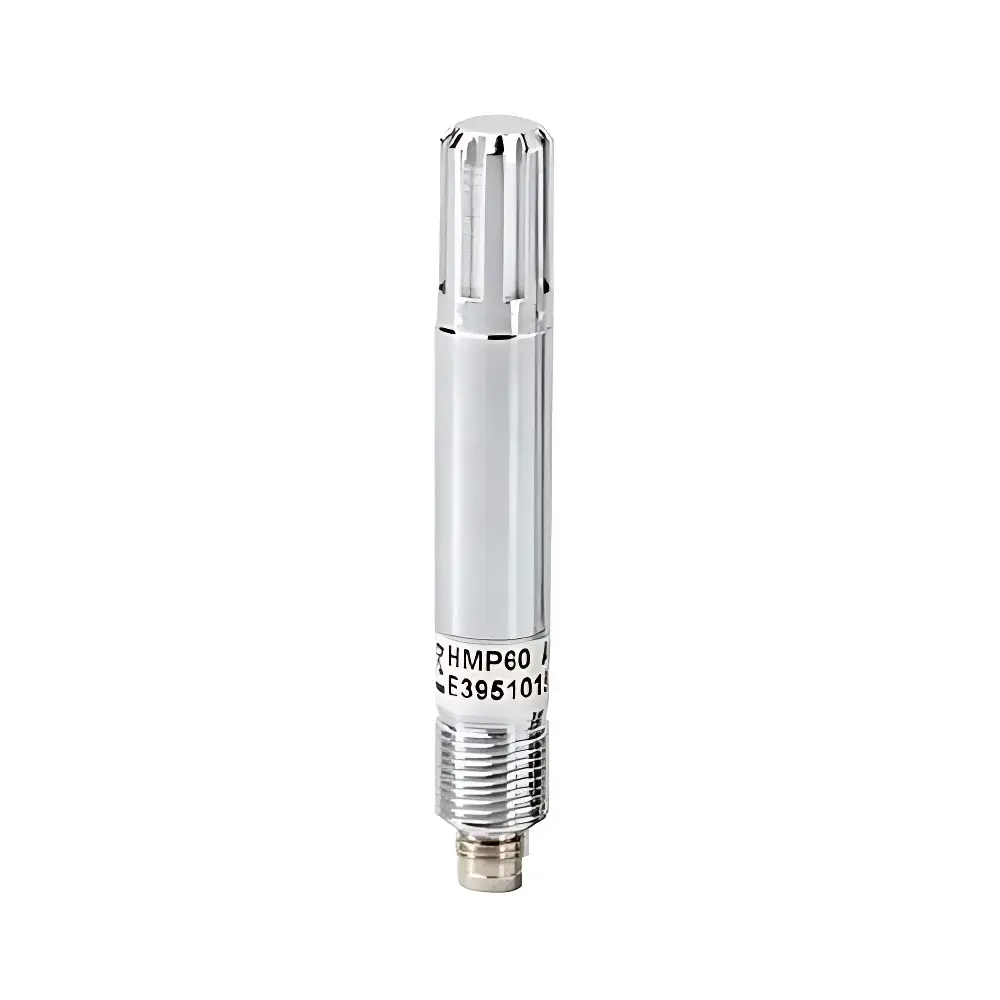
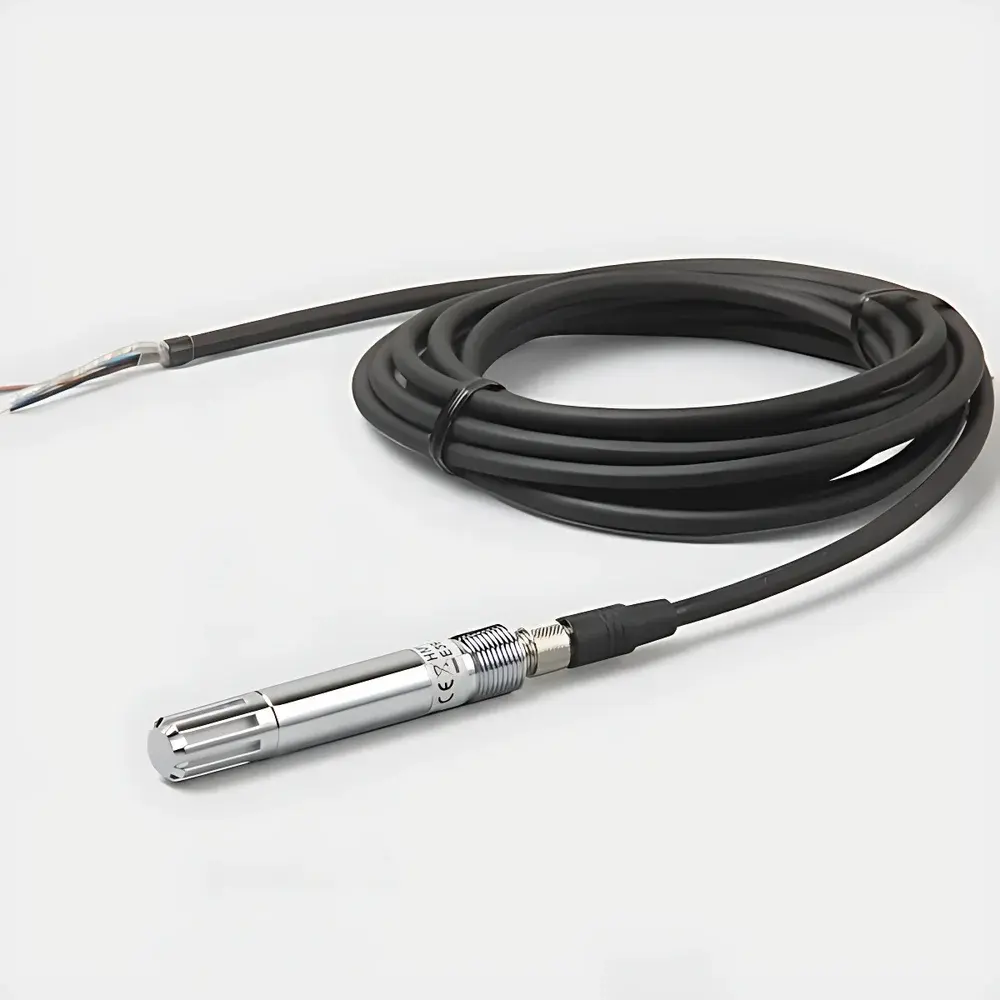
Vaisala HMP60 Temperature and Humidity Probe
| Brand | Vaisala |
|---|---|
| Origin | Finland |
| Model | HMP60 |
| Temperature Range | −40 to +60 °C |
| Temperature Accuracy | ±0.6 °C (full range), ±0.5 °C (10–30 °C) |
| Temperature Resolution | 0.1 °C |
| Relative Humidity Range | 0–100 %RH |
| RH Accuracy | ±3 %RH (0–90 %RH, 0–40 °C), ±5 %RH (90–100 %RH, 0–40 °C) |
| Dew Point Range | −40 to +60 °C |
| Dew Point Accuracy | ±2 °C (ΔT ≤ 15 K, 0–40 °C), ±3 °C (ΔT ≤ 15 K, −40–0 °C & 40–60 °C) |
| Output Options | Dual analog voltage (0–1 V, 0–2.5 V, 0–5 V, or 1–5 V DC), optional RS485 (Modbus RTU), optional 4–20 mA loop-powered output |
| Supply Voltage | 5–28 VDC (8–28 VDC with 5 V auxiliary output) |
| Typical Current Consumption | 1 mA (average), 5 mA (peak) |
| Warm-up Time | 2 s (analog), 1 s (digital) |
| Enclosure Material | AISI 316 stainless steel housing, chrome-plated ABS grille filter (optional stainless steel filter) |
| IP Rating | IP65 |
| Mechanical Interface | M12×1 thread, 10 mm depth |
| Connector | 4-pin M8 (IEC 60947-5-2) |
| Dimensions | 71 mm × Ø12 mm |
| Weight | 23 g (with 0.3 m cable) |
Overview
The Vaisala HMP60 is a compact, high-reliability temperature and humidity probe engineered for integration into OEM systems and industrial monitoring applications where long-term stability, low power consumption, and mechanical robustness are critical. Based on Vaisala’s proprietary INTERCAP® capacitive polymer sensor technology, the HMP60 delivers traceable, repeatable measurements of relative humidity (RH), temperature, and calculated dew point across a wide environmental envelope. Its measurement principle relies on a thermally stabilized capacitive sensing element whose dielectric properties change predictably with ambient moisture content—calibrated and validated against NIST-traceable reference standards. Designed for continuous operation in demanding environments—including climate-controlled enclosures, bioreactors, gloveboxes, greenhouses, and portable data loggers—the HMP60 operates without active heating or fan-assisted aspiration, minimizing thermal perturbation and enabling true static-air measurement capability.
Key Features
- Interchangeable INTERCAP® Sensor: Factory-calibrated, plug-and-play sensor module allows field replacement without recalibration—ensuring continuity of measurement traceability and reducing maintenance downtime.
- Low-Power Architecture: Typical current draw of only 1 mA enables battery-powered deployment for extended periods; peak consumption remains below 5 mA during signal acquisition.
- Dual Analog Outputs: Two independently configurable voltage outputs support simultaneous transmission of RH and temperature, RH and dew point, or temperature and dew point—selectable from four standard ranges (0–1 V, 0–2.5 V, 0–5 V, 1–5 V DC).
- Optional Digital Communication: RS485 interface with Modbus RTU protocol provides noise-immune serial communication suitable for distributed sensor networks and SCADA integration.
- IP65-Rated Stainless Steel Housing: AISI 316 stainless steel body with M12×1 mounting thread and sealed M8 connector ensures resistance to dust ingress, condensation, and incidental water exposure in uncontrolled environments.
- Filter Protection Options: Standard chrome-plated ABS plastic grille or optional stainless steel sintered filter safeguards the sensing element against particulate contamination while maintaining fast response time (< 15 s @ τ₆₃% in still air).
Sample Compatibility & Compliance
The HMP60 is compatible with non-corrosive, non-condensing gaseous environments typical of indoor air quality monitoring, HVAC commissioning, pharmaceutical storage validation, and laboratory incubation systems. It is not intended for direct immersion, high-velocity airflow (>2 m/s), or exposure to solvents, oils, or aggressive chemicals without appropriate external filtration. The probe complies with electromagnetic compatibility requirements per EN 61326-1 (industrial environment), and its analog output circuitry meets IEC 61000-4 immunity standards for electrostatic discharge, radiated RF fields, and fast transient bursts. While the HMP60 itself does not carry FDA 21 CFR Part 11 certification, its stable calibration history, documented sensor interchangeability, and audit-ready calibration certificates support qualification under GLP and GMP frameworks when deployed within validated systems.
Software & Data Management
The HMP60 operates as a stand-alone transducer requiring no embedded firmware updates or host software for basic analog operation. When integrated with Vaisala’s viewLinc or third-party SCADA platforms via RS485, it supports periodic polling, alarm threshold configuration, and timestamped data logging. All factory calibration data—including individual sensor coefficients, uncertainty budgets, and traceability statements—are stored in non-volatile memory and retrievable via digital interface. For compliance-critical deployments, users may archive calibration reports aligned with ISO/IEC 17025 guidelines, and leverage the probe’s consistent interchangeability to maintain measurement continuity during sensor replacement without requalification of the entire measurement chain.
Applications
- OEM integration into environmental chambers, sterilizers, and bioprocessing equipment
- Continuous monitoring in cleanrooms, cold-chain logistics, and vaccine storage units
- Embedded sensing in agricultural IoT gateways and greenhouse control systems
- Reference-grade humidity monitoring in metrology labs and calibration service facilities
- Low-power wireless sensor nodes for remote infrastructure monitoring (e.g., telecom shelters, transformer vaults)
- Validation of humidity uniformity in stability testing cabinets per ICH Q1A(R2) and USP <1151>
FAQ
Is the HMP60 suitable for outdoor installation?
The IP65 rating permits use in sheltered outdoor locations where direct rainfall or prolonged submersion is avoided; however, extended UV exposure may degrade the polymer sensor over time—use of a solar radiation shield is recommended.
Can the HMP60 measure dew point directly?
No—it calculates dew point mathematically from RH and temperature measurements using the Magnus formula; accuracy depends on the combined uncertainty of both primary sensors.
What is the expected lifetime of the INTERCAP® sensor?
Under typical indoor conditions (20–25 °C, 30–70 %RH), the sensor maintains specification performance for ≥5 years; lifetime decreases in high-humidity (>95 %RH), high-temperature (>50 °C), or chemically aggressive environments.
Does the HMP60 support loop-powered 4–20 mA output?
Yes—via an external loop-powered converter module (sold separately), which interfaces with the analog output and maintains RH measurement accuracy compliant with original specifications.
How is calibration traceability maintained after sensor replacement?
Each INTERCAP® sensor carries a unique calibration certificate with NIST-traceable reference values; the probe’s electronics automatically apply stored coefficients upon insertion, preserving measurement integrity without user intervention.