
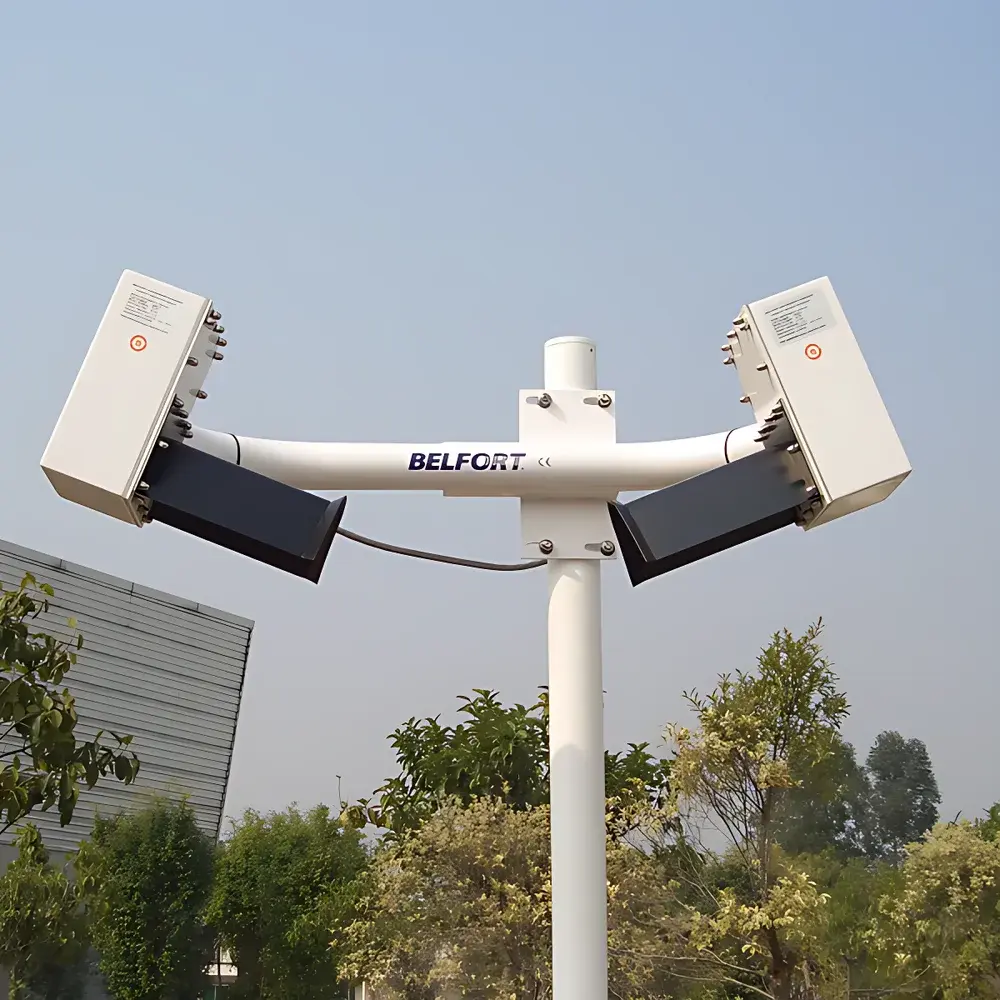
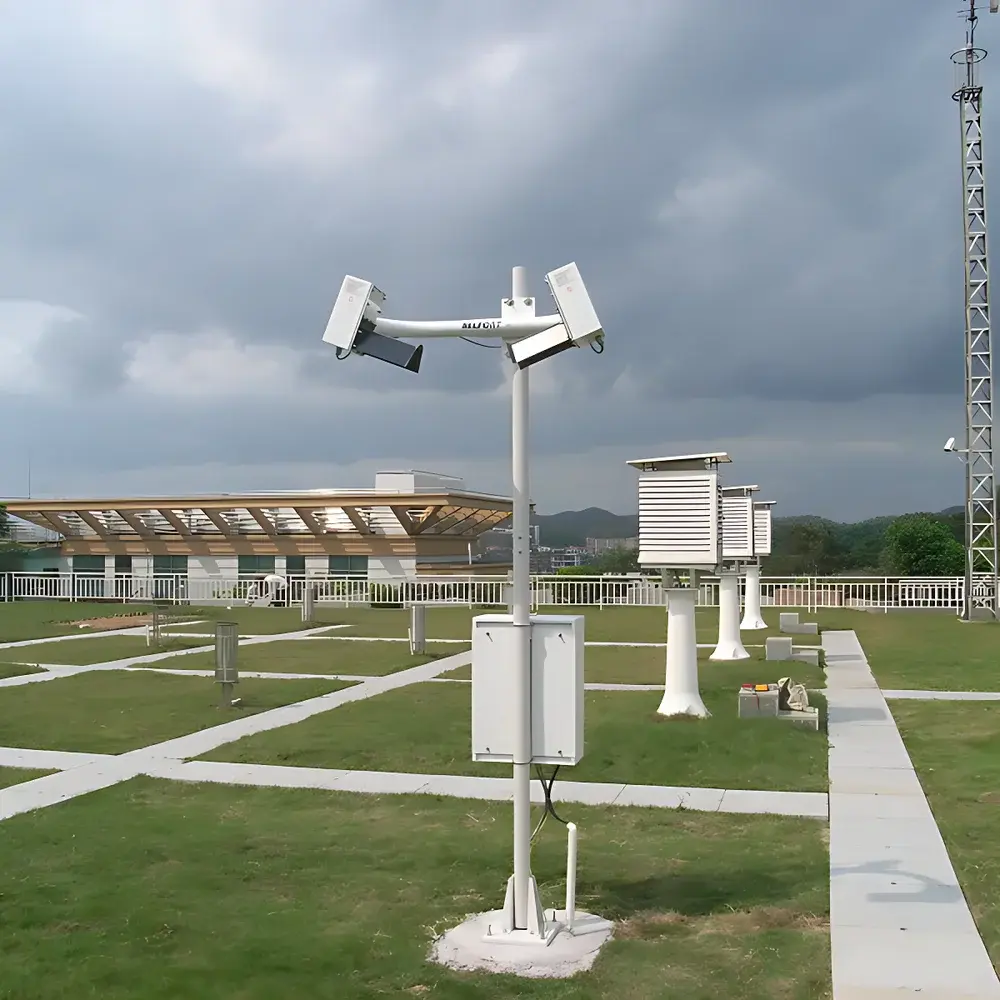
Belfort Model 6000 Forward Scatter Visibility Sensor
| Brand | Belfort (USA) |
|---|---|
| Origin | USA |
| Manufacturer Type | Authorized Distributor |
| Origin Category | Imported |
| Model | Model 6000 |
| Price | USD 9,200 (FOB US Port) |
| Discontinued — Replacement Model | Model 6400 |
| Measurement Principle | Forward Scatter (42° scattering angle) |
| Range | 6 m to 80 km |
| Accuracy | ±10% or ±3 m (whichever greater) |
| Light Source | High-output infrared LED |
| Analog Outputs | 0–1 V, 0–5 V, 0–10 V, 4–20 mA |
| Alarm Outputs | 2-channel TTL (user-configurable thresholds) |
| Digital Interface | RS-232 / RS-422, 300–38,400 baud |
| Operating Temperature | −40 °C to +55 °C |
| Relative Humidity | 0–100 % RH |
| Power Supply | 110 VAC / 220–240 VAC / 12 VDC |
| Power Consumption | 12 W (standard), 17 W (with Ambient Light Sensor), 25 W (with heated shroud) |
| Dimensions | 978 mm × 343 mm × 425 mm |
| Weight | 8.75 kg |
| Mounting | U-bolt bracket |
| Max Wind Speed Tolerance | 60 m/s |
| Housing Material | Corrosion-resistant aluminum alloy |
| Lens Heater | Standard |
| Optional Heated Shroud | Available (Part No. 96916-01) |
| Calibration Kit | Optional (Part No. 90001) |
| Compliance | CE Marked |
| FCC Compliance | 47 CFR Part 15 |
| Environmental Certification | IP65 equivalent |
Overview
The Belfort Model 6000 Forward Scatter Visibility Sensor is an industrial-grade atmospheric transmissometer engineered for continuous, real-time monitoring of meteorological optical range (MOR) across a dynamic span of 6 meters to 80 kilometers. It operates on the internationally standardized forward scatter principle—defined in ISO 4223 and referenced in WMO Guide to Instruments and Methods of Observation (CIMO Guide)—where a collimated infrared LED beam (center wavelength ~850 nm) illuminates a defined air volume, and light scattered at a nominal 42° angle is detected by a matched photodiode receiver. This geometry provides high signal-to-noise ratio under variable ambient lighting, including direct solar exposure, twilight, and precipitation. Unlike transmissometers requiring fixed baselines, the Model 6000’s compact single-unit design eliminates alignment drift and enables rapid deployment on towers, masts, marine platforms, and roadside gantries. Its optical path is intrinsically immune to fog droplet size distribution bias within the operational range, delivering repeatable MOR values traceable to NIST-calibrated reference standards.
Key Features
- Forward scatter measurement geometry compliant with ICAO Annex 3, FAA AC 150/5220-19D, and EASA AMC 20-23 for aviation weather reporting
- Dual independent alarm outputs with fully programmable visibility thresholds—supporting discrete state logic for “Good,” “Moderate,” and “Poor” visibility classification per ICAO visibility categories
- Configurable analog output scaling (0–1 V, 0–5 V, 0–10 V, or 4–20 mA) mapped linearly to log-transformed MOR, enabling seamless integration into SCADA, DCS, and legacy PLC systems
- RS-232 and RS-422 serial interfaces supporting bidirectional communication for real-time MOR data streaming, internal diagnostics, firmware interrogation, and remote threshold reconfiguration
- Integrated lens heater prevents condensation and frost accumulation; optional heated shroud (Part No. 96916-01) mitigates snow and ice bridging in sub-zero maritime or alpine environments
- Robust enclosure fabricated from marine-grade anodized aluminum (ASTM B557), rated to IP65 performance levels per IEC 60529, with wind-loading tolerance up to 60 m/s (216 km/h)
- Low-power architecture (12 W nominal) supports solar-battery hybrid operation in remote locations; compatible with 12 VDC auxiliary power inputs for mobile or vessel-mounted applications
Sample Compatibility & Compliance
The Model 6000 is designed for unattended, long-term operation in diverse atmospheric conditions—including rain, drizzle, snow, haze, dust, and volcanic ash—without recalibration. Its optical system rejects background radiation through spectral filtering and pulse-modulated LED drive, minimizing diurnal solar loading effects. The sensor meets electromagnetic compatibility requirements per EN 61326-1 (industrial environment) and is certified to CE Directive 2014/30/EU (EMC) and 2014/35/EU (LVD). It complies with FCC Part 15 Subpart B for unintentional radiators. While not FDA-regulated, its data integrity framework aligns with GLP principles for environmental monitoring records: timestamped digital logs, non-volatile configuration storage, and deterministic alarm state transitions support audit-ready documentation. All factory calibrations are performed against reference aerosol chambers traceable to NIST SRM 1920a (polystyrene latex spheres) and validated per ISO/IEC 17025-accredited procedures.
Software & Data Management
The Model 6000 does not require proprietary host software for basic operation—its analog and TTL outputs interface directly with third-party data loggers (e.g., Campbell Scientific CR1000X, Onset HOBO RX3000) and control systems. For advanced configuration and diagnostics, Belfort provides the free Model 6000 Terminal Utility, a Windows-based CLI application that enables baud rate selection, alarm threshold definition (in meters), output scaling parameters, and firmware version verification via ASCII command protocol. All configuration changes are stored in EEPROM with write-protection logic to prevent inadvertent corruption. Diagnostic messages—including heater status, signal saturation alerts, and photodiode gain adjustments—are transmitted continuously over the serial interface, supporting predictive maintenance workflows. Raw visibility values are output as ASCII strings (e.g., “MOR=12500”) with millisecond-level timestamps, facilitating time-synchronized fusion with co-located weather station data (wind speed, temperature, RH).
Applications
- Airport surface detection systems (ASDE) and approach lighting control for Category I/II/III instrument landing operations
- Maritime navigation aids—including lighthouses, offshore oil platforms, and coastal ferry terminals—where visibility governs traffic separation schemes
- Intelligent Transportation Systems (ITS) for highway variable message signs (VMS), ramp metering, and incident response activation
- National meteorological networks (e.g., NOAA ASOS, DWD SYNOP) performing automated synoptic observations per WMO Resolution 40
- Environmental monitoring programs tracking regional haze transport, wildfire smoke dispersion, and urban particulate events
- Research-grade boundary layer studies requiring high-temporal-resolution MOR profiles correlated with lidar backscatter or nephelometer data
FAQ
Is the Model 6000 still in production?
No—the Model 6000 was officially discontinued in Q3 2021. Belfort recommends the Model 6400 as its direct functional and regulatory successor, featuring enhanced digital communications (RS-485 Modbus RTU), improved low-end sensitivity (down to 1 m), and extended cold-weather heater control logic.
Can the Model 6000 be calibrated in the field?
Yes—using the optional Calibration Kit (Part No. 90001), which includes certified neutral-density filters and alignment jigs. Field calibration verifies optical path integrity and analog output linearity but does not replace factory traceable aerosol chamber calibration required for regulatory reporting.
What is the minimum detectable visibility value?
The lower limit of reliable measurement is 6 meters, determined by optical noise floor and signal processing resolution—not by physical obstruction. Below this threshold, output saturates and alarms default to “poor visibility” state per configured logic.
Does the sensor require periodic cleaning?
Lens surfaces should be inspected quarterly in high-dust or coastal salt environments. Cleaning must use only lint-free wipes and reagent-grade isopropyl alcohol; abrasive cleaners or compressed air may damage anti-reflective coatings.
Is the Model 6000 suitable for tropical monsoon climates?
Yes—its sealed optics, condensation-resistant heater, and 0–100% RH operating envelope make it suitable for sustained high-humidity deployments; however, biannual inspection of gasket integrity is recommended in such environments.
Related Products







