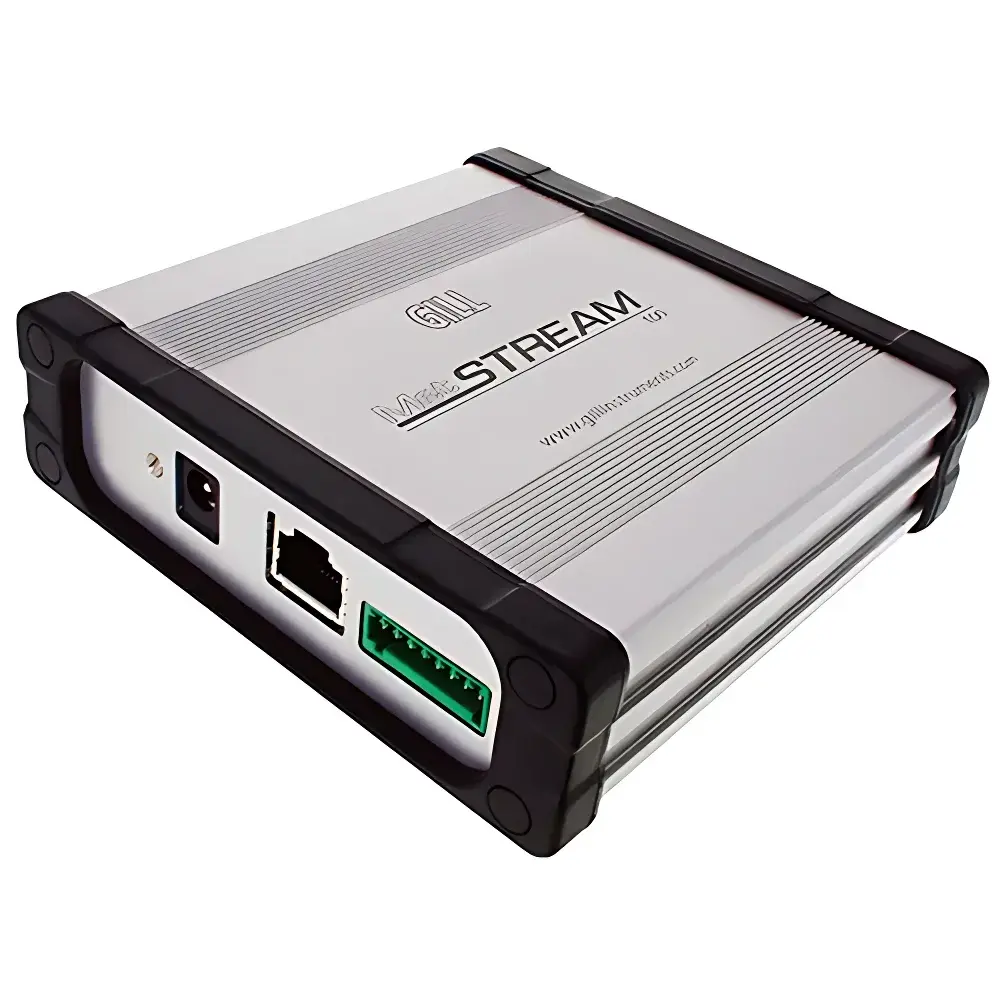
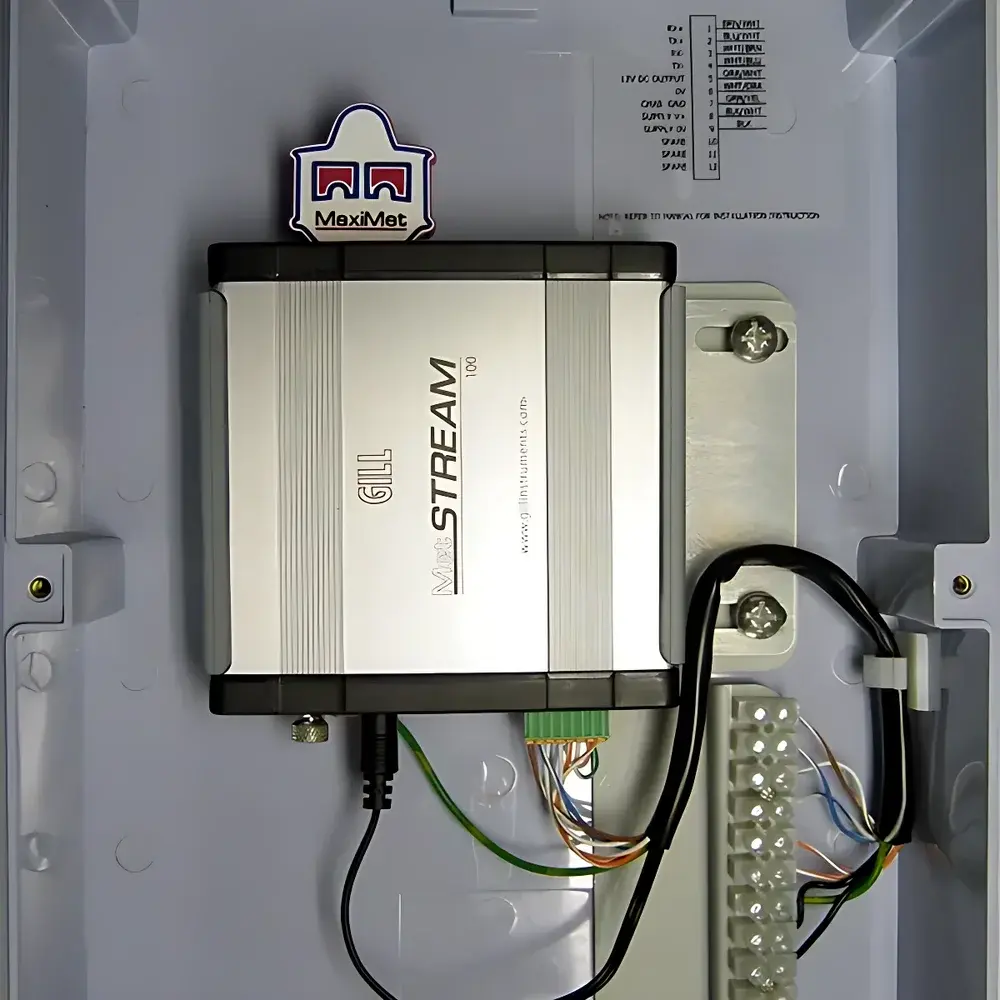
Gill MetStream 100 Data Acquisition Platform
| Brand | Gill |
|---|---|
| Origin | United Kingdom |
| Model | MetStream 100 |
| Power Consumption | 2 W |
| Operating System | Embedded Linux |
| Serial Interface Support | RS-232 / RS-422 / RS-485 |
| Ethernet Interface | 10/100 Base-T |
| Maximum Sampling Rate | 32 Hz |
| Onboard Storage | 8 GB microSD |
| Surge & EMC Protection | IEC 61000-4-5 Level 3, IEC 61000-4-4 Level 3 |
| Web-Based Configuration | Yes |
| Protocol Support | Modbus RTU/ASCII, NMEA 0183, ASCII text streams, custom serial protocols |
Overview
The Gill MetStream 100 Data Acquisition Platform is an embedded, Linux-based edge device engineered for reliable, long-term acquisition and networked transmission of serial sensor data in demanding environmental and industrial monitoring applications. Unlike generic USB-to-Ethernet adapters or PC-dependent DAQ systems, the MetStream 100 functions as a dedicated protocol-aware bridge—converting asynchronous serial data from meteorological sensors (e.g., anemometers, barometers, pyranometers), industrial transmitters (e.g., pH, conductivity, pressure), and legacy instrumentation into standardized, time-stamped network packets. Its measurement architecture operates on deterministic serial framing and configurable baud rate synchronization, ensuring bit-level integrity across variable-length ASCII or binary payloads. Designed for unattended operation in remote or harsh locations—including weather stations, water treatment plants, and distributed infrastructure networks—the platform delivers continuous data logging without host dependency, leveraging its ARM-based processor and real-time scheduling kernel to maintain consistent 32 Hz sampling fidelity across all enabled serial channels.
Key Features
- Protocol-Agnostic Serial Bridging: Supports RS-232, RS-422, and RS-485 physical layers with auto-sensing polarity and termination; compatible with Modbus RTU/ASCII, NMEA 0183, SDI-12, and vendor-specific ASCII command sets.
- Embedded Linux Architecture: Runs a hardened, read-only Debian-derived OS with persistent configuration storage; enables secure SSH access, scriptable automation via shell or Python 3.9, and firmware updates over HTTPS.
- Robust Electromagnetic Resilience: Complies with IEC 61000-4-4 (electrical fast transient immunity) and IEC 61000-4-5 (surge immunity) Level 3 requirements—validated for outdoor deployment near lightning-prone towers or high-noise industrial switchgear.
- Low-Power Edge Intelligence: Consumes ≤2 W under full load; supports passive PoE (802.3af Class 0) and wide-input DC (9–30 VDC); thermal design rated for continuous operation from −25 °C to +60 °C.
- Web-Centric Management: All configuration—including serial port parameters, data forwarding destinations (HTTP POST, MQTT v3.1.1, Syslog), alarm thresholds, and time synchronization (NTP or GPS PPS)—is accessible via responsive HTML5 interface, requiring no client software or proprietary tools.
Sample Compatibility & Compliance
The MetStream 100 interfaces with a broad spectrum of serial-output sensors certified to international environmental monitoring standards, including WMO No. 8 (Guide to Instruments and Methods of Observation), ISO/IEC 17025-compliant calibration workflows, and EN 61326-1 for electromagnetic compatibility in industrial environments. It natively parses timestamped NMEA sentences from GNSS receivers and supports configurable parsing rules for custom ASCII telemetry formats—enabling traceable data lineage per ISO/IEC 17025 Clause 7.5.2. While not a certified medical or safety-critical device, its deterministic packetization and non-volatile logging meet baseline requirements for GLP-aligned field data collection where auditability and metadata integrity are essential.
Software & Data Management
Data acquisition, buffering, and export are managed through a modular service stack: the Serial Input Daemon handles hardware-level framing and error detection; the Tagged Stream Engine applies user-defined field mappings and unit conversions; and the Forwarding Agent dispatches structured JSON or CSV payloads to cloud platforms (e.g., AWS IoT Core, Azure IoT Hub), SCADA historians (e.g., Ignition, Siemens Desigo), or local FTP/SFTP endpoints. All configuration changes and firmware updates generate immutable audit logs with timestamps and operator identifiers—supporting basic 21 CFR Part 11 readiness when deployed behind enterprise identity providers (LDAP/OAuth2). Local 8 GB microSD storage retains ≥30 days of raw sensor data at 32 Hz (depending on payload size), with automatic ring-buffer overwrite and manual archive export via web interface.
Applications
- Meteorological networks requiring synchronized multi-sensor ingestion (wind speed/direction, temperature/humidity, solar irradiance) with sub-second latency for nowcasting models.
- Industrial process monitoring where legacy 4–20 mA transmitters are paired with smart serial converters (e.g., HART-to-Modbus gateways) and integrated into IIoT architectures.
- Academic and government environmental research deployments—such as river gauge telemetry, air quality sensor grids, or coastal buoy arrays—where low-power autonomy and long-term firmware stability are prioritized over real-time compute.
- Calibration laboratories using serial-output reference standards (e.g., Fluke 754, Druck DPI 620) to automate verification reports with embedded time-stamping and digital signature support.
FAQ
Does the MetStream 100 support TLS 1.2 or higher for secure HTTP/MQTT communication?
Yes—TLS 1.2 and TLS 1.3 are enabled by default for all outbound HTTPS and MQTT connections; certificate pinning and custom CA bundle injection are supported via CLI or web interface.
Can multiple serial devices be daisy-chained on a single RS-485 bus and individually addressed?
Yes—the platform supports Modbus RTU multi-drop addressing and configurable polling intervals per slave ID; ASCII-based devices require unique header patterns or time-division multiplexing rules defined in the stream parser.
Is firmware source code available for customization?
No—the Linux kernel and userspace binaries are closed-source and cryptographically signed by Gill Instruments; however, user scripts (Bash, Python) may be deployed in the designated /opt/custom directory with full filesystem access.
What time synchronization methods are supported?
NTP (with configurable stratum priority), PPS input via GPIO pin (for GPS-disciplined timing), and manual UTC offset setting; all timestamps are stored in ISO 8601 format with microsecond precision.
How is data integrity verified during network transmission failures?
The Forwarding Agent implements exponential backoff retry logic with persistent queueing; unsent payloads remain in flash-resident buffers until acknowledged by the destination endpoint, with SHA-256 checksums logged per transmission attempt.