
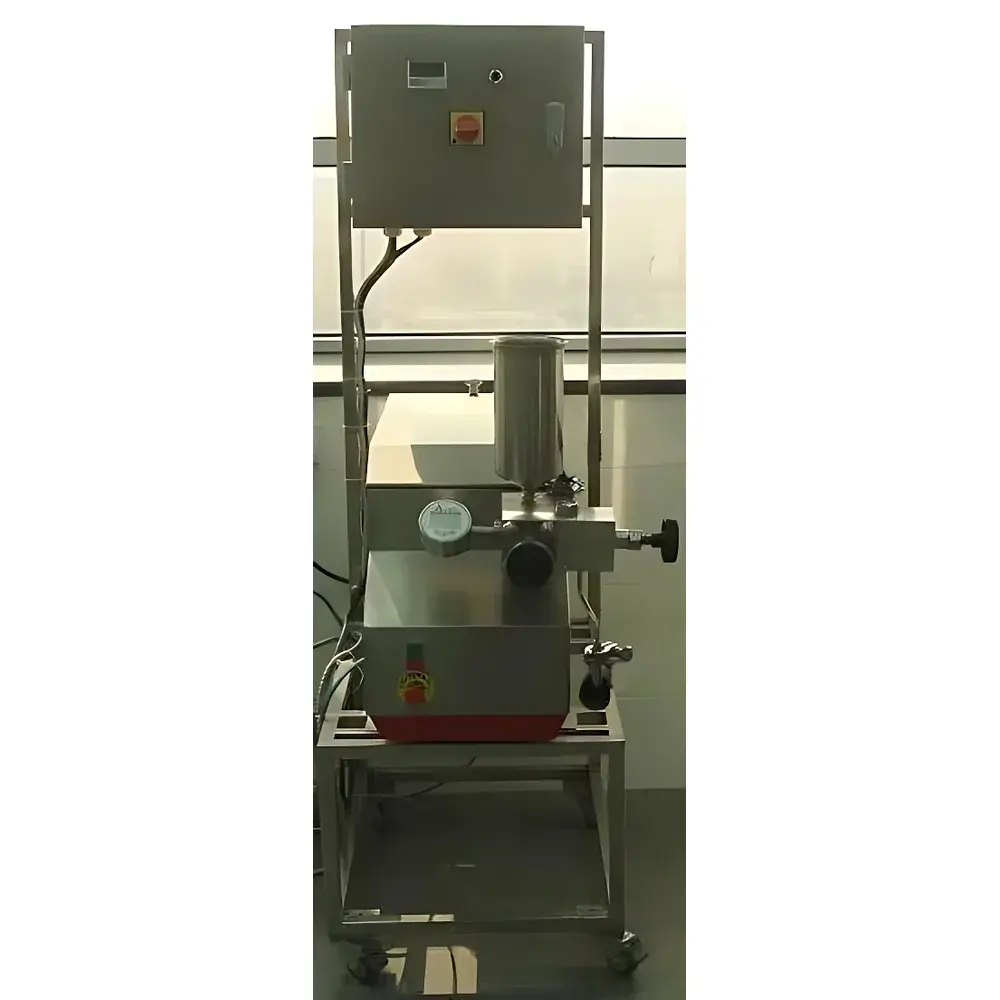
APV APV1000 Laboratory High-Pressure Homogenizer
| Origin | Shanghai, China |
|---|---|
| Manufacturer Type | Authorized Distributor |
| Origin Category | Domestic (China) |
| Model | APV1000 |
| Price | Upon Request |
| Processing Capacity | 22 L/hr |
| Minimum Sample Volume | 150 mL |
| Maximum Operating Pressure | 1000 bar |
| Plunger Diameter / Material | 14 mm / Ceramic |
| Plunger Seal Material | PVDF/EPDM |
| O-Ring / Gasket Material | EPDM/POM |
| Pump Valve Seat Material | Tungsten Carbide Alloy |
| Pump Valve Material | Cobalt-Based Alloy |
| Homogenizing Valve / Seat Material | Tungsten Carbide Alloy |
| Digital Pressure Display | Yes |
| Overpressure Safety Cut-off | Yes |
| Net Weight | 105 kg |
| Dimensions (W × D × H) | 370 × 818 × 620 mm |
| Motor | TEFC, 3 kW, Three-Phase, 50–60 Hz, Multi-Voltage (200/230/380/400/460/575 V) |
| Temperature Rating (Wetted Parts) | Up to 105 °C |
| CIP-Compatible Hygienic Design | Yes |
| CE Marked | Yes |
Overview
The APV APV1000 Laboratory High-Pressure Homogenizer is a precision-engineered, CE-marked benchtop system designed for reproducible cell disruption, particle size reduction, emulsification, and nano-dispersion in R&D and pilot-scale applications. Based on the globally recognized APV high-pressure homogenization platform—originally developed by APV (now part of SPX Flow)—this re-engineered model integrates hygienic design principles with laboratory flexibility. It operates on the principle of controlled fluid shear, cavitation, and impact forces generated when a pressurized sample stream is forced through a precisely engineered homogenizing valve at pressures up to 1000 bar. The two-stage homogenization architecture enables sequential pressure application—first for coarse disruption, then for fine particle refinement—ensuring superior control over final particle size distribution (PSD), polydispersity index (PDI), and colloidal stability. Its stainless-steel structural frame and compact footprint support integration into modular lab environments, including experimental beverage pilot lines, pharmaceutical formulation suites, and academic bioprocessing labs.
Key Features
- Two-stage homogenization system with independent manual pressure adjustment via calibrated handwheels for precise process optimization
- Ceramic homogenizing valve assembly with tungsten carbide alloy seat—engineered for wear resistance, thermal stability, and consistent performance across repeated cycles
- High-integrity wetted materials: ceramic plungers, cobalt-based pump valves, EPDM/PVDF seals rated to 105 °C, and POM-composite gaskets compliant with USP Class VI and FDA 21 CFR 177.2600
- Integrated digital pressure monitoring with real-time display and programmable overpressure cut-off for operator and equipment safety
- CIP-compatible sanitary construction—including polished 316L stainless-steel housing, fully enclosed lubrication system, and internal cabling—to meet ISO 22000 and EHEDG Guideline requirements
- TEFC (Totally Enclosed Fan-Cooled) 3 kW motor with multi-voltage compatibility (200–575 V, 3-phase, 50–60 Hz) ensures stable operation under variable grid conditions
- Stainless-steel feed hopper with ergonomic access and EPDM-contact surfaces validated for aqueous, viscous, and mildly abrasive formulations
Sample Compatibility & Compliance
The APV1000 accommodates a broad range of sample types—including mammalian and microbial cell suspensions, liposomal dispersions, protein aggregates, polymer nanoparticles, dairy emulsions, and fruit juice concentrates—with minimal carryover and no cross-contamination between runs. All fluid-contact components conform to ISO 8536-4 (glass containers), ISO 10993-5 (cytotoxicity), and EU Regulation (EC) No. 1935/2004 for food contact materials. The system’s CE marking confirms compliance with the Machinery Directive 2006/42/EC and Low Voltage Directive 2014/35/EU. Its sealed architecture, validated CIP protocols, and absence of dead-legs support GLP/GMP-aligned workflows; audit trails for pressure events and maintenance logs can be maintained manually per 21 CFR Part 11 data integrity expectations.
Software & Data Management
While the APV1000 operates as a standalone mechanical system without embedded software, its analog-digital hybrid interface—featuring calibrated pressure transducers and fail-safe solenoid cutoff—enables seamless integration with external SCADA or LabVIEW-based acquisition systems. Users may log pressure profiles, cycle counts, and temperature readings via standard 4–20 mA or 0–10 V analog outputs. Optional third-party data loggers (e.g., Omega OM-DAQPRO-5300) support time-stamped CSV export for statistical process control (SPC), DOE analysis, and regulatory submission packages. Calibration certificates for the digital pressure gauge are traceable to NIST standards upon request.
Applications
- Preclinical nanoparticle formulation (e.g., siRNA-loaded lipid nanoparticles, polymeric micelles)
- Yeast and E. coli lysis for intracellular protein recovery
- Standardization of reference emulsions in QC laboratories (ASTM D2703, ISO 1628)
- Particle size reduction in functional beverage development (e.g., turmeric nanoemulsions, vitamin-fortified juices)
- Homogenization validation studies supporting ICH Q5A and Q5C guidelines for biologics manufacturing
- Scale-down modeling for industrial APV homogenizer qualification (e.g., APV1000 → APV2000 → APV10000 series correlation)
FAQ
What is the minimum sample volume required for reliable operation?
The APV1000 is validated for consistent performance starting from 150 mL. Smaller volumes may result in air entrapment and unstable pressure build-up.
Can the system be integrated into a continuous pilot line?
Yes—the unit features standardized 1/2″ BSP inlet/outlet ports, CIP-ready connections, and modular mounting points compatible with peristaltic feed pumps and buffer tanks.
Is validation documentation available for GMP environments?
Factory calibration reports, material compliance declarations (RoHS, REACH), and CE technical files are provided. IQ/OQ protocol templates can be supplied upon project-specific request.
What maintenance intervals are recommended?
Plunger seals and O-rings should be inspected every 200 operating hours; ceramic valves require replacement after ~500 hours of continuous use at ≥800 bar.
Does the system support sterile processing?
While not autoclavable, all wetted surfaces are steam-cleanable (≤121 °C, 2 bar) and compatible with SIP protocols using saturated steam or hydrogen peroxide vapor—subject to pre-approval of seal material compatibility.



