
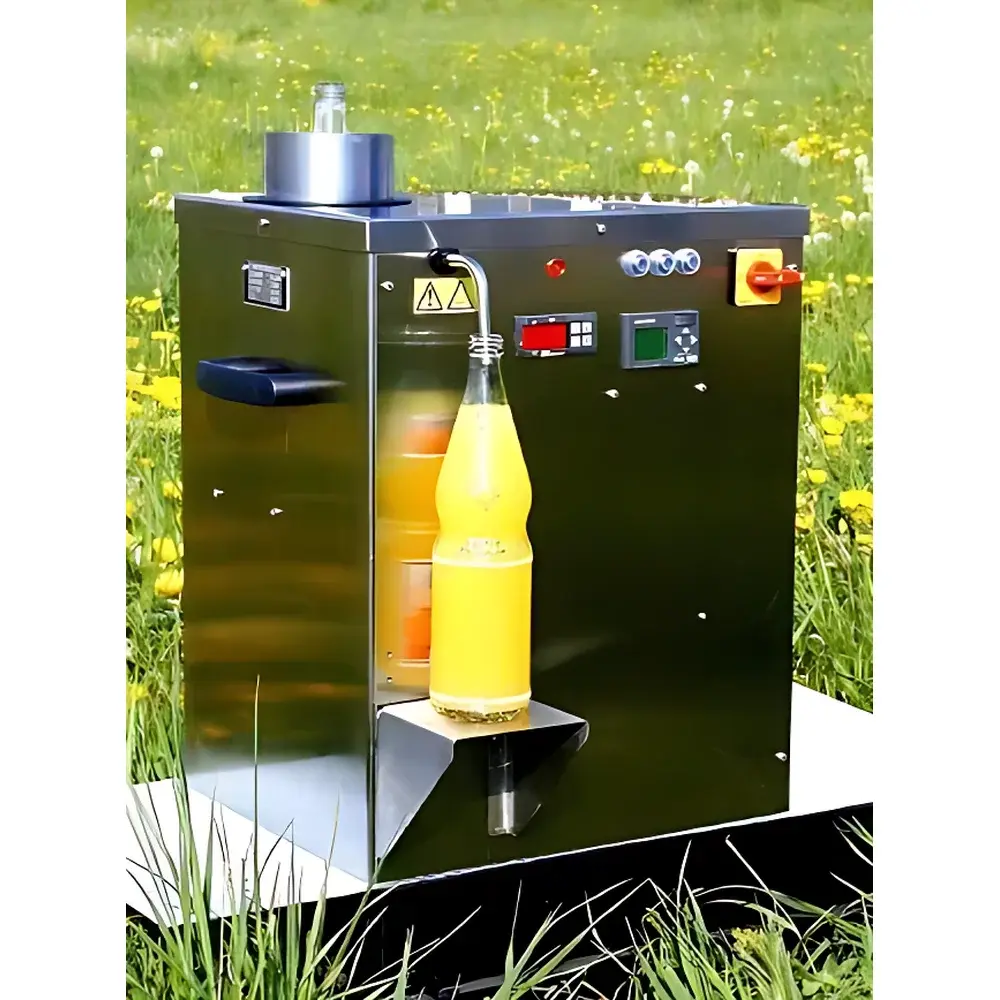
Brookfield BX-10 Benchtop Pasteurization Pilot System
| Origin | Shanghai, China |
|---|---|
| Manufacturer Type | Authorized Distributor |
| Origin Category | Domestic (PRC) |
| Model | BX-10 |
| Pricing | Available Upon Request |
| Throughput | 100 L/h |
| Minimum Batch Volume | 1,000 mL |
| Pasteurization Temperature Range | 30–90 °C |
| Temperature Control Accuracy | ±1 °C |
| Filling Mode | Automated volumetric filling with liquid-level sensing |
| Compatible Containers | PET, PE, glass bottles, and heat-resistant flexible packaging |
| Safety Interlock | Filling disabled until product temperature reaches setpoint |
| Power Supply | 8.5 kW, 380 V AC, 3-phase 5-wire |
| Net Weight | 50 kg |
| Dimensions (L×W×H) | 550 × 450 × 500 mm |
Overview
The Brookfield BX-10 Benchtop Pasteurization Pilot System is a compact, fully integrated thermal processing platform engineered for laboratory-scale validation and optimization of low-temperature pasteurization protocols. Based on the fundamental principles of time–temperature lethality kinetics—governed by D-value and z-value relationships—the BX-10 replicates critical control points (CCPs) defined in Hazard Analysis and Critical Control Point (HACCP) frameworks. Unlike generic heating units, it delivers precise, reproducible thermal profiles under controlled flow conditions, enabling direct correlation between lab-scale process parameters (e.g., residence time distribution, log reduction of target microorganisms) and full-scale production outcomes. Its design adheres to the core tenets of scale-up fidelity: constant dimensionless numbers (Péclet, Reynolds), consistent heat transfer coefficients, and validated thermal hold zones. This ensures that microbial inactivation data, physicochemical stability metrics, and sensory attributes generated on the BX-10 are statistically transferable to industrial plate-and-frame or tubular pasteurizers.
Key Features
- Benchtop footprint (550 × 450 × 500 mm) optimized for ISO 17025-accredited laboratory environments with limited floor space.
- Integrated electric heating system with PID-controlled jacketed heat exchanger; no external steam boiler or chiller required.
- Automated start-stop sequence with real-time temperature interlock: filling cycle initiates only after product temperature stabilizes within ±1 °C of the user-defined setpoint.
- Volumetric filling module equipped with ultrasonic liquid-level sensors and programmable dispense volume per container—supporting repeatable dosing across PET, PE, glass, and retortable pouch formats.
- Stainless-steel 316 wetted parts compliant with FDA 21 CFR Part 110 and EC No. 1935/2004 for food-contact surfaces.
- Modular architecture allows seamless integration with optional inline pH, conductivity, or turbidity probes for multi-parameter process monitoring.
Sample Compatibility & Compliance
The BX-10 accommodates Newtonian and mildly non-Newtonian fluids with viscosities up to 500 mPa·s and particulate content ≤ 2 mm diameter—covering fruit juices (cloudy and clarified), dairy-based beverages, ready-to-drink teas, functional nutraceutical emulsions, and plant-based milk alternatives. All operational parameters comply with internationally recognized thermal processing standards: ASTM F1960-22 (standard guide for thermal process validation), ISO 11133:2014 (microbiological culture media preparation), and Codex Alimentarius CAC/RCP 51-2003 (general principles of food hygiene). The system supports GLP-compliant documentation through timestamped audit trails, operator ID logging, and electronic signature capability—meeting requirements for regulatory submissions to EFSA, FDA, or CFDA.
Software & Data Management
The embedded control interface runs on a deterministic real-time OS with dual-channel data acquisition (sample temperature + surface temperature) at 1 Hz sampling rate. All process events—including heating ramp, hold phase initiation, fill trigger, and shutdown—are logged with millisecond resolution into an encrypted SQLite database. Export formats include CSV (for statistical analysis in JMP or Minitab) and PDF (for QA report generation). Optional Ethernet/IP connectivity enables remote supervision via SCADA systems and synchronization with LIMS platforms using HL7 or ASTM E1384 messaging protocols. Audit trail functionality satisfies FDA 21 CFR Part 11 requirements for electronic records and signatures.
Applications
- Determination of optimal time–temperature combinations for shelf-stable juice formulations while preserving vitamin C and anthocyanin integrity.
- Evaluation of emulsion stability in protein-fortified almond milk following thermal stress exposure.
- Accelerated shelf-life testing (ASLT) under controlled temperature regimes aligned with Arrhenius modeling.
- Validation of preservative-free tea beverage sterilization cycles targeting Alicyclobacillus acidoterrestris spores.
- Process qualification for novel packaging formats (e.g., stand-up pouches) where heat penetration dynamics differ significantly from rigid containers.
- Training platform for food science students and QA technicians on HACCP plan development and thermal death time curve construction.
FAQ
Can the BX-10 be used for ultra-high-temperature (UHT) processing?
No. The BX-10 is specifically designed for low-temperature pasteurization (30–90 °C); its thermal architecture does not support holding temperatures ≥135 °C required for UHT sterilization.
Is third-party calibration certification available?
Yes. Brookfield-certified metrology services provide NIST-traceable calibration of all temperature sensors and flow meters, delivered with ISO/IEC 17025-compliant certificates.
Does the system support continuous operation beyond 8 hours?
It is rated for intermittent duty cycles up to 6 hours per session. Extended runs require scheduled cooling intervals to maintain thermal stability of the heating element and sensor accuracy.
Can I integrate my own PLC or SCADA system?
Yes. The BX-10 features Modbus TCP and RS-485 interfaces with documented register maps, enabling bidirectional communication with industry-standard automation controllers.
What maintenance is required to ensure long-term measurement fidelity?
Quarterly verification of temperature sensor drift against reference thermistors and annual inspection of gasket integrity in the heating chamber are recommended per the manufacturer’s preventive maintenance schedule.



