
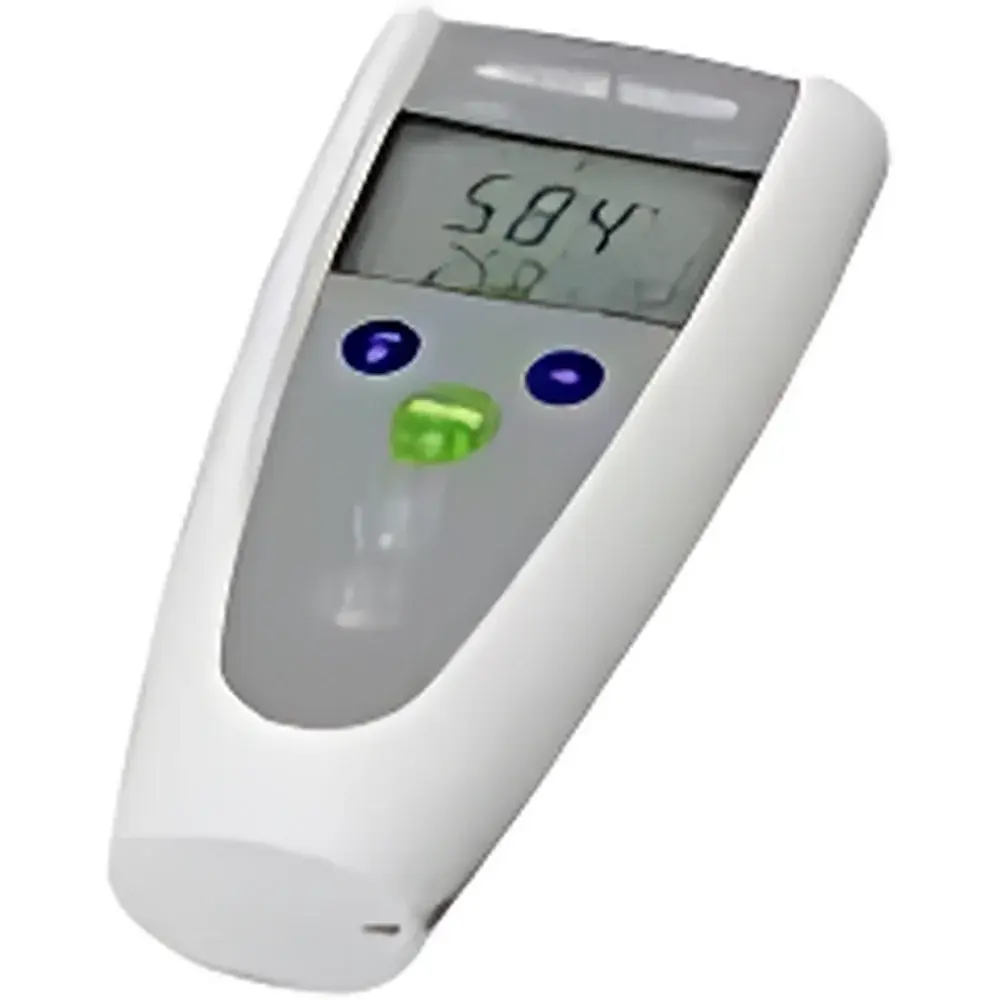
METTLER TOLEDO FG3 FiveGo™ Portable Conductivity and TDS Meter
| Brand | METTLER TOLEDO |
|---|---|
| Origin | Switzerland |
| Model | FG3 |
| Conductivity Range | 0.01 µS/cm to 199.9 mS/cm |
| TDS Range | 0.01 mg/L to 199.9 g/L |
| Salinity Range | 0.00–19.99 psu |
| Temperature Range | 0.0–100.0 °C |
| Temperature Resolution | 0.1 °C |
| Temperature Accuracy | ±0.3 °C |
| Conductivity Accuracy | ±0.5 % of reading |
| Calibration | Single-point automatic calibration |
| Display | LCD with simultaneous readout of conductivity/TDS/salinity, temperature, endpoint status, and system symbols |
| Protection Rating | IP54 |
| Power Supply | 4 × AAA 1.5 V batteries |
| Operating Environment | 0–40 °C, 5–80 % RH |
| Data Storage | 30 measurement records |
| Compensation | Linear temperature compensation with selectable reference temperature (e.g., 20 °C or 25 °C) |
| Auto-Endpoint Detection | Yes |
Overview
The METTLER TOLEDO FG3 FiveGo™ Portable Conductivity and TDS Meter is an entry-level, field-deployable electrochemical instrument engineered for precision, repeatability, and operational simplicity in routine conductometric analysis. Based on two-electrode AC conductivity measurement principles—compliant with ISO 7888 and ASTM D1125—the FG3 determines solution ionic strength by applying a low-frequency alternating current across a platinum or graphite sensing cell and measuring the resulting conductance. Its robust architecture supports direct measurement of electrical conductivity (EC), total dissolved solids (TDS), and practical salinity units (psu) across aqueous matrices ranging from ultrapure water to concentrated brines. Designed for use in regulated and non-regulated environments—including municipal water treatment plants, food & beverage QC labs, environmental monitoring stations, and educational laboratories—the FG3 delivers traceable, GLP-aligned results without requiring complex setup or continuous maintenance.
Key Features
- Compact, ergonomic handheld design optimized for one-handed operation and extended field use
- IP54-rated enclosure providing protection against dust ingress and water splashes during outdoor or industrial deployment
- Intuitive five-button interface: dedicated keys for measurement start/stop, data recall, calibration access, unit toggle, and menu navigation
- High-contrast LCD display showing real-time conductivity/TDS/salinity value, measured temperature, auto-endpoint indicator, temperature compensation mode, and battery status simultaneously
- Automatic endpoint detection ensures stable, reproducible readings by halting acquisition once signal drift falls below 0.1 %/s for ≥3 seconds
- Single-point calibration workflow with built-in memory for last calibration date, standard used, and electrode constant—supporting audit readiness under ISO/IEC 17025 and FDA 21 CFR Part 11 requirements when paired with optional data export tools
- Linear temperature compensation with user-selectable reference temperatures (20 °C or 25 °C), adhering to industry-standard conversion protocols per ISO 7888 Annex A
- Integrated data logging for up to 30 measurement events, each timestamped and tagged with temperature and unit context
Sample Compatibility & Compliance
The FG3 is validated for use with liquid samples exhibiting conductivity between 0.01 µS/cm (e.g., deionized water, pharmaceutical rinse water) and 199.9 mS/cm (e.g., seawater, industrial process brines). It accommodates standard conductivity cells with cell constants of 0.1 cm⁻¹, 1.0 cm⁻¹, and 10 cm⁻¹—though the LE703 electrode supplied with FG3-ELK and FG3-FK configurations features a fixed 1.0 cm⁻¹ constant optimized for general-purpose applications. All measurements conform to internationally recognized methodologies: conductivity values are reported in SI units (S/cm), TDS is calculated using default 0.65 conversion factor (adjustable via firmware), and salinity follows PSS-78 conventions. The instrument meets CE marking requirements, complies with IEC 61010-1 safety standards for laboratory equipment, and operates within environmental limits defined by ISO 17025 for measurement uncertainty control.
Software & Data Management
While the FG3 operates as a standalone instrument without onboard PC connectivity, its internal memory enables manual traceability through on-device review of stored readings and calibration history. For laboratories requiring electronic record retention, METTLER TOLEDO recommends pairing the FG3 with LabX® Lite software (via optional RS232-to-USB adapter) to export measurement logs—including date/time stamps, temperature, units, and calibration metadata—to CSV or PDF formats. This integration supports basic 21 CFR Part 11 compliance elements such as operator identification, audit trail generation, and electronic signature capability when deployed within validated IT infrastructure. Firmware updates are distributed via METTLER TOLEDO’s official support portal and maintain backward compatibility with existing calibration and configuration settings.
Applications
- Drinking water quality verification per WHO Guidelines and EPA Method 120.1
- Boiler feedwater and cooling tower monitoring in HVAC and power generation facilities
- TDS screening in bottled water production and beverage formulation QC workflows
- Soil extract conductivity assessment (1:5 suspension method) in agricultural testing labs
- Wastewater effluent characterization prior to discharge compliance reporting (e.g., NPDES permits)
- Calibration verification of inline conductivity sensors in bioreactor or CIP systems
- Field-based environmental surveys including river, lake, and estuarine salinity profiling
FAQ
Does the FG3 support multi-point calibration?
No—the FG3 implements single-point calibration only, consistent with its role as a foundational field instrument. Multi-point calibration is available on higher-tier FiveGo models (e.g., FG5) and benchtop instruments such as the SevenCompact series.
Can the FG3 measure resistivity?
Resistivity is not directly displayed but can be derived manually as the reciprocal of conductivity (ρ = 1/σ), provided units are converted appropriately (e.g., MΩ·cm from µS/cm). No automated resistivity mode is included.
Is the LE703 electrode compatible with other METTLER TOLEDO meters?
Yes—the LE703 is a universal analog conductivity electrode with BNC connector and is interoperable with all METTLER TOLEDO portable and benchtop conductivity meters supporting 1.0 cm⁻¹ cell constant inputs.
What is the recommended recalibration frequency?
Calibration interval depends on usage intensity and sample matrix; METTLER TOLEDO recommends daily calibration for high-accuracy applications and before each analytical session in regulatory environments. Field users performing grab sampling may calibrate at the start and end of each shift.
How does temperature compensation affect accuracy in non-aqueous solutions?
The FG3’s linear temperature compensation algorithm is validated exclusively for aqueous electrolyte solutions. Use in organic solvents or mixed-phase systems requires empirical correction factors and is outside the scope of factory validation.
Related Products





