
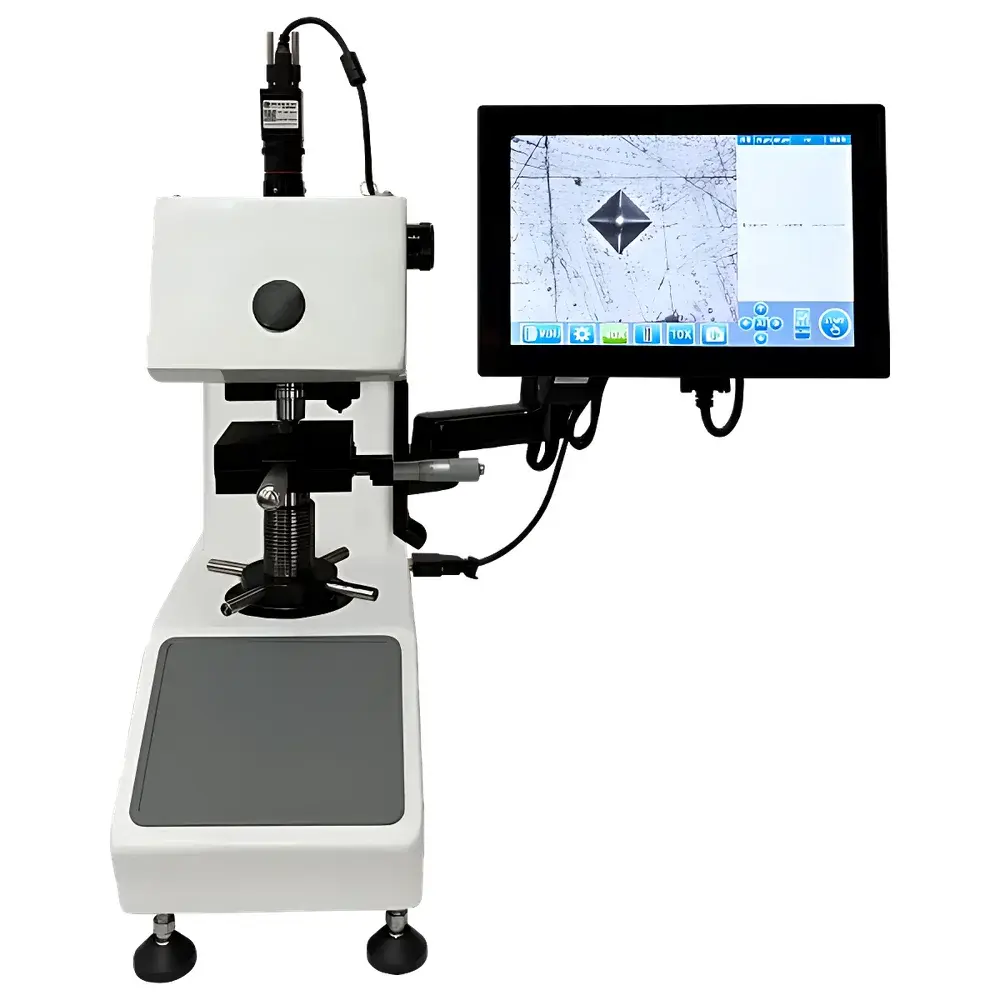
YANRUN HV-5/10/30/50VE10Z Automated Vision-Based Vickers Hardness Tester
| Brand | YANRUN |
|---|---|
| Origin | Shanghai, China |
| Manufacturer Type | Manufacturer |
| Model | HV-5/10/30/50VE10Z |
| Hardness Tester Type | Vickers Hardness Tester |
| Measuring Range | 8–3000 HV |
| Test Force Options | 0.2–50 kgf (6 force ranges across four capacity tiers) |
| Objective Lenses | 10× (observation), 20× (measurement for 5/10 kgf models) |
| Minimum Detectable Indentation Resolution | 0.16 µm (10×), 0.08 µm (20×) |
| Indentation Dwell Time | 0–60 s (1 s increments) |
| Max Specimen Height | 230 mm |
| Distance from Indenter Axis to Chamber Wall | 130 mm |
| Power Supply | AC 220 V / 50 Hz |
| Dimensions (L×W×H) | 580 × 375 × 800 mm |
| Net Weight | 47.0 kg |
| Compliance | GB/T 4340, ISO 6507 |
Overview
The YANRUN HV-5/10/30/50VE10Z is a fully automated vision-based Vickers hardness tester engineered for precision metrology in metallurgical laboratories, quality control departments, and R&D facilities. It operates on the fundamental principle of Vickers micro- and macro-hardness testing: applying a precisely controlled diamond pyramid indenter (136° apex angle) under standardized load conditions, followed by optical measurement of the resulting diagonal impressions on the specimen surface. The system integrates high-fidelity optical imaging with closed-loop motorized positioning and real-time digital analysis to ensure traceable, repeatable, and operator-independent hardness evaluation. Designed to meet international standard requirements—including ISO 6507-1 (Metallic materials — Vickers hardness test) and GB/T 4340.1 (Chinese national standard equivalent)—the instrument supports both routine production verification and advanced material characterization workflows.
Key Features
- Triple-objective turret architecture: accommodates up to three objective lenses simultaneously (e.g., 10× observation, 20× measurement, and optional 40× high-resolution lens), enabling rapid switching between sample survey and indentation measurement without manual repositioning.
- Motorized auto-turret with stepper-driven actuation: ensures repeatable, backlash-free lens and indenter alignment; position accuracy maintained within ±0.5 µm after repeated cycles.
- Dual-magnification optical path: dedicated 10× objective for wide-field specimen overview (100× total magnification), and 20× objective optimized for high-contrast indentation imaging (200× total magnification) on low-to-medium load models (HV-5/HV-10); unified 100× magnification path for HV-30/HV-50 configurations.
- Optimized illumination system: constant-output LED-based Köhler illumination with adjustable intensity and glare suppression—designed for extended lamp lifetime (>10,000 hours) and stable image contrast across varying surface finishes.
- Floating-point computational algorithm: eliminates rounding errors in diagonal measurement interpolation, improving agreement between measured values and theoretical Vickers hardness calculations per ASTM E92 and ISO 6507-2.
- Full-force automation: programmable loading, dwell (0–60 s in 1 s steps), and unloading sequence compliant with GB/T 4340.2 and ISO 6507-2; force repeatability < ±0.5% of set value.
Sample Compatibility & Compliance
The HV-5/10/30/50VE10Z accepts specimens up to 230 mm in height and accommodates samples with a maximum width of 150 mm (subject to stage clearance). Its 130 mm indenter-to-chamber-wall clearance allows testing of cylindrical or irregularly shaped components, including heat-treated gears, turbine blades, and welded joints. All test procedures adhere to ISO 6507-1:2018, GB/T 4340.1–2012, and ASTM E384 (for microhardness applications). The instrument’s mechanical design conforms to ISO 14644-1 Class 8 cleanroom-compatible tolerances for vibration isolation and thermal drift mitigation. Calibration traceability is supported via NIST-traceable reference blocks (e.g., HBW 10/3000, HV 10/1000) and internal verification routines aligned with ISO/IEC 17025 documentation requirements.
Software & Data Management
Controlled via an integrated industrial-grade tablet interface, the system runs proprietary hardness analysis software compliant with GLP and GMP data integrity principles. Measurement data—including raw pixel coordinates, diagonal lengths, calculated HV values, load/dwell parameters, operator ID, timestamp, and image metadata—are stored in encrypted SQLite databases with immutable audit trails. Export formats include CSV, PDF reports (with customizable templates), and XML for LIMS integration. Optional computer linkage enables remote monitoring, batch report generation, SPC charting (X̄-R, Cpk), and FDA 21 CFR Part 11-compliant electronic signatures when deployed with validated third-party validation packages. Software updates are delivered via secure HTTPS firmware push with version-controlled changelogs.
Applications
This tester serves critical roles in failure analysis labs evaluating case depth uniformity in carburized steels; aerospace QA verifying hardness gradients across Ti-6Al-4V weld zones; electronics manufacturing assessing solder joint integrity on Cu/Ni substrates; and academic research quantifying irradiation-induced hardening in nuclear cladding alloys. Its broad force range (0.2–50 kgf) permits seamless transition from thin-film coatings (70% compared to traditional analog systems—validated per ISO 5725-2 repeatability studies.
FAQ
What standards does this instrument comply with?
ISO 6507-1:2018, GB/T 4340.1–2012, ASTM E384, and EN ISO 6507-2 for test method execution and uncertainty estimation.
Can the system be integrated into an existing LIMS or MES environment?
Yes—via configurable API endpoints and standardized CSV/XML export protocols; full HL7 and ASTM E1384 support available upon request.
Is calibration verification performed automatically?
The software includes scheduled self-check routines for optical magnification calibration and force transducer linearity verification using certified reference standards.
What is the minimum resolvable indentation size?
0.08 µm per pixel at 20× magnification, enabling reliable measurement of indentations as small as 5 µm diagonally (HV-0.2 level).
Does the instrument support multi-point sequential testing?
Yes—the optional motorized XY stage (custom-configured) enables programmed grid-based indentation mapping with automatic focus adjustment and image stitching for cross-sectional hardness profiling.



