
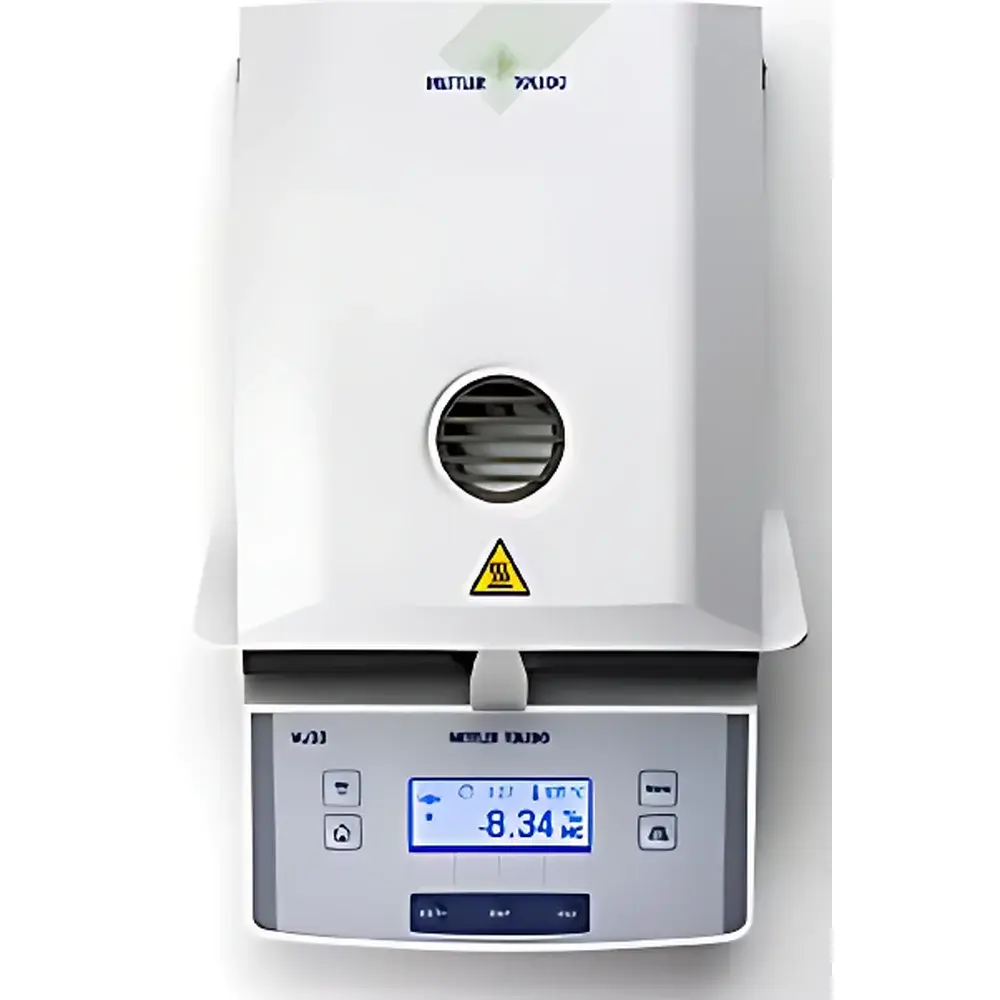
METTLER TOLEDO MJ33 Infrared Moisture Analyzer
| Brand | METTLER TOLEDO |
|---|---|
| Origin | Switzerland |
| Model | MJ33 |
| Temperature Range | 50–160 °C |
| Min. Sample Weight | 0.5 g |
| Max. Sample Weight | 35 g |
| Repeatability (2 g) | ±0.15 % |
| Repeatability (10 g) | ±0.05 % |
| Readability (Moisture) | 0.01 % |
| Readability (Weight) | 1 mg |
| Drying Programs | 1 (Standard) |
| Switch-off Criteria | Automatic, Manual, Time-controlled |
| Display | Backlit LCD |
| Interface | RS232C |
| Languages | English, French, German, Italian, Spanish, Portuguese, Japanese, Russian |
| Dimensions (W×D×H) | 230 × 360 × 150 mm |
| Weight | 4.3 kg |
| Printer | External (optional) |
Overview
The METTLER TOLEDO MJ33 Infrared Moisture Analyzer is a robust, entry-level thermogravimetric instrument engineered for rapid, reliable moisture determination in routine industrial and quality control laboratories. It operates on the principle of infrared heating combined with high-precision mass loss monitoring: a dual-metal heating unit rapidly raises sample temperature to induce controlled evaporation of volatile components—primarily water—while an integrated analytical balance continuously records mass change with 1 mg readability. The system automatically detects drying endpoint based on real-time mass stabilization, eliminating user dependency on pre-defined time or slope thresholds. Designed for operational simplicity and long-term stability, the MJ33 meets the practical demands of raw material incoming inspection, production line QC checks, and batch release testing where speed, repeatability, and ease of use are prioritized over advanced method development capabilities.
Key Features
- Dual metal heating units: Provide uniform, rapid thermal transfer across the sample surface—minimizing thermal gradients and reducing drying time without compromising measurement integrity.
- Intuitive step-by-step operation: Guided workflow displayed directly on the backlit LCD eliminates training overhead; users open the heating chamber lid and follow on-screen prompts from tare to result.
- Automatic endpoint detection: Built-in algorithm monitors mass change rate in real time and terminates drying when mass loss falls below a predefined stability threshold—no programming or parameter tuning required.
- Multi-language interface: Supports eight languages (English, French, German, Italian, Spanish, Portuguese, Japanese, Russian), facilitating global deployment in multinational manufacturing sites and contract labs.
- Rugged mechanical architecture: Encased in impact-resistant housing with reinforced hinge mechanism and stable base design—optimized for high-traffic industrial environments including warehouses, blending rooms, and packaging lines.
- RS232C serial interface: Enables direct data export to LIMS or Excel-based reporting systems; compatible with standard thermal printers (optional external accessory) for audit-ready hardcopy output.
Sample Compatibility & Compliance
The MJ33 accommodates solid and semi-solid samples ranging from 0.5 g to 35 g, making it suitable for granular feedstocks (e.g., starches, polymers, pharmaceutical excipients), powdered chemicals, food ingredients, and agricultural commodities. Its fixed 1 °C temperature adjustment resolution (50–160 °C range) ensures consistent thermal treatment across diverse matrices without risk of thermal degradation in heat-sensitive materials. While not validated for regulatory submission under FDA 21 CFR Part 11 out-of-the-box, the device supports GLP/GMP-aligned workflows through traceable weight records, automatic timestamping, and non-editable result logs when interfaced with compliant data management software. It aligns with core principles of ASTM D4442 (moisture content in wood) and ISO 712 (cereals and cereal products), serving as a validated alternative to oven-drying methods where throughput and operator consistency are critical.
Software & Data Management
The MJ33 operates autonomously without embedded PC software—its firmware manages all drying logic, calculation routines, and display rendering locally. Moisture content (%), dry weight (g), ATRO Dry, and ATRO Wet results are computed using standardized gravimetric equations per ISO 665 and displayed simultaneously. All measurements include date/time stamps and sample identification fields (user-entered alphanumeric ID). Raw mass-vs.-time datasets are accessible via RS232C transmission in ASCII format, enabling integration into third-party validation platforms such as LabWare LIMS or Thermo Fisher SampleManager. Audit trail functionality—including operator ID, start/stop times, and final result—is maintained in volatile memory and can be exported per session for internal review or external audit preparation.
Applications
- Raw material acceptance testing in chemical, food, and pharma supply chains
- In-process moisture verification during drying, milling, or granulation stages
- Final product release testing for hygroscopic intermediates (e.g., lactose, microcrystalline cellulose)
- Quality assurance of packaging desiccants and moisture-barrier films
- Educational use in analytical chemistry laboratories for teaching thermogravimetric fundamentals
- Field-deployable moisture screening in agro-processing facilities with limited IT infrastructure
FAQ
Does the MJ33 require calibration with certified reference standards?
Yes—periodic calibration using NIST-traceable moisture standards (e.g., sodium tartrate dihydrate) is recommended per ISO/IEC 17025 and internal QA procedures. Balance calibration with certified weights should be performed daily or before each analytical shift.
Can multiple drying profiles be stored on the MJ33?
No—the MJ33 supports only one fixed drying program (standard mode). Method flexibility is intentionally limited to ensure operational consistency in untrained-user environments.
Is the MJ33 compliant with FDA 21 CFR Part 11?
Not natively. Full electronic record/electronic signature compliance requires integration with validated third-party data acquisition software that provides audit trails, role-based access, and electronic signatures.
What maintenance is required for the heating unit?
The dual metal heater requires no consumables or periodic replacement. Routine cleaning of the sample pan and chamber interior with lint-free cloth and isopropyl alcohol is sufficient to maintain thermal efficiency and prevent cross-contamination.
How is repeatability verified during routine use?
Repeatability is confirmed by analyzing three replicates of a homogeneous reference material (e.g., 10 g of dried silica gel) under identical conditions; observed standard deviation must remain within ±0.05 % for 10 g samples per manufacturer specifications.
Related Products




